How Concrete Patios Get Built: 8 Steps From Site Prep to Finished Pour
If you are gathering bids for a patio, knowing how concrete patios actually get built will make you a sharper comparison shopper. Most websites show pretty photos and say "call for a quote," but few explain what happens between the estimate and the finished slab. This article walks through the installation process step by step, so when a concrete contractor in Salt Lake City describes their approach, you can tell whether they are cutting corners or doing it right.
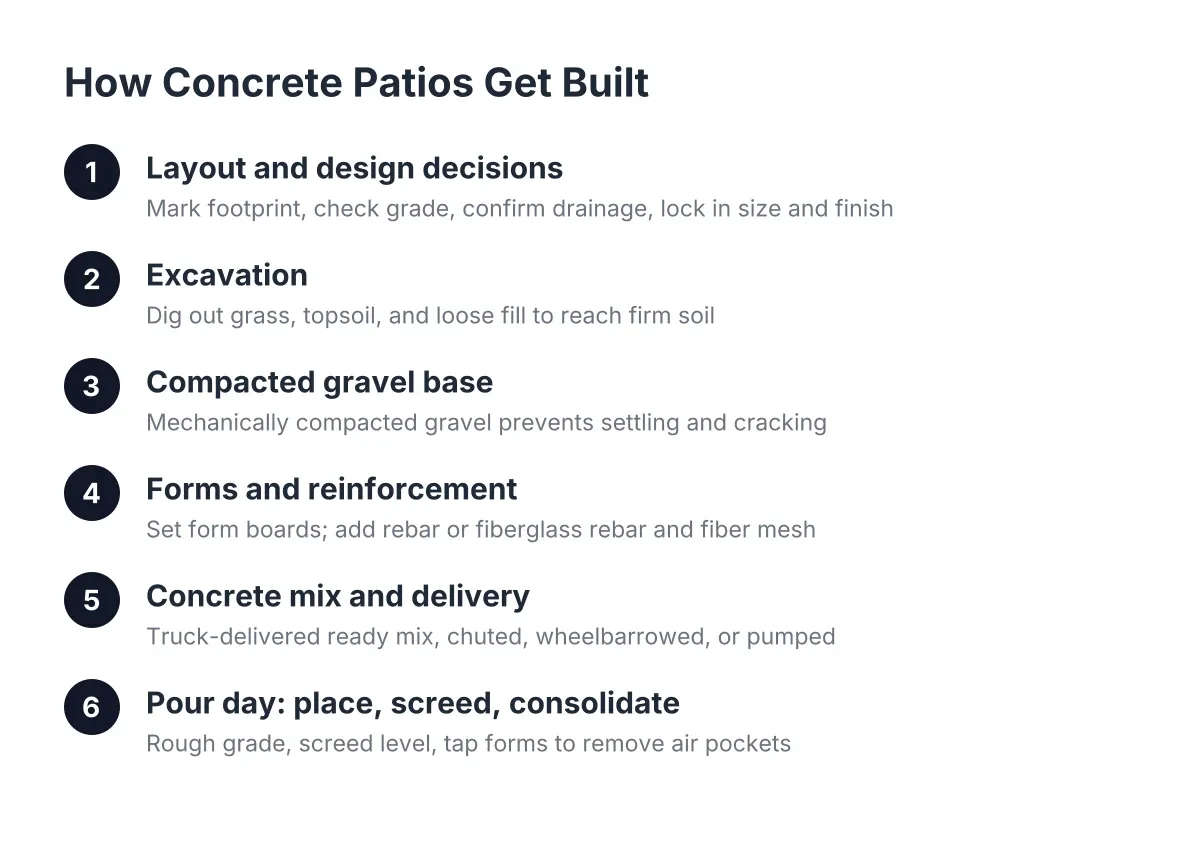
Here are the eight steps a well-built patio goes through, in order, with what to watch for at each one.
1. Layout and Design Decisions Come First
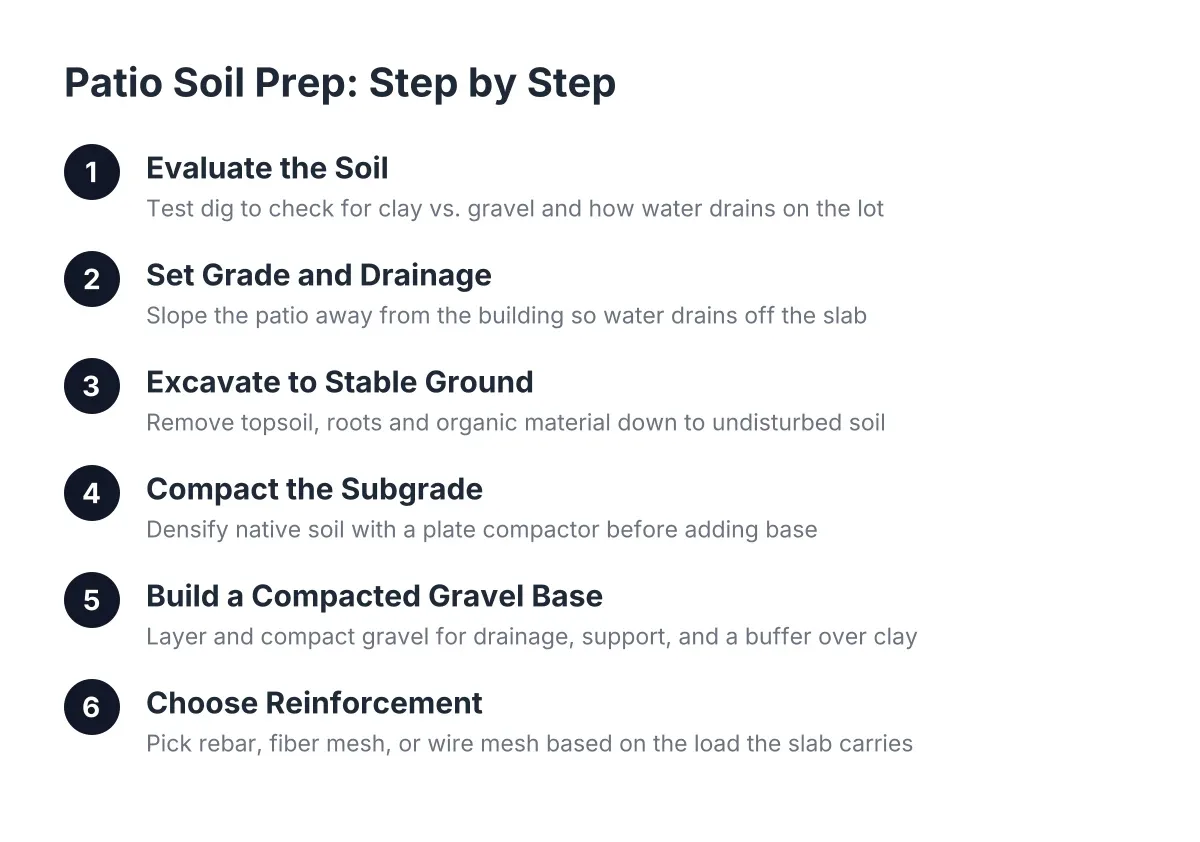
Before anyone digs, the contractor marks the patio footprint, checks grade, and confirms how water will drain away from your house. In the Salt Lake Valley, drainage matters because spring snowmelt needs somewhere to go, and a patio that slopes toward your foundation creates problems you will pay for later. This is also when you lock in size, shape, and finish, whether that is a plain broom finish, stamped concrete, or stained and colored concrete, since those choices affect both price and schedule.
A useful benchmark while you compare bids: a typical concrete patio around 288 square feet costs an average of $3,200, about $11 per square foot, according to Concrete Network. Nationwide, a professionally installed patio averages $2,925, according to Lawn Love. Salt Lake City numbers vary with slab size, excavation, reinforcement, finish type, and site access, so treat those figures as orientation, not a quote.
2. Excavation Sets Up Everything That Follows
The crew digs out grass, topsoil, and loose fill to reach soil firm enough to build on. Along the Wasatch Front, soils shift between clay and gravel, sometimes within one backyard, and clay-heavy soil holds water and moves with freeze-thaw cycles. A contractor who digs to the right depth and removes soft spots is buying your patio decades of flat, crack-resistant life.
Ask every bidder how deep they excavate and what they do when they hit soft or wet ground. A vague answer here is a red flag, because excavation is one of the biggest cost drivers in any patio bid and the easiest place for a lowball quote to hide a shortcut.
3. A Compacted Gravel Base Is Non-Negotiable in Freeze-Thaw Country
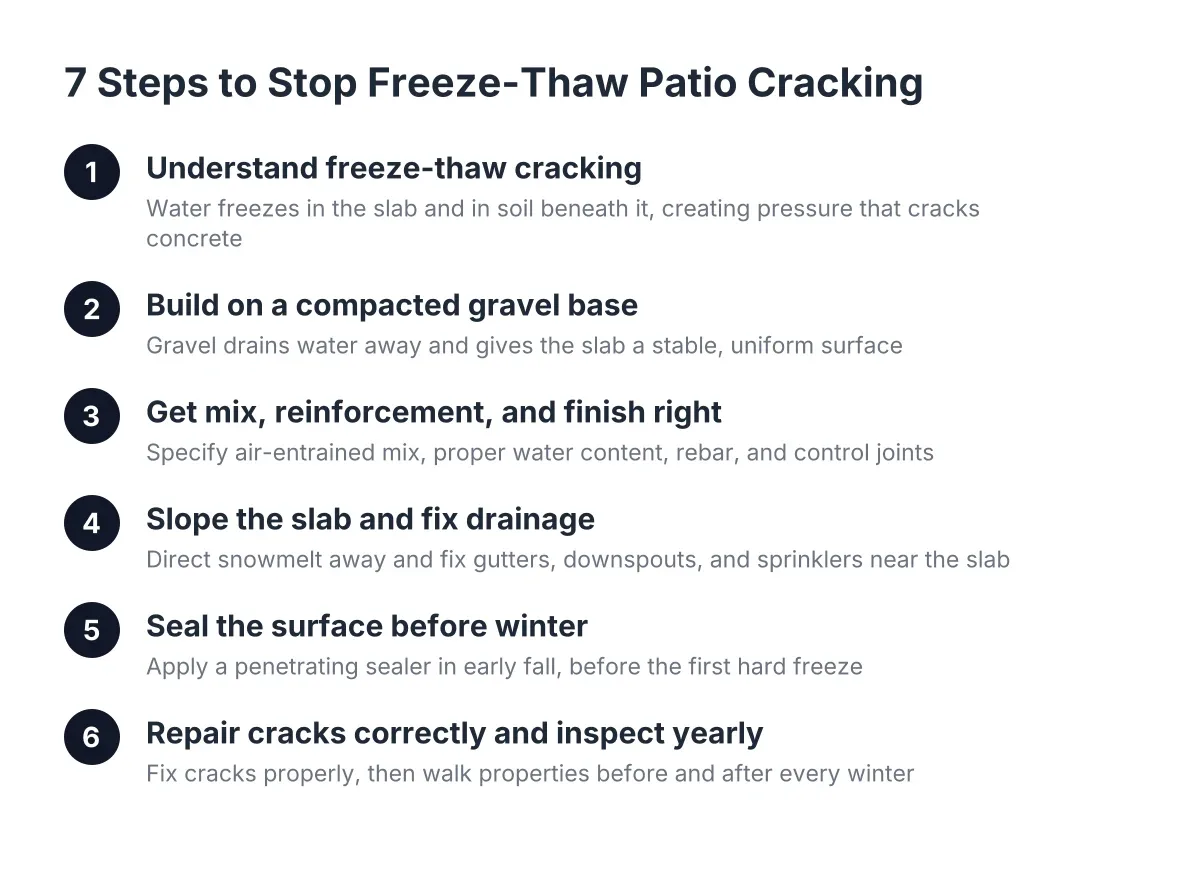
In a climate with hard winter freeze-thaw cycles like Salt Lake City, a compacted gravel base under the slab is essential to prevent movement and cracking. A slab poured over loose, poorly compacted fill tends to settle unevenly over time. It ends up tilted and sloped, and no surface finish can fix a sunken base.
Therefore, when you compare quotes, confirm each contractor includes gravel base material and mechanical compaction, not just "grading." Here is a hypothetical scenario a first-time buyer would recognize: suppose you get three patio bids and one comes in noticeably lower than the other two. Ask that bidder what base depth and compaction they include. If the answer is "we pour on compacted native soil," you have likely found where the savings came from.
4. Forms and Reinforcement Shape the Slab
Next, the crew sets form boards that define the patio's edges, height, and slope. Good forming is why a finished patio has crisp lines and drains the right direction. Inside the forms, reinforcement goes in: most quality patio slabs in this area use rebar or fiberglass rebar, often paired with fiber mesh mixed into the concrete itself, since fiber adds crack resistance at modest cost.
Reinforcement is another place quotes differ quietly. Two bids for the same square footage can be hundreds of dollars apart simply because one includes rebar on a proper grid and the other includes nothing. Make every bidder spell out what reinforcement is in the price.
5. Concrete Mix and Delivery Method Matter More Than People Think
Concrete is not one product. A good mix keeps the cement paste and aggregate blended without separating, and it stays workable without being so wet that it weakens the cured slab. Mixes that include pea gravel consolidate well and finish to a harder surface. Ready mix is a major industry for a reason; it is a $64 billion revenue business across the United States, according to the National Ready Mixed Concrete Association, and patio pours almost always use truck-delivered ready mix rather than bagged concrete.
How the concrete gets from truck to forms matters too. Concrete placed by direct chute off the truck behaves differently than concrete pumped through a hose. Pumping pushes the mix through a small line, which generates friction and heat, and pump mixes typically carry more cement, so pumped concrete sets up faster. If your backyard has tight access, side gates, or slopes, ask bidders whether they plan to chute, wheelbarrow, or pump, because access drives both cost and finishing time.
A quick note on the DIY route: a concrete bag patio built from bagged mix can work for a small stepping pad, but for a full patio it usually means inconsistent mixes, cold joints between batches, and a weaker slab. For anything you want to last through Utah winters, truck-delivered concrete placed by a crew is the better path.
6. Pour Day: Placing, Screeding, and Consolidating the Concrete
On pour day, speed and sequence matter. The crew establishes a rough grade first with rakes or a placer tool, filling the forms evenly. Then they screed, pulling a straight board across the top of the form boards to level the concrete from one side to the other. Tapping the forms as the pour goes helps shake out voids and air pockets along the edges, so your patio has solid, clean borders instead of honeycombed ones.
Weather dictates the pace. Warm weather and full sun speed up set time and shrink the window for finishing work, which is why Salt Lake City crews often start summer pours early in the morning. A contractor who talks about pour timing and weather during your estimate is thinking ahead; that is a good sign.
7. Finishing Is Where Concrete Patio Designs Take Shape
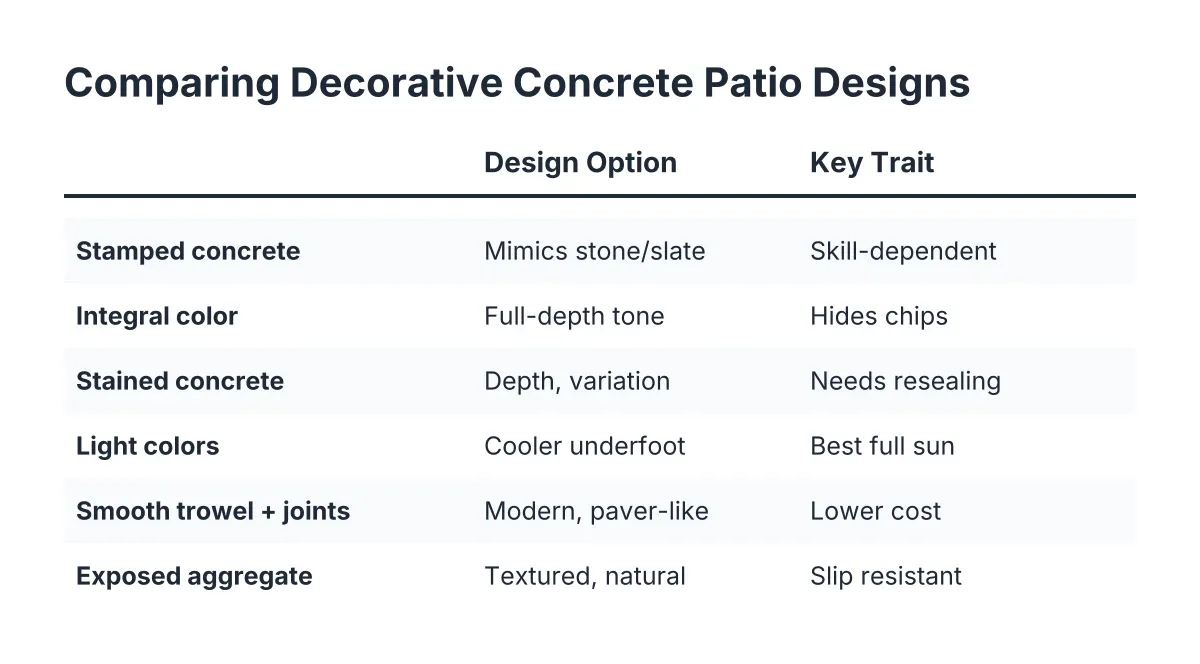
Once the slab is screeded, finishers float the surface, work the edges, and apply the final texture. This is the stage where design choices become real. A broom finish gives reliable traction for snow and ice season. Stamped concrete presses pattern and texture into the surface while it is still workable, mimicking stone, slate, or wood. Stained and colored concrete adds tone, either mixed into the concrete or applied after.
Common finish options for concrete patios, roughly from simplest to most involved:
- Broom finish: textured, slip-resistant, and the most budget-friendly
- Exposed aggregate: decorative stone texture with strong traction
- Colored concrete: integral color mixed into the load for even tone
- Stamped concrete: patterned texture that imitates flagstone, brick, or wood
- Stamped and stained combinations: the most custom look, and the most labor on pour day
Control joints get cut or tooled in during or shortly after finishing. Those lines are not decoration; they tell the slab where to crack as it shrinks, so cracks happen in straight, planned lines instead of wandering across your patio.
8. Curing and the First Weeks of a New Patio
Concrete does not reach strength when it looks dry; it cures over weeks as the chemistry finishes. A responsible crew applies a curing compound or keeps the surface moist, and tells you when you can walk on it, usually within a day or two, and when it can take furniture and heavier loads. In Salt Lake City, pour timing also matters at the season level, since fresh concrete and an early hard freeze do not mix well.
As a result, expect an honest contractor to give you aftercare instructions: when to seal, what deicers to avoid the first winter, and how to keep snowmelt draining off the slab. A sealed, properly cured patio handles Wasatch Front freeze-thaw cycles far better than a neglected one.
How to Compare Concrete Patio Bids Using This Process
Now that you know the sequence, use it as a checklist. Every legitimate patio quote should address, in writing, each of these stages:
- Excavation depth and what happens if soft soil shows up
- Gravel base thickness and compaction method
- Reinforcement type: rebar, fiberglass rebar, fiber mesh, or a combination
- Concrete mix strength and delivery method for your site access
- Finish type, with photos of comparable past work
- Control joint plan and curing approach
For example, say a homeowner in Sugar House collects three bids for a 300 square foot stamped patio. One bid is a single line: "stamped patio, $X." The other two break out base prep, reinforcement, mix, stamping, and sealing. Even if the one-liner is cheapest, the detailed bids tell you what you are buying, and they give you leverage to ask the cheap bidder what is missing. Three detailed bids is usually enough to see the pattern.
One honest caveat: if your yard has significant slope, retaining walls, poor drainage, or suspect fill soil, the standard process above may not be enough. In those cases, get a contractor or engineer to look at the site before you compare prices, because the right fix for the ground costs less than replacing a failed slab.
Hiring well may also take patience in 2026. Skilled concrete crews are stretched thin; 88% of construction firms with open craft positions say those jobs are as hard or harder to fill than a year ago, according to the Associated General Contractors of America. A contractor who books out a few weeks is often a better sign than one who can start tomorrow.
Knowing the process from site prep through finished pour will not pour the patio for you, but it changes every quote conversation. You will ask about base compaction instead of just price per square foot, and the contractors worth hiring will notice the difference.
If you need concrete patios, Salt Lake Valley Concrete can help.
Prefer to talk it through? Call (385) 433-4634 — a quick call is usually the fastest way to get a straight answer for your situation.