8 Decorative Concrete Patio Designs: Color, Pattern, and Stain Options
If you are comparing decorative concrete patio designs before hiring a contractor, the options come down to three levers: pattern, color, and finish. Get those three right and a plain gray slab becomes the best-looking surface in the backyard. Get them wrong and you pay decorative prices for a patio that gets too hot to walk on or looks dated in five years.
This list walks through eight design directions we see work well along the Wasatch Front, with the trade-offs for each. It is written for Salt Lake City homeowners upgrading an existing patio, but the same logic applies if you manage rental properties and want shared outdoor areas that look good and hold up without constant repair calls.
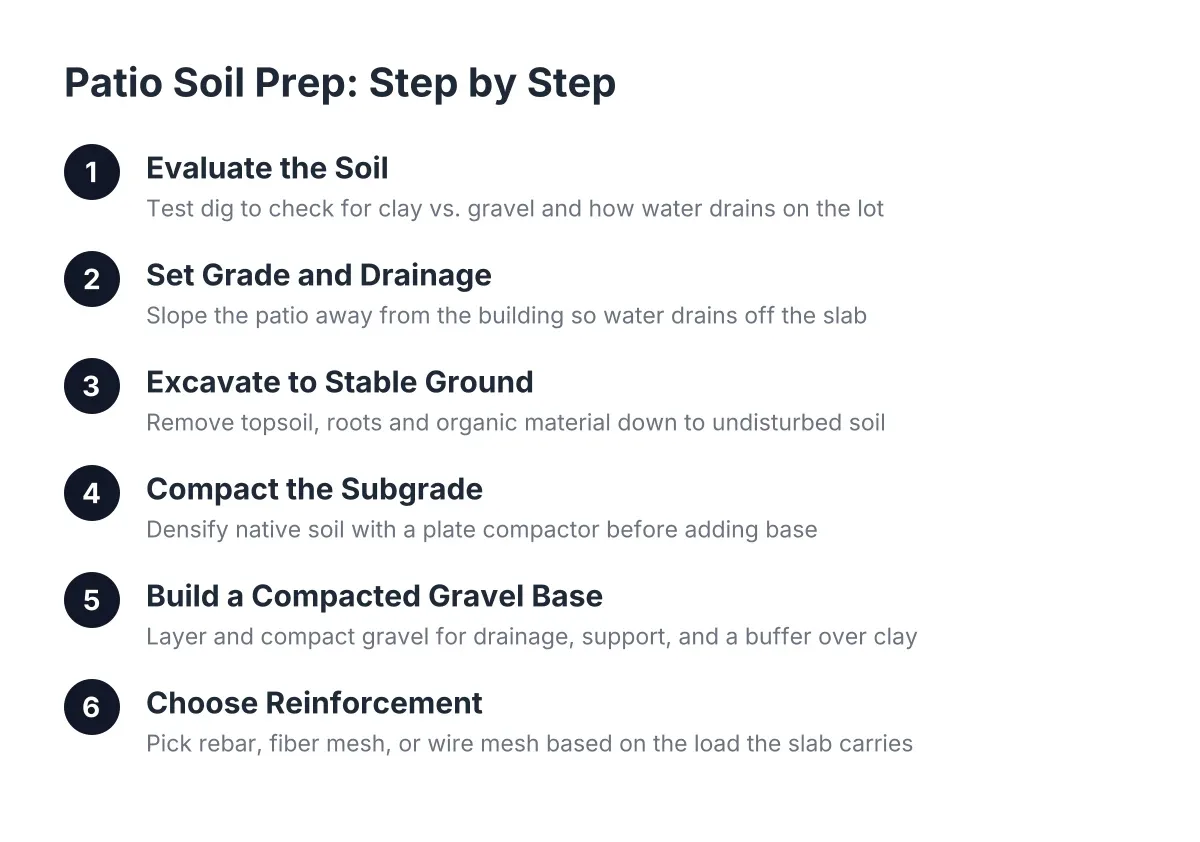
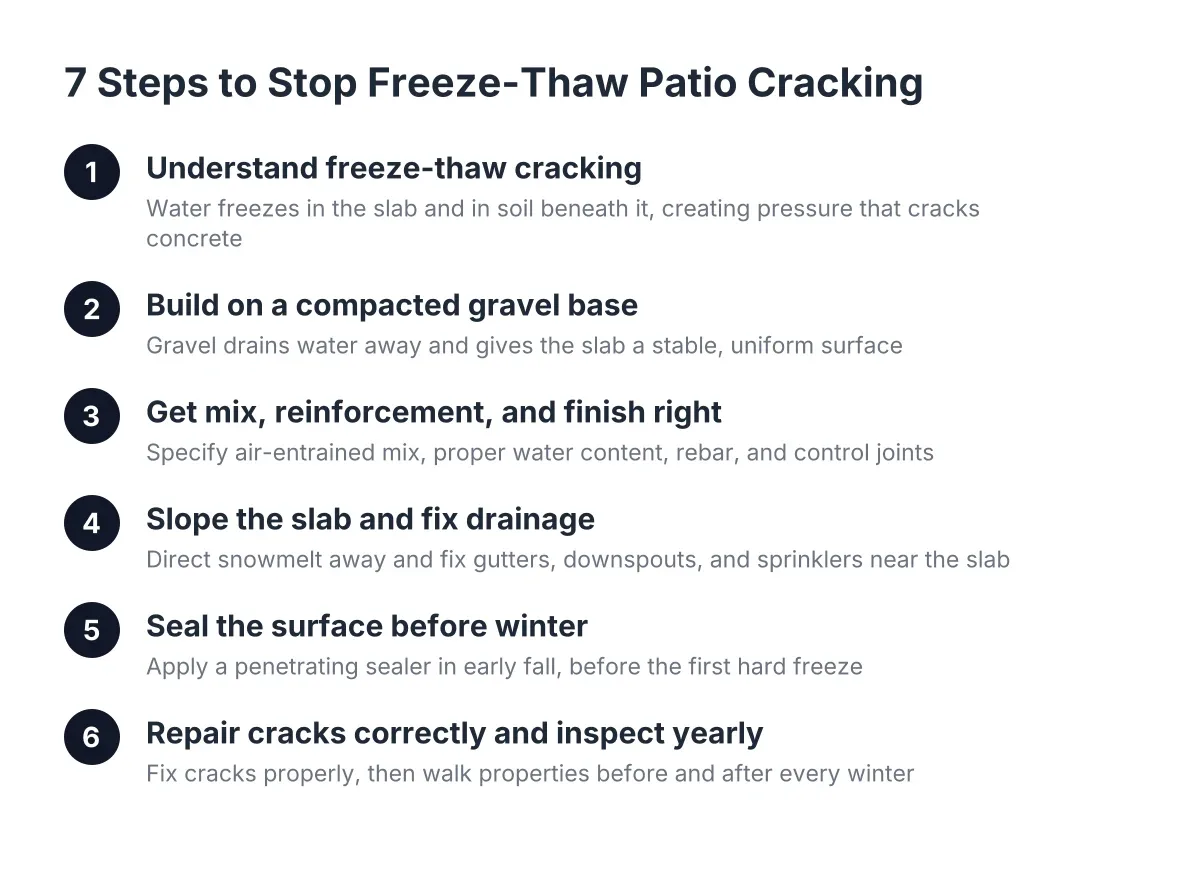
One note before the list: in our climate, design choices and durability choices are the same conversation. Freeze-thaw cycles each winter stress every slab in the valley, and the clay-and-gravel soils here move with moisture. A compacted gravel base and the right finish matter as much as the pattern you pick.
1. Stamped Concrete That Mimics Stone or Slate
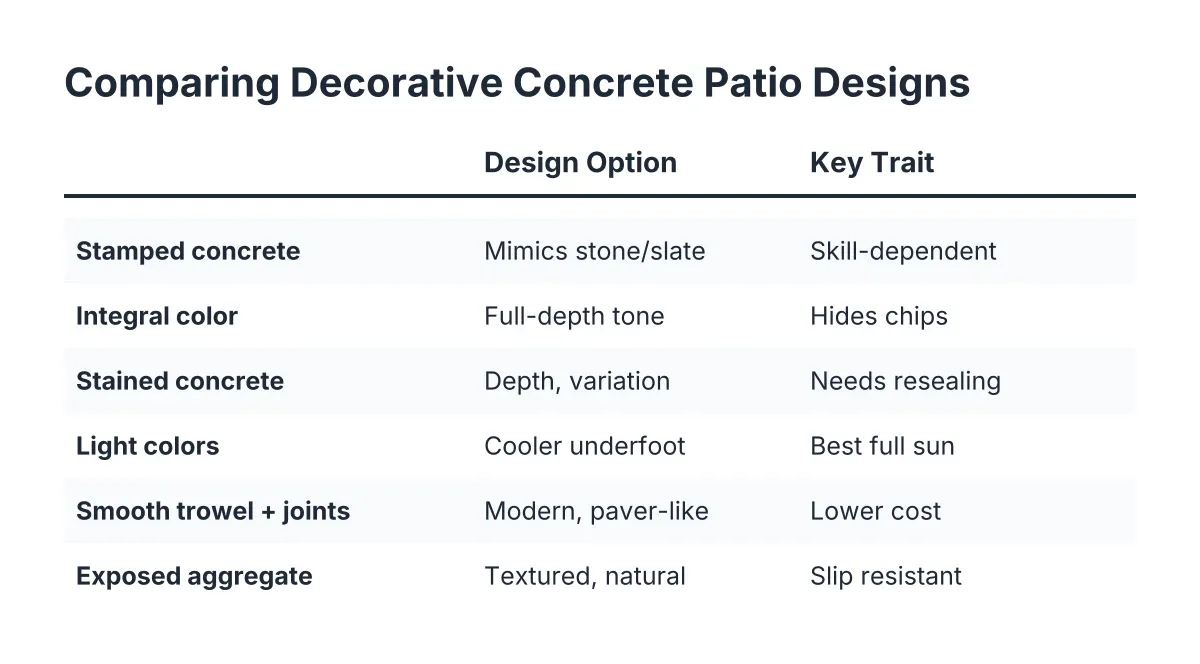
Stamped concrete is the most popular decorative option, and for a reason. The crew pours a standard slab, then presses textured mats into the surface while it is still workable. The result reads as flagstone, slate, cobblestone, or wood plank at a fraction of the cost of the real material.
Ashlar slate and random flagstone patterns are the safest long-term choices for stamped concrete patio designs. They hide minor surface wear better than tight, repeating patterns, and they pair with almost any house style. Wood-plank stamps look sharp in photos but show wear faster in high-traffic spots like the path from the back door to the grill.
Stamping is also the most skill-dependent finish on this list. Timing the stamp, managing release agent, and keeping the pattern aligned across a large slab all take an experienced crew. This is one place where the cheapest bid tends to show in the final surface.
2. Integral Color Mixed Into the Concrete
Integral color goes into the concrete truck, not onto the surface. The pigment runs through the full depth of the slab, so a chip or a scratch exposes the same color underneath. For a patio that will take furniture drags, snow shovels, and kids, that depth matters.
Earth tones dominate here: tan, buff, sandstone, and warm gray. They complement the mountain backdrop and most Salt Lake City brick and stucco exteriors. Integral color also sets the base tone for stamped work, with a release agent or stain adding the darker accent in the pattern's grooves.
The trade-off is subtlety. Integral color gives you one even tone, not the mottled, layered look of stained concrete. Many of the best decorative concrete patio designs combine the two, using integral color as the base and stain for variation.
3. Stained Concrete for Depth and Variation
Stains come in two families, and they behave differently. Acid stains react chemically with the concrete and produce mottled, translucent color that looks different on every slab. Water-based stains sit closer to a paint-like consistency, with more predictable color and a wider palette.
Acid stain suits homeowners who want a patio that looks like aged stone or leather, with natural variation across the surface. Water-based stain suits anyone who wants a specific color to match a remodel. Both can be applied to new pours or to an existing slab in decent shape, which makes staining a strong option when the concrete is sound but the look is dated.
However, stain is a surface treatment. It needs a quality sealer, and high-traffic areas will need resealing on a maintenance schedule. Budget for that upkeep when you compare options.
4. Light Colors That Stay Cooler Underfoot
Here is the mistake we see most often in color selection: homeowners pick charcoal, slate gray, or deep brown because it looks dramatic in a photo, then discover the surface is uncomfortable to walk on barefoot in July sun. Darker concrete absorbs more heat. Lighter concrete reflects more sunlight and stays cooler underfoot.
For a patio that gets full afternoon sun, lean toward buff, sand, light gray, or cream tones. Save the dark colors for borders, accent bands, or shaded areas under a pergola. This matters even more around pools and in shared courtyards at rental properties, where tenants walk barefoot and a scorching surface generates complaints.
A good concrete contractor will raise this before you commit to a color. If a bidder takes your dark-charcoal request without mentioning heat, that tells you something about how much guidance you will get on the rest of the job.
5. Smooth Trowel Finish With Decorative Control Joints
Not every decorative patio needs a stamp. A smooth trowel finish with control joints cut in a deliberate pattern, say a large grid or a diagonal layout, gives a clean, modern, paver-like look while still providing traction. The joints become the design instead of an afterthought.
This approach costs less than stamping because it skips the mats, release agents, and extra labor. It also serves a structural purpose. Control joints tell the slab where to crack as it moves through freeze-thaw cycles, which is a real consideration for every patio in the Salt Lake Valley.
Compare that to a standard broom finish, which drags a broom across fresh concrete for a textured, slip-resistant surface. Broom finish is the simpler option and the budget baseline, though a clean, even broom texture still takes a skilled hand. Many designs combine the two: smooth troweled borders framing a broomed field.
6. Exposed Aggregate for Texture and Grip
Exposed aggregate washes away the top layer of cement paste to reveal the stones in the mix. The result is a pebbled, natural surface with excellent slip resistance when wet, which matters on a patio that catches snowmelt and sprinkler overspray.
You can steer the look by choosing the aggregate: warm river rock, crushed granite, or a specified decorative stone blended into the mix. Exposed aggregate pairs well with smooth troweled or stamped borders, giving the patio a framed, finished edge.
The trade-off is comfort and cleaning. The texture is harder on bare feet than a smooth finish, and the recessed surface holds dirt and leaves more than a troweled slab. It is a strong choice for walkways and pool surrounds, and a situational one for a dining patio.
7. Borders, Bands, and Two-Tone Layouts
The fastest way to make any patio look custom is contrast. A stamped field with a smooth troweled border. A light buff slab with a charcoal band outlining the seating area. Additionally, a scored grid with alternating stain tones. These layout moves cost less than stamping the entire slab and often photograph better.
For example, suppose a homeowner in Sugar House has a 300-square-foot patio budget. In that scenario, a full ashlar slate stamp with integral color and accent stain sits at the top of the range, while a broom-finished field with a 12-inch stamped and stained border delivers much of the same visual impact for noticeably less. For scale, Concrete Network puts a typical 288-square-foot patio at an average of about $11 per square foot, around $3,200, before decorative upgrades; your actual number depends on slab size, excavation, reinforcement, finish type, and site access.
Two-tone layouts also work for property managers upgrading shared spaces across several units. A standard field finish with one consistent decorative border gives every property a matching, documented spec, which keeps bids comparable from one address to the next.
8. Decorative Concrete Patio Designs Built for a Fire Pit or Seating Area
Design the layout around how you will use the space, not just the shape of the yard. Stamped concrete patio ideas with a fire pit are a common request, and they work best when the slab is planned for it: a circular or octagonal pad sized for chairs pushed back from the flame, with a contrasting band marking the fire zone.
In addition, think through furniture footprints before the pour. A dining set needs roughly a 10-by-10 zone to pull chairs out comfortably. A built-in fire pit or outdoor kitchen may change the reinforcement plan, since heavier loads call for rebar in the slab, often paired with fiber mesh in the mix as inexpensive extra reinforcement. Furthermore, a small, lightly loaded patio may not strictly need rebar, but anything supporting masonry or appliances should get it.
Curved edges, multi-level pads, and integrated steps all fall under this heading too. Concrete is poured, not laid, so it takes curves and custom shapes more easily than pavers or stone. That flexibility is the core advantage of concrete patios over modular materials when the yard is sloped or oddly shaped.
How to Compare Decorative Concrete Patio Designs Before You Commit
Comparing designs comes down to five questions: how the patio handles sun and heat, how the finish performs in freeze-thaw winters, how much maintenance the surface needs, how the pattern will age, and what each option adds to the base cost. Answer those five and the shortlist usually narrows itself to two or three candidates.
Use this checklist when you review bids in 2026:
- Sun exposure: Full afternoon sun favors lighter colors; shaded patios can carry darker tones.
- Base and reinforcement: Confirm the bid includes a compacted gravel base, and ask when rebar or fiber mesh is included. In this climate, the base prevents the movement that cracks slabs.
- Finish maintenance: Stamped and stained surfaces need periodic resealing; broom and exposed aggregate finishes need less.
- Pattern scale: Large, random patterns like flagstone age better than small, repeating ones on big slabs.
- Matching samples: Ask to see cured color samples or completed local projects, not just catalog photos. Pigment looks different in Utah sun than on a screen.
One honest limitation: decorative work is only as good as the slab under it. If your existing patio is cracked through, sinking, or heaved from frost, staining or overlaying it hides the problem without fixing it. In that case, have a concrete contractor evaluate whether repair, resurfacing, or full replacement makes sense before you spend anything on decorative finishes.
The patios that still look good ten winters from now share the same DNA: a properly compacted base, the right reinforcement for the load, a color chosen for the sun exposure, and a finish the owner is willing to maintain. Start with those four, then pick the pattern you love.
If you need concrete patios, Salt Lake Valley Concrete can help.
Prefer to talk it through? Call (385) 433-4634 — a quick call is usually the fastest way to get a straight answer for your situation.