What Causes Stamped Concrete to Crack and Fade? Answers for Salt Lake City Homeowners
You spent real money on a stamped patio or driveway, so a crack or a dull patch of color is hard to ignore. Understanding what causes stamped concrete cracking helps you tell the difference between a harmless hairline and a problem that needs a concrete contractor. This FAQ covers the most common questions Salt Lake City homeowners ask about cracking and fading in stamped and decorative concrete, and what to do about each.
What Are the Main Causes of Stamped Concrete Cracks?
The main causes of stamped concrete cracks are poor base preparation, missing or badly placed control joints, shrinkage as the slab cures, freeze-thaw stress, and water working under the slab. Heavy loads on a thin slab, like a loaded truck on a patio, also cause cracks. Stamped concrete cracks for the same reasons plain concrete does; the stamp pattern does not change the physics.
Here in the Salt Lake Valley, two local factors matter most. First, our clay-and-gravel soils along the Wasatch Front can shift with moisture, and a slab poured over a soft or uneven base will crack when the ground moves. Second, hard freeze-thaw winters push water into any opening, freeze it, and pry the concrete apart a little more each cycle.
In short, most cracking traces back to one of these:
- A base that was not compacted or graded before the pour
- Control joints that were skipped, cut too late, or spaced too far apart
- Normal shrinkage during curing, which shows up as thin hairlines
- Freeze-thaw cycles working on unsealed or poorly drained concrete
- Snowmelt, sprinkler water, or roof runoff eroding soil under the slab
- Vehicle loads on a slab that was not designed for them
Does Stamped Concrete Crack More Than Regular Concrete?
Stamped concrete does not crack more than regular concrete when both are poured on a solid base with proper joints. The mix, thickness, reinforcement, and base preparation determine crack resistance, not the stamped finish. However, cracks can look worse on a decorative surface because they cut across the pattern instead of hiding in plain gray.
There is one honest trade-off. Stamp patterns limit where control joints can go without interrupting the design, so some contractors space joints wider than they should to protect the look. That choice raises the odds of a random crack. A good decorative concrete contractor plans joint lines into the pattern instead of fighting it.
Are Hairline Cracks in New Stamped Concrete Normal?
Hairline cracks in new stamped concrete are normal and usually come from shrinkage as the slab cures. Concrete loses water as it hardens, and that shrinkage creates thin surface cracks that do not affect strength. If the crack is narrower than a credit card edge and both sides sit level, it is cosmetic.
That said, pay attention to timing and width. A hairline that appears in the first few weeks and stays put is expected. A crack that keeps widening, runs the full depth of the slab, or shows one side sitting higher than the other points to base movement, and that deserves a professional look.
How Do Salt Lake City Winters Cause Stamped Concrete to Crack?
Salt Lake City winters cause stamped concrete to crack through freeze-thaw cycling. Snowmelt soaks into the surface or into existing hairlines during the day, then freezes and expands overnight. Each cycle widens cracks and can pop small flakes of the colored surface, a problem called spalling. Deicing salts make it worse by pulling more moisture into the concrete.
Therefore, the single best winter defense is a maintained sealer. Sealed stamped concrete sheds water instead of absorbing it, which gives the freeze-thaw cycle less to work with. Skip rock salt on decorative surfaces; use sand for traction instead, and shovel with a plastic-edged blade that will not gouge the pattern.
Why Does Stamped Concrete Fade, and Can the Color Come Back?
Stamped concrete fades when UV sunlight breaks down the sealer, foot and tire traffic wears the surface, and deicing chemicals etch the color layer. Most of what homeowners call fading is actually a worn-out sealer, not lost color. The pigment is still there; the protective gloss that made it pop is gone.
As a result, the fix is often simpler than people expect. Cleaning and resealing restores depth and sheen in most cases. If the color coat itself has worn through in traffic lanes, a contractor can apply a tinted sealer or recolor the surface before sealing. Resealing every two to three years is the habit that keeps a colored patio looking like it did on day one.
Can Cracks in Stamped Concrete Be Repaired Without Replacing the Slab?
Cracks in stamped concrete can be repaired without replacing the slab when the crack is stable and both sides remain level. A contractor cleans the crack down to bare concrete, fills it with a flexible sealant tinted to match, and blends the repair into the pattern. Done well, the fix is hard to spot from a few feet away.
Preparation decides whether the repair lasts. Both sides of the crack need to be cleaned to bare, sound concrete so the sealant can bond; sealant pushed into a dirty crack sinks and fails early. The sealant should also sit slightly below the surrounding surface, not flush, and it needs to cure fully before anything coats over it. A light dusting of dry sand over fresh sealant helps it blend in and keeps debris from sticking while it dries.
However, repair has limits. Spider cracking spread across the whole surface, cracks with vertical offset, or a slab that is sinking usually mean the base has failed. At that point, crack repair is a bandage, and removal and replacement is the honest recommendation.
How Do You Prevent Cracks in a New Stamped Patio or Driveway?
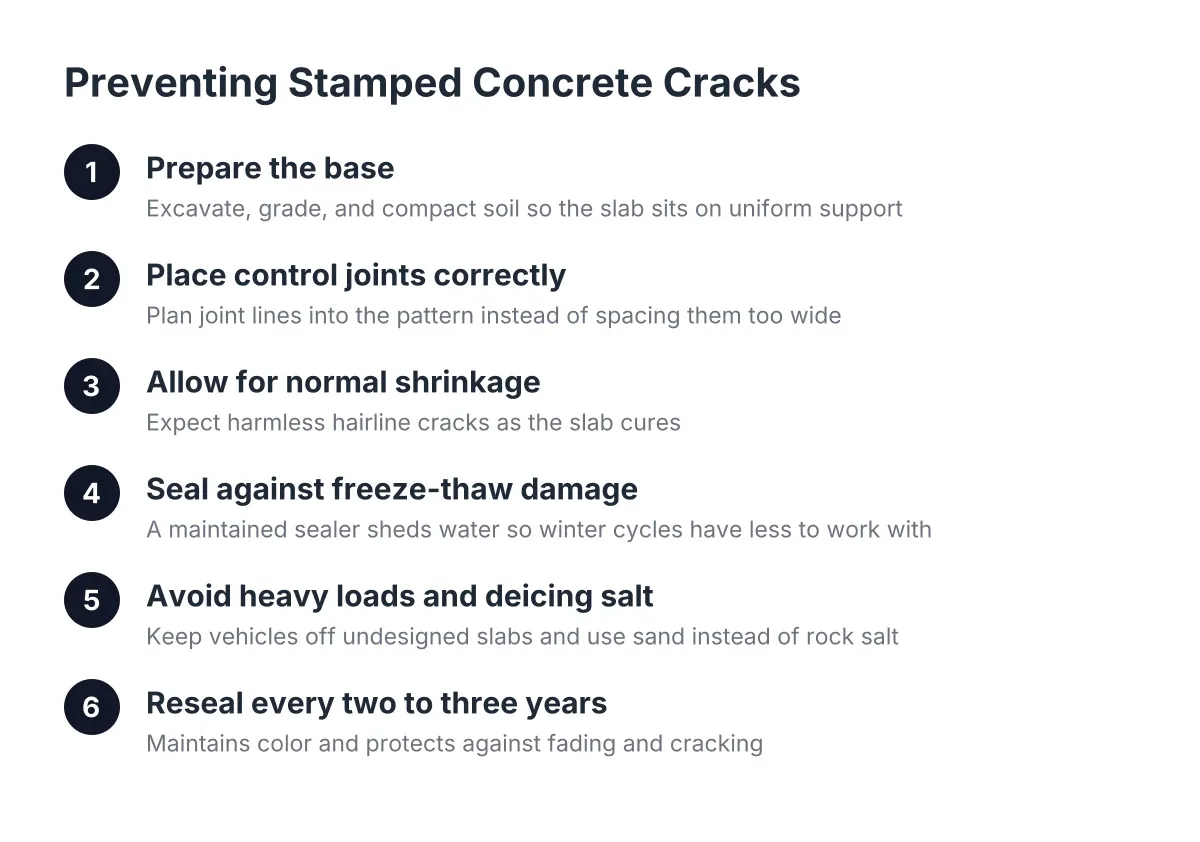
Preventing cracks in a new stamped patio or driveway starts before the truck arrives. The base must be excavated, graded, and compacted so the slab sits on uniform support. Control joints need to be planned into the stamp layout, the slab needs the right thickness for its use, and water needs somewhere to go other than under the concrete.
For example, suppose a homeowner in Sugar House replaces a cracked 1990s patio with a stamped design in a wood plank pattern. A careful crew would ask where downspouts discharge, where sprinklers hit, and how snowmelt drains off the yard before finalizing the layout. In that scenario, sloping the slab away from the house and routing a downspout past the edge does more to prevent future cracks than any product applied afterward.
After the pour, your job as the owner is modest but real:
- Stay off the new surface for the cure period your contractor specifies.
- Keep the sealer maintained on a two-to-three-year cycle.
- Keep sprinklers from soaking the slab edges, where water undermines the base.
- Skip deicing salts the first winter, and go easy on them after that.
When Does a Cracked Stamped Surface Need a Professional?
A cracked stamped surface needs a professional when cracks widen over time, one side sits higher than the other, sections sink, or spider cracking covers large areas. These symptoms point to base or drainage failure under the slab, which no surface product can fix. Hairlines that stay stable can wait for your next reseal.
Sealing stable cracks promptly still matters, because it keeps water from reaching the base and turning a small flaw into a sunken corner. If you are getting quotes in 2026 for repair versus replacement, ask each concrete contractor to explain what they think is causing the crack, not just what they will fill it with. The cause determines whether a repair holds. For anything involving a sinking slab or repeated cracking in the same spot, bring in a contractor who works with Wasatch Front soils and drainage, because the ground under the slab is usually the real story.
If you need stamped and decorative concrete, Salt Lake Valley Concrete can help.
Prefer to talk it through? Call (385) 433-4634 — a quick call is usually the fastest way to get a straight answer for your situation.