Stamped Concrete Durability in Salt Lake’s Freeze-Thaw Winters: An Honest Guide
If you are weighing a stamped concrete patio or driveway along the Wasatch Front, the real question is not how it looks the day it is poured. It is how it holds up after five winters of hard freezes, snowmelt, and deicer. Questions about stamped concrete durability in Salt Lake come up constantly, and they deserve a straight answer. Understanding stamped concrete freeze-thaw durability is essential for anyone considering this decorative finish in this climate. Stamped concrete can last decades here, but only if the base, the mix, the sealer, and the winter care are all handled with this climate in mind. Skip any one of those, and you end up with the flaking, faded slab that gives stamped work a bad name.
This guide walks through how stamped concrete behaves in a freeze-thaw climate, what actually damages it, how it compares to pavers and plain concrete, and what to ask before you sign a contract. It is written for two readers: the homeowner staring at a cracked or scaling slab wondering whether to repair or replace, and the HOA or property manager planning common-area flatwork out of a reserve budget.
What Stamped Concrete Is and Why Winter Is the Real Test
Stamped concrete is a standard concrete slab with texture pressed into the surface while it is still wet. A contractor pours the slab, adds color, then presses rubber mats into the surface to mimic stone, slate, brick, or wood plank. The result is one continuous slab with a decorative face.
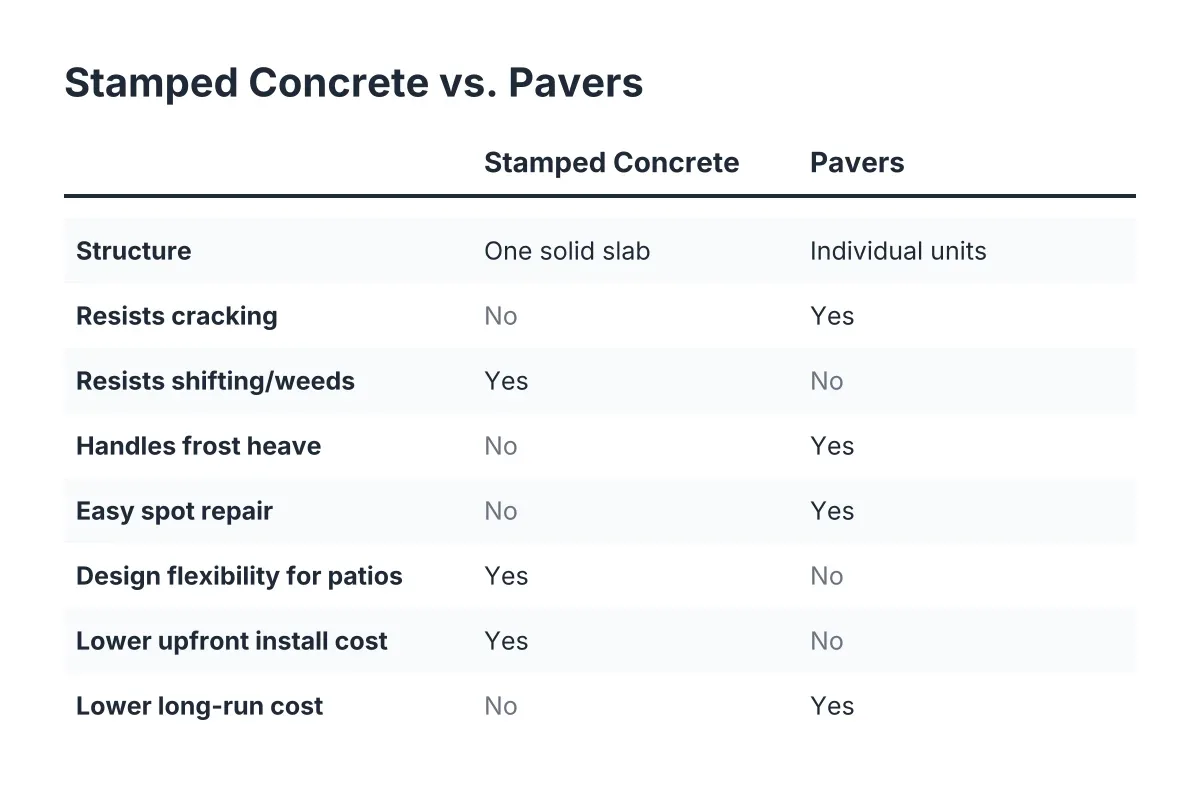
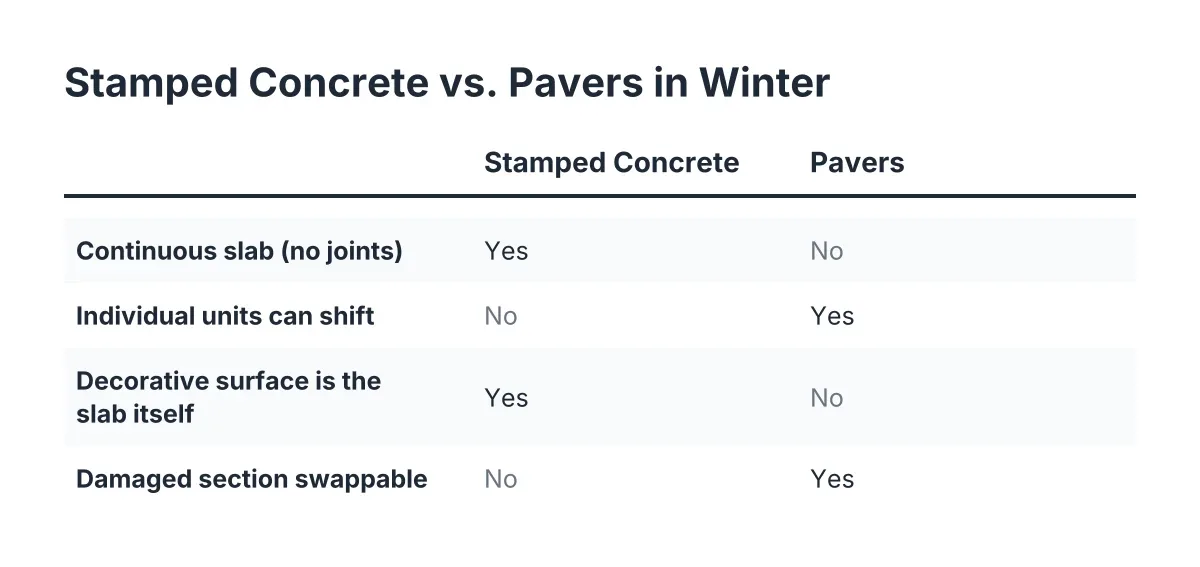
That continuous slab is both the strength and the weakness. Unlike pavers, there are no hundreds of joints for weeds and ants, and no individual units to shift out of line. However, the decorative surface is the slab itself. There is no separate wear layer you can swap out. If the surface scales or the color fades, the fix happens on the slab you already own.
Winter along the Wasatch Front is the real test. Water gets into the surface pores of concrete, freezes, expands, and pushes outward. Thaw, refill, refreeze. One winter here can run through that cycle dozens of times. Each cycle stresses the top layer of the slab. On plain gray concrete, minor surface damage is ugly but tolerable. On a stamped concrete patio where freeze-thaw durability is critical, the texture and color are the whole point, so surface damage shows fast.
How Freeze-Thaw Durability Affects Stamped Concrete in Salt Lake's Climate
Stamped concrete in Salt Lake's freeze-thaw climate is as durable as the slab beneath it, which means it can last for decades when it is poured on a compacted base, with an air-entrained mix, proper joints, and a maintained sealer. The stamping itself does not weaken the concrete. Failures almost always trace back to installation shortcuts or deicer damage, not the pattern.
That point is worth repeating, because it is the most common misunderstanding we hear. Pressing a texture mat into fresh concrete does not make the slab weaker. A stamped slab and a broom-finished slab poured from the same truck, on the same base, cured the same way, will carry the same loads and survive the same winters.
The difference is cosmetic tolerance. A broom finish hides small surface flaws. A stamped surface with an antique release color highlights them. So stamped concrete durability in a salt-and-freeze climate is really a question of protecting the top quarter inch of the slab. That comes down to four things:
- The base. In a freeze-thaw climate, a compacted gravel base under the slab is essential. It drains water away and gives the slab uniform support, so it does not flex and crack as the ground moves.
- The mix. Air-entrained concrete contains tiny bubbles that give freezing water room to expand without blowing apart the surface. This is non-negotiable for exterior flatwork in Utah.
- The joints. Control joints tell the slab where to crack. Stamped slabs still need them, cut or tooled to work with the pattern, or random cracks will cut across the design.
- The sealer. Sealer is the raincoat. It slows water and deicer from soaking into the surface. On stamped work, it also holds the color. Let it wear through, and winter gets direct access to the slab.
Get those four right and the stamp pattern is just the finish on a sound slab. Get any of them wrong and no pattern or color will save it.
Road Salt, Deicers, and Stamped Concrete: What Actually Causes Damage
Road salt does not melt concrete. What deicers do is keep the surface wet at temperatures where it would otherwise stay frozen, which multiplies the freeze-thaw cycles the top layer endures. More cycles, more stress, more scaling. Some chemical deicers, especially magnesium chloride blends, can also attack the cement paste directly over time.
This matters in Salt Lake City because salt is everywhere in winter. The plow trucks spread it on the street. Your car carries brine into the driveway and drips it where you park. You or your snow contractor spread it on walkways to manage slip liability. A stamped driveway apron near the street takes a beating that a backyard stamped concrete patio never sees.
The first winter is the most dangerous. Fresh concrete is still gaining strength through its first year, and its surface is most vulnerable to deicer-accelerated scaling during that period. The slabs that fail ugly, the ones you see in online horror stories about ruined patios, are usually slabs that got salted hard in their first winter before the surface matured and before the sealer had done its job. When stamped concrete freeze-thaw durability is compromised by early deicer application, surface damage accelerates rapidly.
For example, suppose a homeowner in Millcreek pours a stamped driveway in October. November brings an early storm, and they spread rock salt across the new surface for three months. By March, the surface is flaking in patches and the color release is gone in the tire paths. In that scenario, nothing was wrong with the stamping. The slab was asked to survive its hardest conditions at its weakest age.
Practical winter rules for stamped surfaces:
- Use sand for traction instead of deicer during the first winter, whenever possible.
- After the first year, if you must use a deicer, avoid harsh chemical blends and use the minimum needed.
- Shovel early and often. Snow removed before it melts and refreezes never becomes a salt problem.
- Rinse off deicer residue and car drippings in spring, then inspect the sealer.
- Reseal on schedule, typically every two to three years depending on traffic and exposure.
Stamped Concrete vs. Pavers vs. Plain Concrete for Utah Winters
Each option trades durability, appearance, and maintenance differently, and the honest answer is that all three can work in a freeze-thaw climate when installed correctly.
Stamped concrete
A stamped slab gives you a continuous, decorative surface with no joints to weed and no units to shift. It handles vehicle loads well on a proper base. Its weak points are surface scaling if deicers hit it early or the sealer lapses, and the fact that cracks, while controllable with joints, cannot be invisibly repaired the way a single paver can be swapped. Sealed stamped surfaces can also be slick when wet or icy; a grit additive in the sealer helps.
Pavers
Pavers shrug off salt better at the surface, since each unit is a dense factory-made block. However, they bring their own winter problems: joint sand washes out, edges shift with frost heave, and snow shoveling catches raised edges. For an HOA, pavers mean ongoing joint maintenance across every walkway. Individual replacement is easy, which is their real durability advantage.
Plain or broom-finished concrete
Plain concrete is the budget baseline and hides surface wear best. A broomed surface also gives better wet traction than a smooth sealed finish. What it lacks is the appearance. For context on cost, a professionally installed concrete patio averages $2,925 nationwide according to Lawn Love, and a typical 288 square foot patio runs about $11 per square foot according to Concrete Network. Stamped work adds labor and materials on top of a plain pour, so you are paying for the finish; the structural slab underneath costs the same either way.
There is no single winner. If you want individual-unit repairability and do not mind joint upkeep, pavers make sense. If you want a continuous surface with decorative range and are willing to commit to sealing and smart deicer habits, stamped concrete holds up well here. Additionally, if budget rules, plain concrete with a broom finish is the durable, unglamorous choice.
Cracked or Scaling Stamped Concrete: Repair or Replace?
A cracked or scaling stamped slab does not automatically need replacement. The right call depends on what failed and how deep the damage goes. Hairline cracks and localized scaling are usually repairable. A slab that is cracked through, sunken, or scaling across most of its surface is usually a replacement.
Here is how to think through it, the same way a contractor walks a damaged slab:
- Hairline cracks that follow or stay near the joints are normal concrete behavior. Clean them, seal them, and keep water out. Properly sealed cracks keep water from getting under the slab, which is what prevents small problems from becoming settlement problems. Preparation matters; sealant pushed into a dirty, unprepared crack will not bond and fails early.
- A random crack across the pattern is cosmetic damage plus a water entry point. It can often be sealed and color-blended. A light dusting of dry sand over fresh sealant helps it blend into the texture instead of reading as a shiny line.
- Surface scaling in patches can sometimes be addressed with cleaning, spot repair, and resealing. Widespread scaling means the decorative surface is gone, and an overlay or replacement is the honest recommendation.
- A sunken section with water pooling points to a base or drainage failure, not a surface failure. Leveling may work on plain slabs; on stamped work, lifting rarely restores pattern alignment cleanly, so get an on-site assessment before assuming either answer.
If you are the homeowner worried a contractor will just say "replace it all," ask them to explain which of these categories your slab falls into and why. A contractor who can point to the specific failure mode, base movement versus surface scaling versus normal joint cracking, is giving you a diagnosis. One who quotes replacement without explaining the failure is giving you a sales pitch. Structural questions, especially slabs tied to foundations, retaining walls, or drainage toward a building, are worth a professional evaluation rather than a guess from this or any article.
What HOAs and Property Managers Should Know About Stamped Concrete Durability and Salt Exposure
For common-area flatwork, stamped concrete durability under salt exposure is as much a management question as a construction question. The slab's lifespan depends on decisions the board controls: the deicer your snow contractor uses, the resealing line item in the reserve budget, and whether drainage sends snowmelt across the decorative surface.
Stamped concrete shows up in HOA projects as entry monuments, pool decks, clubhouse patios, and accent bands in walkways. The durability math changes at this scale. A homeowner can baby one patio. A property manager has a snow contractor spreading deicer across 300 units' worth of walkways at 5 a.m., because slip-and-fall liability beats concrete preservation every time.
Therefore, plan around that reality instead of fighting it:
- Put stamped surfaces where salt is not. Use decorative concrete at entries, pool decks, and courtyards, and specify broom-finished concrete for the walkways and curb lines that get salted all winter.
- Write the deicer into the snow contract. Specify sand or a concrete-safer product on decorative areas, and flag new pours for a no-deicer first winter.
- Budget resealing in the reserve study. A resealing cycle every two to three years is a predictable maintenance cost. Deferred sealing turns into resurfacing or replacement, which is a capital cost.
- Specify traction in the sealer. Pool decks and sloped walkways need a grit additive, both for resident safety and for your liability exposure.
- Favor lighter stamped concrete patterns and colors in sun-exposed gathering areas. Lighter surfaces reflect more sun and stay cooler underfoot, which residents notice on a July pool deck.
When bidding stamped work in 2026, ask each concrete contractor the same durability questions and compare the answers: What base depth and compaction? Is the mix air-entrained? Where will control joints fall relative to the pattern? What sealer, and what resealing interval do they recommend for this exposure? Vague answers on those four points predict the slab you will get.
Questions to Ask Before You Pour Stamped Concrete in Salt Lake City
Whether you are a homeowner replacing a failed patio or a manager specifying common-area work, the pre-pour conversation determines the outcome more than anything you do afterward. Soils along the Wasatch Front vary from expansive clay to gravel within short distances, and drainage from spring snowmelt differs lot to lot, so the right answers are site-specific.
Bring this list to every estimate:
- What is under the slab? Ask about excavation depth, gravel base, and compaction for your specific soil.
- Is the concrete air-entrained and appropriate for exterior freeze-thaw exposure?
- How will control joints be placed so they work with the stamp pattern instead of against it?
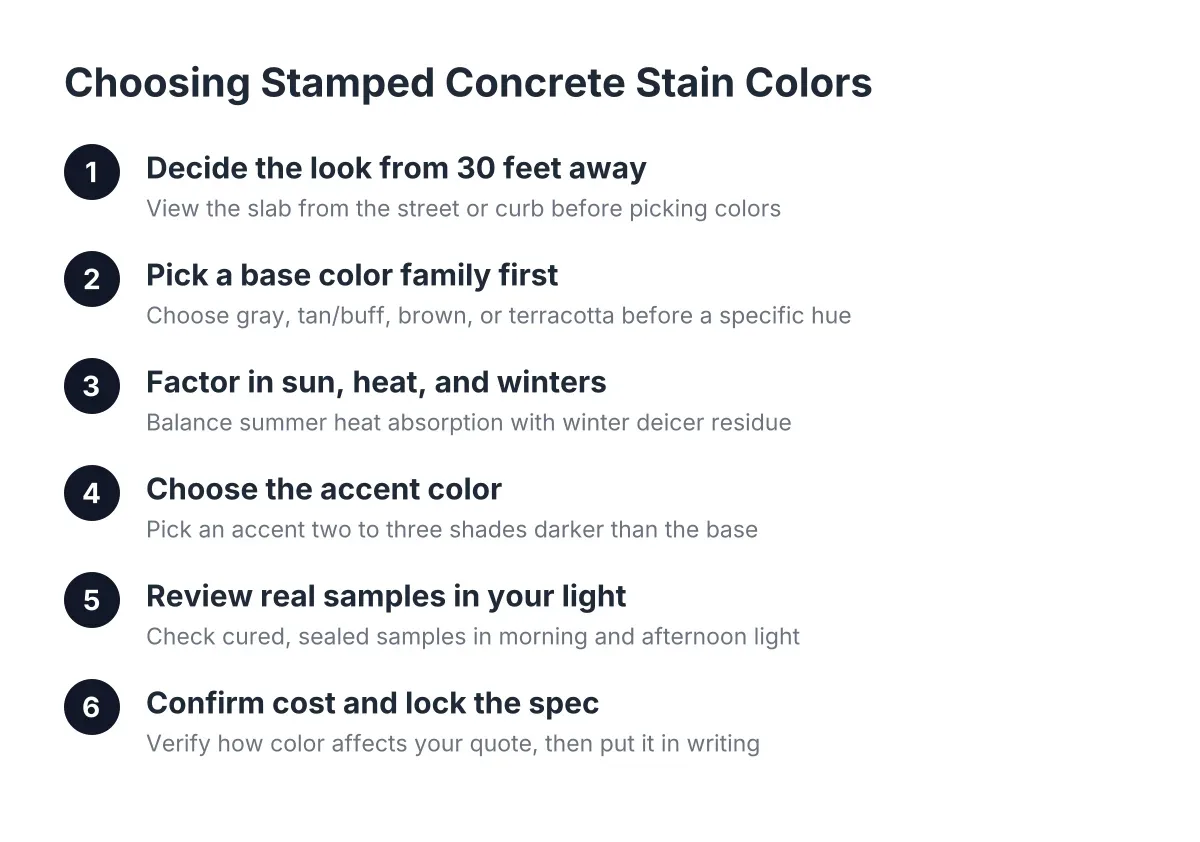
- Which stamped concrete patterns and colors hide wear best for this use? Textured, variegated patterns disguise small flaws better than smooth, uniform ones.
- What sealer will be used, will it include a slip-resistant additive, and when is the first reseal due?
- What are the first-winter rules? A good contractor will tell you to keep deicer off the new slab without being asked.
- How does water leave this slab? Slope and drainage decide whether snowmelt runs off or sits and refreezes on the surface.
Stamped concrete is not a fragile upgrade, and it is not maintenance-free either. In Salt Lake's climate it sits in the middle: a durable slab with a decorative surface that asks for a sealer every few years and some discipline about salt. Price that maintenance in honestly, place it where winter chemicals will not pound it, and insist on the base, mix, and joints that any slab here needs. Do that, and the patio you pour this year should still look intentional, not just intact, long after the first dozen winters have come and gone.
If you need stamped and decorative concrete, Salt Lake Valley Concrete can help.
Prefer to talk it through? Call (385) 433-4634 — a quick call is usually the fastest way to get a straight answer for your situation.