Stamped Concrete vs. Pavers for Driveways and Patios: A Salt Lake City Comparison Guide
If you are planning a new driveway or patio in Salt Lake City, the choice between stamped concrete vs pavers, and driveways poured with plain gray concrete comes up fast. Both stamped concrete and pavers can look sharp. Both can last for decades. But they behave differently under Wasatch Front winters, they fail in different ways, and quotes for them are built from different line items. If you are gathering your first bids, that last part matters most.
This guide walks you through the comparison as a step-by-step process, so you can look at any quote, for either surface, and know whether the numbers make sense. The goal is not to sell you on one material. It is to make sure the first contractor who shows up cannot tell whether you have done your homework or not. Because you will have.
Step 1: Understand What Each Surface Actually Is
Start with the basics, because the two products get confused all the time. Stamped concrete is a single poured slab. While the concrete is still wet, a crew presses textured mats into the surface to create the look of brick, flagstone, cobblestone, or cut stone. Color comes from integral color mixed into the concrete, a color hardener worked into the surface, or both.
Pavers are the opposite approach. They are individual pre-made units, usually concrete or clay brick, set one at a time on a compacted gravel and sand base. There is no single slab; the surface is hundreds or thousands of small pieces locked together by edge restraints and joint sand.
Here is the plain version of the difference:
- Stamped concrete: one continuous slab, textured and colored to imitate individual stones
- Pavers: actual individual stones or bricks, installed over a compacted base
- Both: require real excavation, a proper base, and good drainage to survive Utah winters
That one-slab versus many-pieces distinction drives almost every pro and con that follows, from cracking to repair costs to how each one handles a freeze-thaw cycle.
Step 2: Compare How Stamped Concrete and Pavers Handle Driveways
Is stamped concrete better than pavers for a driveway?
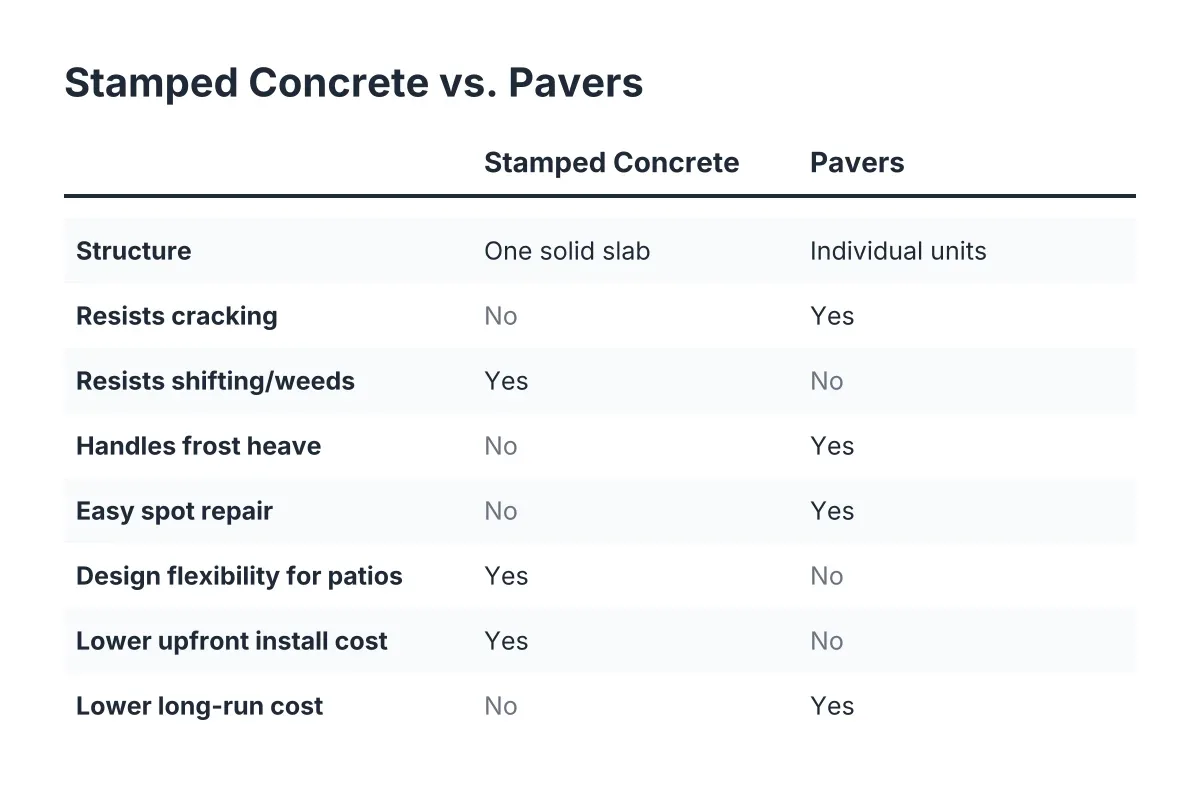
Neither stamped concrete nor pavers is automatically better for a driveway; it depends on what you want to maintain. Stamped concrete gives you one solid slab that resists shifting and weed growth but can crack. Pavers resist cracking because each unit moves independently, but they can settle, heave, and sprout weeds in the joints.
A driveway is the harder test for both materials because it carries vehicle weight, not just foot traffic. For stamped concrete, that means the slab needs adequate thickness, reinforcement, and well-placed control joints. A contractor who skips any of those to hit a low price is setting you up for cracks that run straight through the stamped pattern.
For pavers, vehicle weight pushes down on the base, not the surface. If the base was not excavated deep enough or compacted well, you get ruts and dips where the tires travel. In the Salt Lake Valley, the clay and gravel soils along the Wasatch Front vary from lot to lot, so base prep is not a place to cut corners for either surface.
Winter is the other driveway factor. Pavers shrug off frost heave better because individual units can lift and resettle. However, snow removal is harder on them; a plow or shovel edge can catch a raised paver and chip or dislodge it. A stamped slab plows clean, but harsh deicing salts attack the sealer and surface color, so you manage snow with sand or plain shoveling instead.
Step 3: Compare Them for Patios
A patio is a gentler application, and that changes the math. Without vehicle loads, both surfaces can perform well for decades if the base work is done right. So the patio decision usually comes down to look, feel, and upkeep rather than structure.
Stamped concrete wins on design flexibility for patios. One pour can flow around curves, wrap a fire pit, and carry a continuous pattern with no cut lines. You can also mix finishes; a smooth troweled field with cut control joints and a stamped border reads as decorative concrete without stamping the whole surface.
Pavers win on repairability. If one unit stains or chips, you pull it and drop in a replacement. With a stamped patio, a bad spot means patching or resurfacing, and matching the original color and texture takes skill.
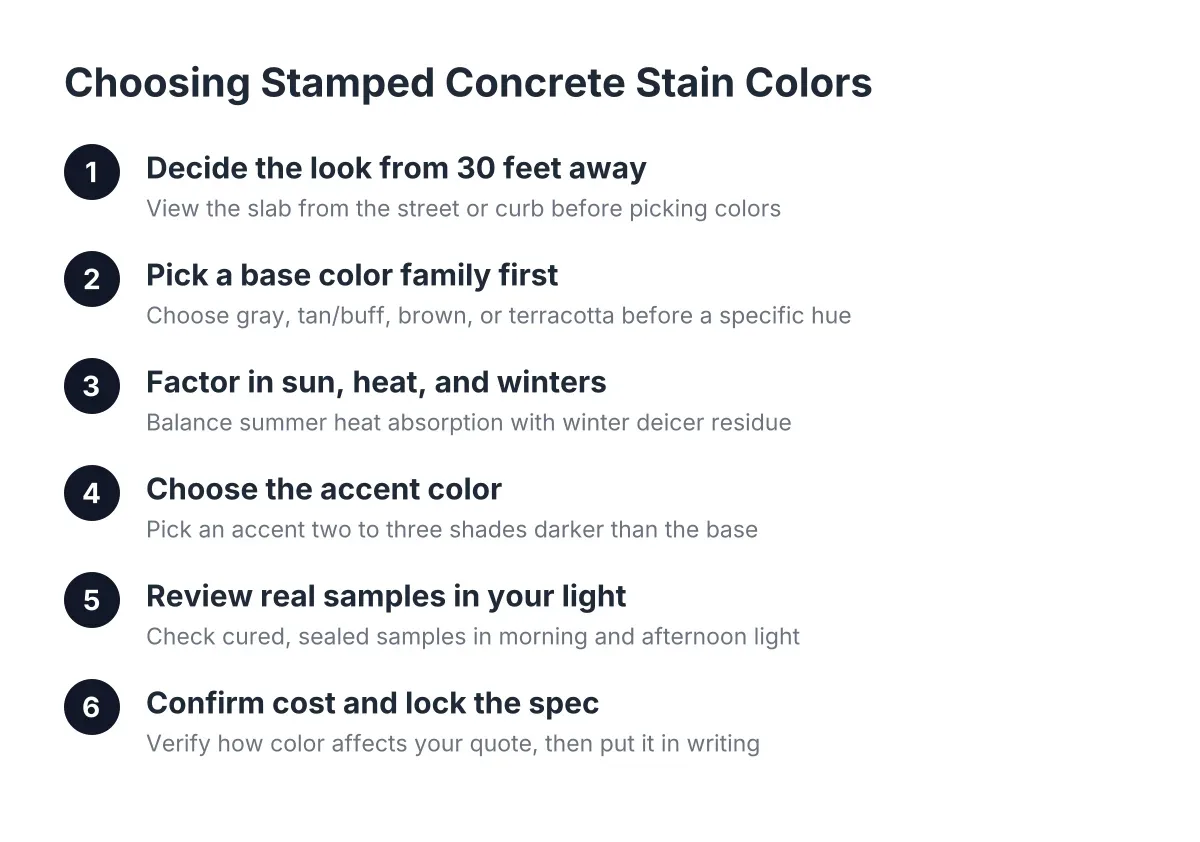
One detail many homeowners miss on either surface: color affects comfort. Darker concrete and dark pavers absorb more sun and get noticeably hotter underfoot than lighter tones. For a patio you will stand on barefoot in July, lean toward lighter colors.
Step 4: Compare the Cost Structure, Not Just the Price
Is stamped concrete cheaper than pavers?
Stamped concrete is often cheaper than pavers to install for the same square footage, because one pour with stamping labor usually costs less than placing individual units by hand over a prepared base. However, pavers can cost less over the long run since spot repairs are cheap, while stamped concrete needs periodic resealing and eventual crack repair.
Rather than fixating on a single per-square-foot number, look at what builds each quote. For stamped concrete, pricing is driven by slab size, excavation depth, reinforcement, the number of colors and patterns, and site access. For pavers, it is driven by excavation, base material and compaction, the paver product itself, cutting and edging labor, and again site access.
For scale, a professionally installed plain concrete patio averages $2,925 nationwide according to Lawn Love, and Concrete Network puts a typical 288 square foot concrete patio at about $11 per square foot. Stamping and coloring add labor and material on top of a base figure like that, and pavers typically land higher still. On driveways, HomeAdvisor reports a concrete driveway averages about $6,400, which gives you a floor before any decorative upgrade.
A concrete calculator can help you estimate yardage for the slab itself, but material is only one slice of the bid. Labor is the bigger variable, and it is tight; according to the Associated General Contractors of America, 88% of construction firms with open craft positions say those jobs are as hard or harder to fill than a year ago. Skilled stamping crews and paver installers both command real wages in 2026, and a bid far below the others usually means less skilled labor or thinner base work.
Step 5: Weigh the Downsides Honestly
What is the downside of stamped concrete?
The main downside of stamped concrete is that it is one continuous slab, so when it cracks, the crack can run visibly through the decorative pattern. It also needs resealing every few years to hold its color, it can be slippery when sealed and wet, and repairs are hard to blend with the original finish.
Pavers have their own list. Weeds and ants find the joints. Edges can creep without solid restraints. Individual units settle or heave with our freeze-thaw cycles, creating trip hazards, which matters a lot if you manage an HOA or commercial property where a raised paver on a common walkway is a liability claim waiting to happen.
Neither surface is a good DIY project at driveway or patio scale. Stamping is a timed operation; the concrete sets whether the crew is ready or not. Paver installation is simpler in theory but lives or dies on excavation and compaction. If your site has poor drainage, heavy clay, or a steep grade, have a concrete contractor or qualified installer evaluate it before you commit either way.
Step 6: Run a Real Scenario Before You Take Bids
Suppose a homeowner in Sugar House wants to replace a cracked 600 square foot driveway and is deciding between a stamped concrete finish and pavers. Three bids come in. The lowest stamped bid skips mention of reinforcement and excavation depth. The paver bid is the highest but itemizes base depth, compaction, and edge restraints. Additionally, the middle stamped bid lists slab thickness, control joint layout, two colors, and a resealing recommendation.
In that scenario, the middle bid is the one speaking your language, and the paver bid is at least honest about why it costs more. The lowball is the one to question hard. Ask what is under the surface, literally: how deep is the excavation, what is the base, where are the joints or restraints, and how does water leave the slab. Also ask about sequencing; on a driveway replacement, a good crew keeps an access section usable as long as possible and removes the final apron right before the pour.
Comparing stamped concrete and pavers quotes this way turns a confusing stack of numbers into a clear picture of who plans to build a base that survives a Salt Lake City winter and who plans to pour and leave.
Step 7: Make the Call Based on Your Priorities
Pull it together with a short checklist. Choose stamped concrete if you want a continuous custom look, a lower upfront price, easy snow shoveling, and you accept resealing every few years plus the chance of a visible crack someday. Choose pavers if you want spot-repairable surfaces, better tolerance for soil movement, and you accept higher upfront cost plus joint maintenance.
For an HOA board or property manager working from a reserve study, that trade-off often tilts by use. Pavers suit common walkways where a single damaged unit gets swapped in an afternoon. Stamped or decorative concrete suits larger flatwork areas, pool decks, and entries where a continuous slab, plowable surface, and lower install cost stretch the budget further.
Whichever direction you lean, get at least three bids, make every contractor itemize excavation, base, reinforcement or restraints, finish, and sealing, and compare those line items instead of the bottom line. Stamped concrete and paver driveways fail for the same root reason, a weak base over tricky Wasatch Front soil. The surface you pick matters less than the quality of what sits underneath it.
If you need concrete driveways, Salt Lake Valley Concrete can help.
Prefer to talk it through? Call (385) 433-4634 — a quick call is usually the fastest way to get a straight answer for your situation.