How Much Does Stamped Concrete Cost?
How much does a stamped concrete patio cost? The honest answer depends on three things more than anything else: the size of the slab, the complexity of the stamp pattern and color, and what your site needs before the pour, like excavation or access work. Anyone who gives you a firm number before seeing your yard is guessing, and a guess is worth what you paid for it. This guide walks through what actually drives the price in the Salt Lake Valley, where our clay and gravel soils and hard freeze-thaw winters shape how a patio has to be built. By the end, you will know exactly what to ask and how to get a real number for your project.
What Drives the Cost of Stamped Concrete
Stamped concrete starts as a standard slab, then adds color, texture, and sealing on top. That means you pay for everything a plain patio costs, plus the decorative work. Here are the factors that move the price most.
Slab Size and Thickness
Size is the biggest lever. A larger patio needs more concrete, more base gravel, more labor, and more stamping time. Thickness matters too. A patio that will hold a hot tub or heavy furniture may need a thicker slab and more reinforcement than one meant for a table and chairs. You can tell which side you are on by measuring the space and being honest about what will sit on it. Bigger and heavier pushes the price up. Smaller and lighter keeps it down.
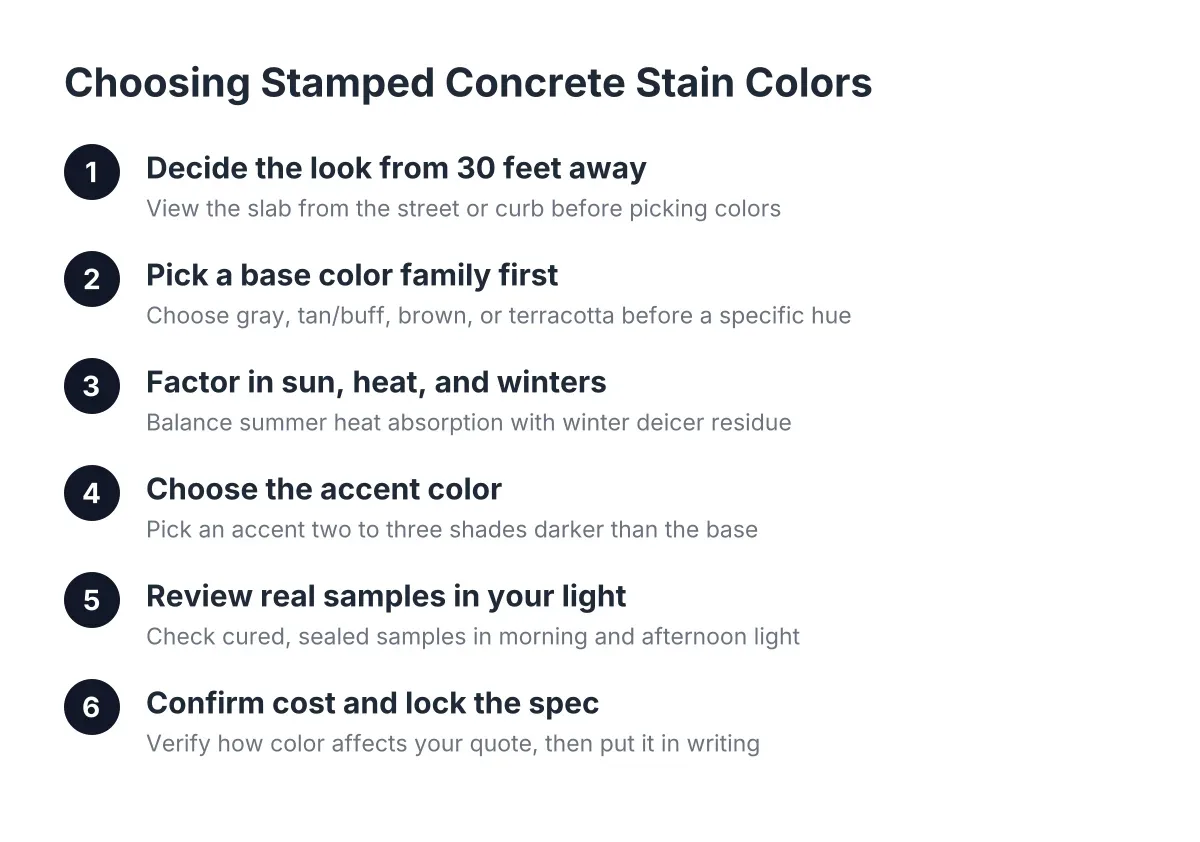
Stamp Pattern and Color Complexity
A single stamp pattern with one base color is the simplest decorative job. Multiple patterns, borders, several colors, and hand-applied accent tints all add labor hours. Stamping is time-sensitive work; the crew has a window while the concrete is workable, and complex designs need more hands in that window. If you want a patio that reads as slate or flagstone from ten feet away, a mid-range design does that. If you want it to fool someone standing on it, expect to pay for the extra detail.
Site Prep and Excavation
Before any concrete gets poured, the ground has to be dug out, graded, and compacted with a gravel base. Along the Wasatch Front, soils vary from lot to lot. Expansive clay needs more careful base prep than well-drained gravel, because clay moves with moisture and can crack a slab poured over a poor base. If your yard is flat with decent soil, prep is routine. If the site slopes, holds water after snowmelt, or sits on heavy clay, prep costs rise. Good prep is where the money protects you; it is the difference between a patio that lasts and one that heaves in its third winter.
Site Access
Concrete trucks are big. If the truck can back up close to the pour, the crew places concrete fast and the job stays efficient. If the patio sits behind a narrow gate or down a slope, the crew may need to wheelbarrow or pump the concrete, and both add time or equipment cost. Walk the path from your street to the patio site. If a truck cannot get within a short distance of it, plan for access to show up on the quote.
Demolition and Removal
If an old patio, deck footing, or walkway occupies the space, someone has to break it out and haul it away before the new work starts. Tear-out and disposal are real line items. A bare, open yard skips this cost entirely. If you are replacing an existing slab, ask for demolition as its own line on the estimate so you can see what it adds.
Sealing and Finish Work
Stamped concrete needs a sealer to protect the color and surface, and in Salt Lake City that sealer earns its keep. Freeze-thaw cycles and de-icing salts are hard on decorative surfaces. The initial seal is part of the job, and resealing every few years is part of owning the patio. A contractor who skips or skimps on sealing hands you a cheaper quote and a shorter-lived patio.
Cost Factor Table
| Factor | Pushes the price down when… | Pushes it up when… |
|---|---|---|
| Slab size and thickness | The patio is small and holds light loads | The slab is large, thick, or reinforced for heavy loads |
| Pattern and color | One pattern, one base color | Multiple patterns, borders, and layered colors |
| Site prep | The ground is flat with stable, well-drained soil | The site slopes, holds water, or sits on expansive clay |
| Site access | The concrete truck can park next to the pour | Concrete must be pumped or wheeled through tight access |
| Demolition | The space is open and bare | An old slab or structure must be broken out and hauled off |
| Sealing and finish | Standard sealer on a simple surface | Premium sealers or detailed hand-finishing work |
Factors That Determine Stamped Concrete Patio Costs
A phone number is not an estimate. The price of a stamped patio depends on your yard, so a real quote starts with a site visit or at least detailed photos and measurements. Here is how to make that fast and accurate.
Have this ready before you call a concrete contractor:
- The patio dimensions, even rough ones measured with a tape
- Photos of the space, including the path from the street to the site
- What is there now: grass, an old slab, a deck, or bare dirt
- The look you want: a pattern style, a color, or photos you like
- How you will use it: dining, a hot tub, a fire pit, foot traffic
A good quote spells out the slab size and thickness, the base prep, reinforcement, the stamp pattern and colors, control joints, sealing, demolition if needed, and cleanup. If a quote is one line with one number, you cannot compare it to anything, and you cannot hold anyone to it.
Estimates differ between contractors for real reasons. One crew may plan a thicker gravel base for your soil. Another may price a cheaper sealer or thinner slab. The lowest bid often removes something you cannot see until winter. Compare what each quote includes, not just the total. Our stamped and decorative concrete page covers how we approach this work in Salt Lake City if you want more detail on the process itself.
Ways to Keep the Cost Down
You do not need coupons to lower the cost of a stamped patio. You need smart scope choices.
- Simplify the design. One pattern and one color cost less than borders, multiple tints, and hand accents. A clean, single-pattern patio still beats plain gray concrete by a mile.
- Right-size the slab. Build the patio for how you actually live. A smaller, well-placed patio you use daily is better money than a sprawling one you heat the grill on twice a summer.
- Clear your own obstacles. Moving planters, furniture, or a small shed before the crew arrives cuts labor time. Ask the contractor what you can handle yourself.
- Ask about scheduling. Concrete work in the Salt Lake Valley is seasonal. Crews pour from spring through fall, and flexibility on timing can sometimes work in your favor. Ask rather than assume.
- Keep up with resealing. This is the cheapest money you will ever spend on the patio. A sealed surface shrugs off freeze-thaw damage and de-icing salt. A neglected one needs resurfacing or crack repair years early, and that is the expensive version.
Cost Questions People Ask
How much does a 20×20 stamped concrete patio cost?
A 20×20 patio is 400 square feet, which is a large residential pour, so size alone puts it on the higher end for patios. The final price still depends on your soil, site access, the pattern and colors you pick, and whether anything needs to be torn out first. Get an itemized quote based on your actual yard; two 20×20 patios on different lots can price out differently for good reasons.
What is the downside of stamped concrete?
The main downsides are maintenance and repair. Stamped surfaces need resealing every few years to protect the color, especially with Salt Lake City winters and de-icing salts. If a stamped slab cracks, matching the pattern and color in a repair is harder than patching plain concrete. Proper base prep and control joints reduce that risk, which is why cheap prep is a bad trade.
Can I do stamped concrete myself?
For a patio, we do not recommend it. Stamping has a short working window while the concrete is still plastic, and a mistimed stamp or a bad base is permanent. Tool rental, color hardeners, and release agents eat into the savings, and a failed pour costs more than hiring it done right. Plain concrete is a more forgiving DIY project; stamped work rewards experienced hands.
Why do stamped concrete estimates vary so much between contractors?
Because the quotes are not describing the same job. One contractor prices a thicker base, reinforcement suited to clay soil, and a quality sealer. Another prices the minimum. Ask each bidder to itemize the base depth, slab thickness, reinforcement, and sealing so you can compare the actual work, not just the number at the bottom.
The Bottom Line
The cost of a stamped concrete patio comes down to size, design complexity, and what your site needs before the pour; no honest contractor can price it without seeing it. Measure your space, take photos, and gather two or three itemized quotes so you can compare the work line by line. If you are in the Salt Lake Valley, we are glad to be one of them.
Prefer to talk it through? Call (385) 433-4634 — a quick call is usually the fastest way to get a straight answer for your situation.