Stamped Concrete Patio Styles: 8 Decorative Finish Looks for Salt Lake City, UT
If you are replacing a plain gray patio, the style decision matters as much as the pour itself. A decorative concrete finish lets you pick a pattern, texture, and color that fits your house instead of settling for the same slab every neighbor has. This guide walks through eight stamped concrete patio styles that work well for homeowners in Salt Lake City, UT, with honest notes on cost drivers, color choices, and how each look holds up through Wasatch Front winters.
Here is the short version before the list. Stamping presses a pattern into fresh concrete, usually with a base color mixed into the concrete and a release color applied on top for depth. The pattern is set in the first hours after the pour, so the style decision happens before the truck arrives, not after. Choose the look first, then build the estimate around it.
1. Ashlar Slate: The Safe Bet for Most Salt Lake City Patios
Ashlar slate is a pattern of rectangular stones in mixed sizes with a light slate texture across each one. It reads as cut natural stone without the cost of setting individual pieces, and it pairs with almost any home style, from 1950s brick ramblers in Sugar House to new builds in Daybreak.
Because the stones run in a repeating but irregular layout, small surface wear and hairline cracks hide better than they would in a rigid grid. If you want a decorative concrete finish that will still look intentional in fifteen years, this is the pattern most contractors suggest first.
2. Random Stone and Flagstone: The Natural Look
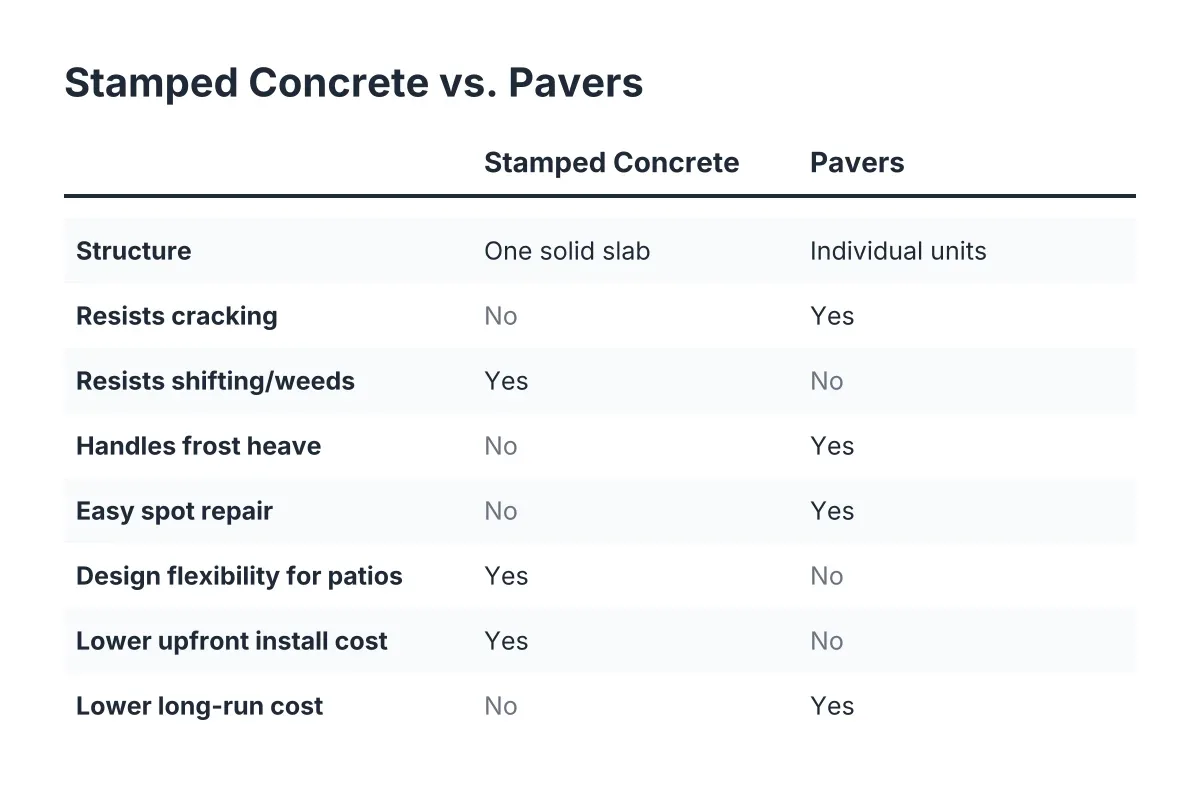
Random stone patterns mimic flagstone, with curved, irregular shapes and deep joint lines between them. The result looks like a mortared flagstone patio, but it pours as one continuous slab, so you avoid the shifting and weed growth that loose-set flagstone can develop here after a few freeze-thaw winters.
Flagstone patterns ask more of the crew. The joint lines are deeper and the layout has to look random without obvious repeats, so placement and timing matter. Expect this style to sit toward the higher end of stamped pricing because of the extra hand detailing.
3. Wood Plank: Warm Texture Without the Maintenance
Wood plank stamps press realistic grain and board lines into the slab, then color layering makes it read as weathered timber. For a covered patio or a space that connects to a deck, it ties the two materials together visually. Unlike real wood, it will not splinter, rot, or need restaining every couple of years.
The trade-off is that wood plank patterns depend heavily on the coloring work. A single flat color makes the grain look printed; a base color plus a contrasting release and a careful seal makes it convincing. Ask any contractor to show you photos of their own wood plank pours, not stock images.
4. Herringbone and Running Bond Brick: The Classic Choice
Brick patterns, stamped in herringbone or running bond layouts, suit older Salt Lake City neighborhoods where real brick is everywhere. A stamped brick border around a plainer field is also a common way to get a custom look while keeping the budget in check.
In addition, brick stamps work well for driveways and front walks, so a Curb Appeal Upgrader redoing the whole front yard can carry one pattern from the sidewalk to the patio. That repetition is what makes a property read as designed rather than pieced together.
5. Cobblestone and European Fan: Old-World Detail
Cobblestone stamps create rounded, tightly packed stones; the European fan layout arranges them in sweeping arcs. Both suit formal landscaping, circular patios, and courtyard spaces. They carry the most visual texture of any pattern on this list, so they work best when the surrounding hardscape is kept simple.
However, heavy texture is a real consideration for furniture. Chairs and tables rock more on deep cobble joints than on slate or wood plank. If the patio is mainly for dining, consider cobblestone as a border with a smoother stamped field in the middle.
6. Seamless Texture Skins: Stone Feel Without Joint Lines
Texture skins press a stone or slate surface into the concrete without any joint pattern at all. You get the feel and shadow of natural rock across the whole slab, with saw-cut control joints providing the only lines. The look is clean and modern, and the cut joints double as the crack control the slab needs anyway.
This is often the most budget-friendly decorative concrete finish after plain colored broom work, because stamping goes faster without pattern alignment. It also hides repair work well later, since there is no grid that a patch has to match.
7. Exposed Aggregate: The Durable Decorative Alternative
Exposed aggregate is not a stamp, but it belongs in any patio style conversation. The crew washes or retards the top paste so the stone in the mix shows through, producing a pebbled surface with natural color variation. It offers strong traction when wet, which matters on a patio that ices over in a Salt Lake winter.
Many homeowners pair it with stamped work: an exposed aggregate field with a stamped slate border, for example. The combination costs less than stamping the full slab and gives the patio a defined edge that reads as custom.
8. Stamped Borders on a Broom or Trowel Field
The most budget-conscious decorative route keeps most of the patio as a colored broom finish or a smooth trowel finish with cut joints, then adds a stamped border in slate or brick. A broom finish also gives better slip resistance when wet, which is worth having on north-facing patios that stay icy longer.
Say a homeowner in Millcreek wants a 20 by 20 patio but the full-stamp estimate stretches the budget. In that scenario, a colored broom field with a 16-inch stamped slate border might trim the decorative labor substantially while still looking far from builder-grade gray. That hybrid approach is one of the most common compromises on real projects.
How to Choose a Decorative Concrete Finish That Fits Your Home
Pick the pattern last, after you have answered three questions about the space. The style that photographs best online is not always the one that works for your lot, your furniture, or your winters along the Wasatch Front.
- Match the architecture. Brick and cobble suit traditional homes; seamless slate and wood plank suit modern ones. Ashlar slate works with nearly everything.
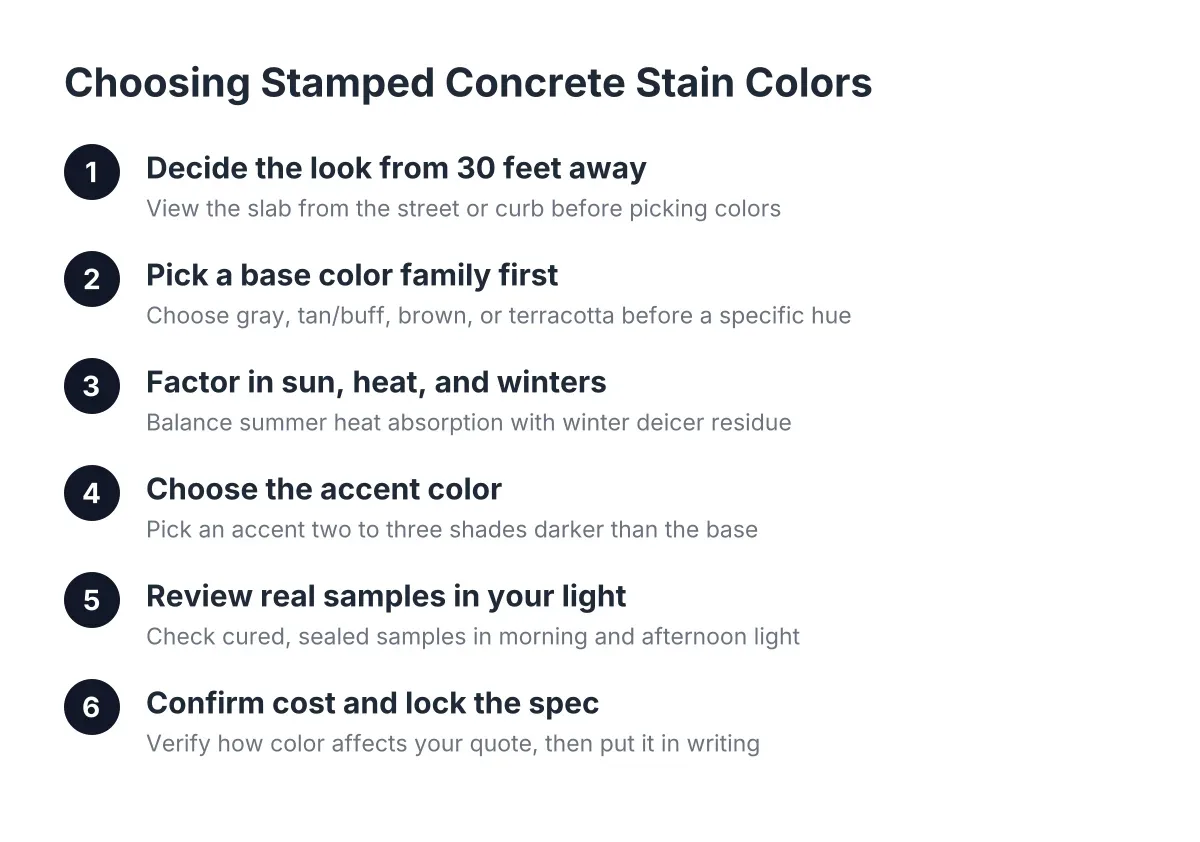
- Go lighter on color than you think. Dark concrete absorbs sun and gets uncomfortably hot underfoot in July. Lighter tones stay cooler and show dusty snowmelt residue less.
- Think about traction. Smoother stamped surfaces, once sealed, can be slick when wet or icy. Heavier textures, exposed aggregate, or a traction additive in the sealer help.
- Plan the furniture zone. Deep joint lines under a dining table get annoying. Keep heavy texture at borders and edges.
- Look at the pattern at scale. A stamp that looks great in a 4-foot sample photo can read as obviously repeated across a 400 square foot patio. Ask to see full-patio photos of any pattern you are considering.
Pricing a Decorative Concrete Finish
A stamped patio costs more than a plain gray pour because of added labor, color, and sealing, with the gap driven by pattern complexity and site conditions. For scale, a typical plain concrete patio around 288 square feet averages about $3,200, or roughly $11 per square foot, according to Concrete Network. Stamped work adds to that baseline.
The main cost drivers in 2026 are the same ones that drive any flatwork estimate: slab size, excavation and base prep, reinforcement, finish type, and site access. Integral color, a release color, hand detailing on joint lines, and sealer all add labor and material on top. A straightforward seamless texture costs less than a hand-detailed flagstone layout on the same footprint, so the pattern you choose is itself a pricing decision.
Will These Finishes Hold Up to Utah Freeze-Thaw and Road Salt?
Stamped and decorative finishes hold up well in Salt Lake City winters when the slab is built for the climate: proper base compaction over our clay and gravel soils, reinforcement in the slab, correct control joints, and a sealer maintained on a regular schedule. The finish itself is not the weak point; the prep underneath it usually is.
Road salt and deicers are harder on any concrete surface, decorative or plain, so plan on resealing periodically and using sand or a concrete-safe deicer near stamped areas. For patios with drainage problems, standing snowmelt, or questionable soil, have a concrete contractor evaluate the site before you commit to a pattern; no finish fixes a slab poured over a bad base.
The Bottom Line for Salt Lake City Homeowners
Every pattern on this list can look custom and high-end, or fake and flat, depending on the coloring, the detailing, and the prep under the slab. Start with the three or four patterns that fit your home's style, ask for full-project photos of each, and let the estimate show you exactly where the decorative labor adds cost. A clear style decision up front is what separates a patio you love in ten years from one you tolerate.
If you need stamped and decorative concrete, Salt Lake Valley Concrete can help.
Related guide: stamped concrete — Complete Guide
Prefer to talk it through? Call (385) 433-4634 — a quick call is usually the fastest way to get a straight answer for your situation.