Concrete Patio Cost Breakdown: Labor, Materials, and Finishing Options Explained
You searched for patio pricing and found a dozen websites that all say the same thing: "every project is different, call for a free quote." That is true, but it is not helpful when you are trying to figure out whether the one bid sitting in your inbox is fair. This concrete patio cost breakdown walks through where the money actually goes on a patio pour: labor, materials, site prep, reinforcement, and finish. By the end, you should be able to read a quote line by line and know what questions to ask before you sign anything.
One honest note up front. We will not invent prices for your specific project, because nobody can price a patio they have not seen. What we can do is show you the structure of the cost, so when a contractor hands you a number, you understand what is behind it.
What a Concrete Patio Actually Costs: The National Picture
Before the breakdown, it helps to have a baseline. A professionally installed concrete patio costs an average of $2,925 nationwide, according to Lawn Love. The Concrete Network puts a typical 288 square foot patio at about $3,200, or around $11 per square foot.
Treat those as reference points, not promises. Salt Lake City pricing moves with local labor availability, concrete supply, site conditions, and the finish you choose. A plain broom-finished slab on an easy-access backyard sits at one end of the range. A stamped, colored patio behind a house with a narrow side yard sits at the other.
Here is why the range exists at all. Concrete work is labor-heavy, and labor is tight. Among construction firms with open craft positions, 88% say those jobs are as hard or harder to fill than a year ago, according to the Associated General Contractors of America. Skilled finishers cost more because there are fewer of them, and that shows up in every bid you collect in 2026.
The Concrete Patio Cost Breakdown, Line by Line
A patio quote, whether the contractor itemizes it or not, is built from five buckets: site prep and excavation, base material, concrete and reinforcement, labor, and finish. Understanding each bucket is the fastest way to compare two bids that look nothing alike on paper.
Site Prep and Excavation
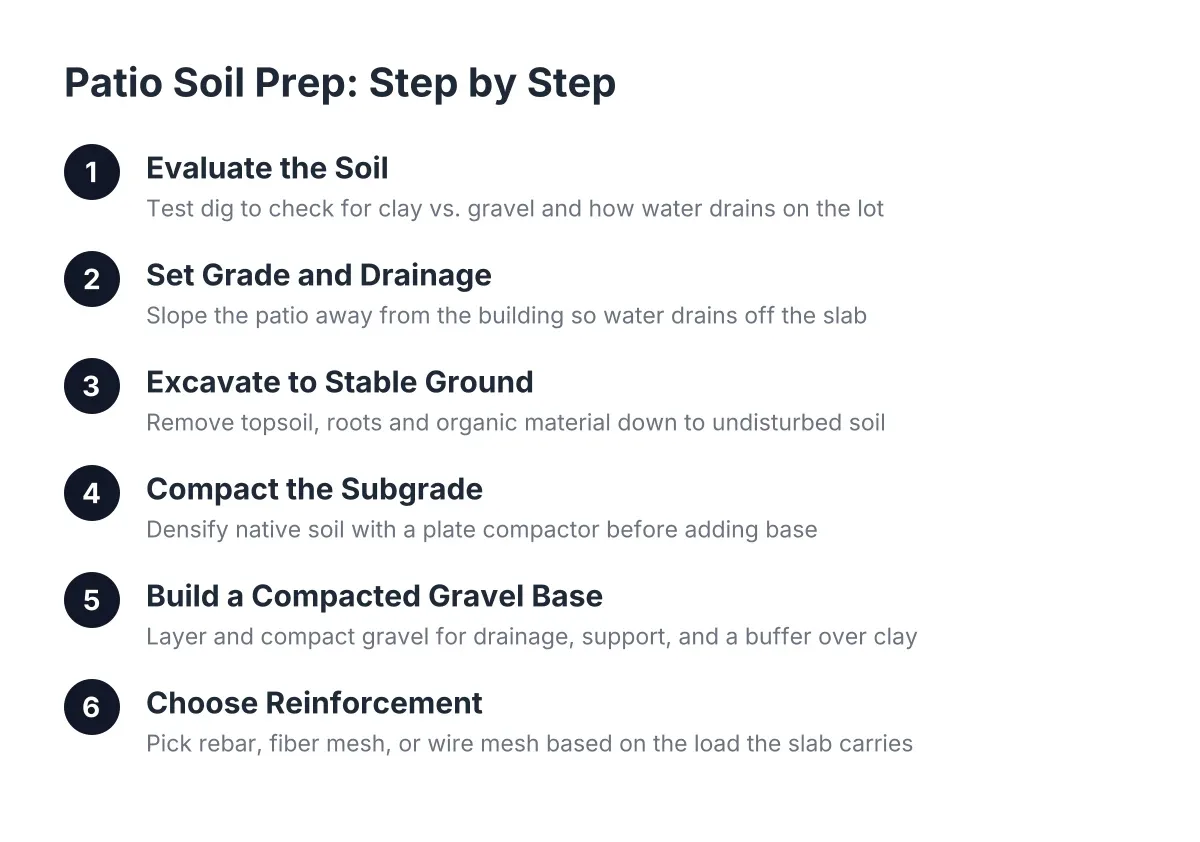
Every patio starts with digging. The crew removes sod, topsoil, and sometimes an old slab, then grades the area so water runs away from your house. Along the Wasatch Front, soils shift between clay and gravel from one neighborhood to the next, and clay-heavy ground often needs more excavation and base work to stay stable.
Access matters here more than most homeowners expect. If a skid steer can drive straight to the patio site, excavation goes fast. If the only path is a 36-inch gate and everything moves by wheelbarrow, labor hours climb, and so does the price. Two identical patios can carry different prices for this reason alone, and neither bid is wrong.
Demolition of an existing patio is its own line. Breaking out old concrete, hauling it away, and paying disposal fees adds real cost. If your quote for a replacement patio seems higher than your neighbor's quote for a new one, this is usually why.
Base Material
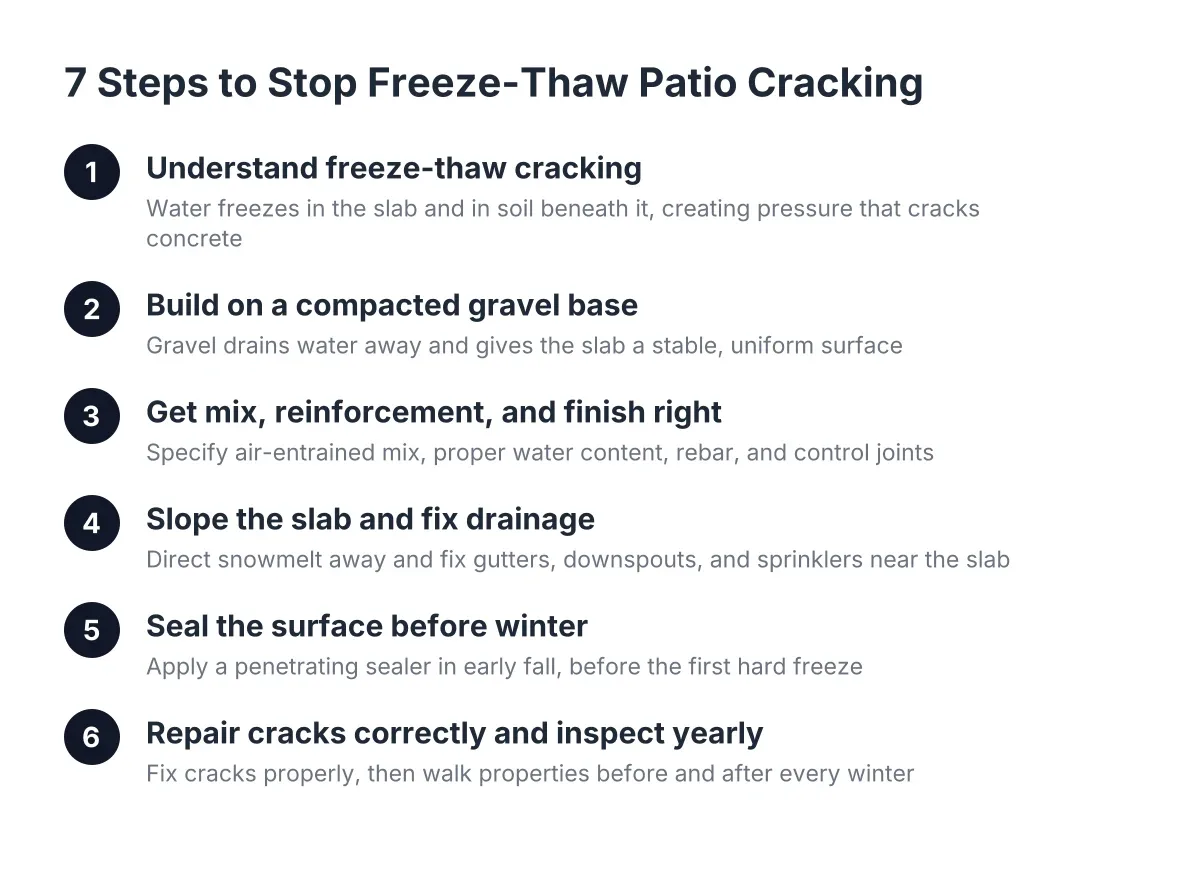
Under every good patio in a freeze-thaw climate sits a compacted gravel base. Salt Lake City winters push moisture into the ground, freeze it, and thaw it again, over and over. A properly compacted base gives the slab a stable, draining foundation so that movement does not crack the concrete above it.
This is the cheapest place for a lowball bidder to cut corners, and the most expensive place to find out later. Gravel and compaction do not show up in photos of concrete patios, so some contractors skimp here and pass the "savings" to you as a lower bid. Ask every bidder what base they install, how deep, and whether they compact it. A contractor who answers in specifics is telling you something important about how they work.
Concrete and Reinforcement
The concrete itself is a material cost tied to slab size and thickness. Ready mix concrete is a $64 billion industry across the United States, according to the National Ready Mixed Concrete Association, and your patio draws from the same local batch plants every contractor uses. The mix matters: a workable mix keeps the paste and aggregate blended without being so wet that it weakens the cured slab, and pea gravel in the mix helps the concrete consolidate into a harder surface that finishes well.
Reinforcement is where quotes start to separate. Common practice for patio slabs is a combination approach: rebar or fiberglass rebar laid in a grid, plus fiber mesh mixed into the concrete itself. Fiber mesh is inexpensive as an add-on, which is why skipping it saves the contractor little and costs you durability. If one bid includes rebar and fiber and another mentions neither, you are not comparing the same patio.
Labor
Labor is the largest single bucket on most patio jobs, and it covers more than pour day. Forming, grading, setting reinforcement, placing the concrete, screeding, floating, finishing, cutting control joints, and curing all take skilled hands on a schedule the weather controls.
Finish complexity drives labor hours directly. A broom finish is one of the simpler surfaces to execute, though a clean result still takes real skill. Stamped concrete needs more people on site at once, because the stamping window is short; the crew has to color, stamp, and detail the surface before the concrete sets. That extra crew time is a big part of why decorative concrete costs more per square foot than plain gray.
Finish and Color
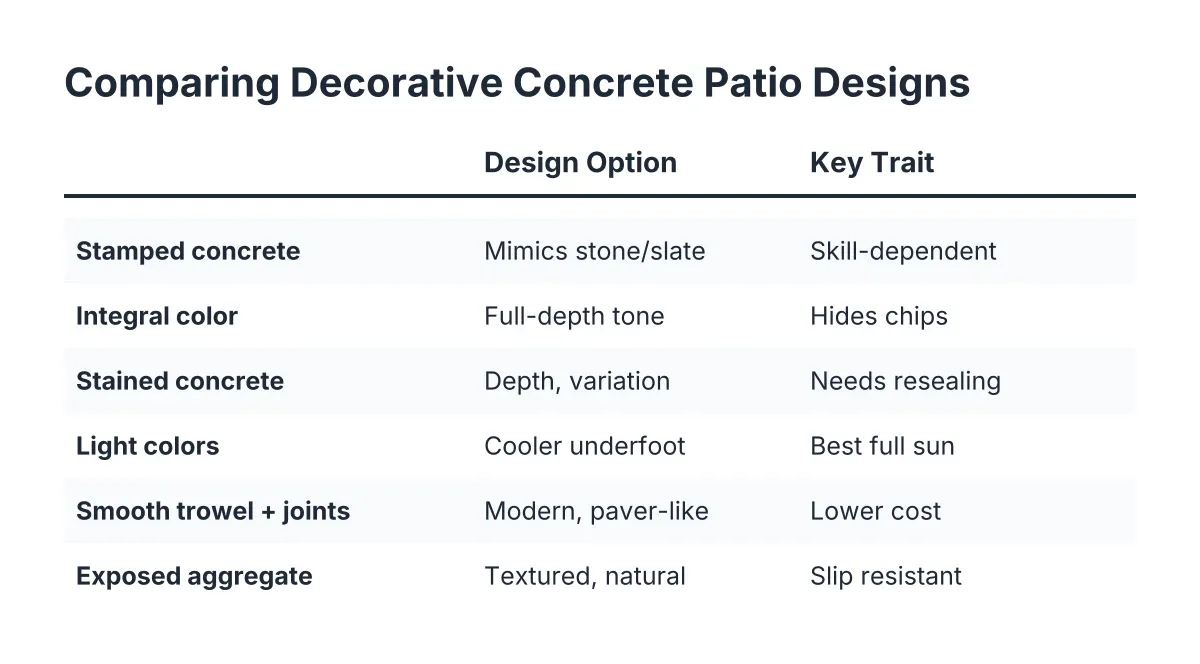
The finish is where your choices move the price most. From least to most expensive, the usual ladder looks like this:
- Broom finish: the standard textured surface, slip-resistant, and the baseline price for flatwork.
- Exposed aggregate: the top layer is washed away to reveal stone, adding labor and sealing steps.
- Stained or integrally colored concrete: color added to the surface or mixed into the batch, adding material and labor cost.
- Stamped concrete: patterned to resemble stone, slate, or brick, with the highest labor demand and usually a release agent, color, and sealer on top.
One local note on color that most pricing articles skip. Dark concrete looks sharp in photos, but it absorbs heat and gets uncomfortably hot underfoot in direct summer sun. Lighter colors reflect sunlight and stay cooler, which matters on a south-facing Salt Lake City patio in July. A good concrete contractor will raise this before you pick a color, not after the pour.
How Design and Layout Change the Price
Size is the obvious cost driver, but shape and layout matter almost as much. When homeowners browse concrete patio designs layouts online, they tend to fall for curves, multi-level slabs, and borders in contrasting finishes. All of those are buildable, and all of them add forming and finishing labor.
Straight lines are cheap to form. Curves require flexible forms, more stakes, and more layout time. A two-tone patio with a stamped border around a broom-finished center means two finishing processes on one slab, coordinated in the same pour window. None of this is a reason to avoid the design you want; it is a reason the quote for that design costs more than the plain rectangle your neighbor poured.
Slope is a design element too, even though it is invisible. A patio against your house gets pitched away from the foundation, commonly about an inch and a half across the slab's width, so snowmelt and rain drain into the yard instead of your basement. In a valley with heavy spring snowmelt, that detail protects your foundation for the life of the slab. If a bidder never mentions drainage, that silence should concern you more than their price.
A quick word on the DIY route. You may have seen the concrete bag patio idea, where homeowners stack or mix bagged concrete themselves. For a stepping path or a small pad, bagged mix can work. For a full patio, the math and the logistics turn against you fast: a slab of any real size needs more bags than most people expect, consistent mixing, a compacted base, reinforcement, and a finished surface completed before the concrete sets. Mixed-by-hand slabs often cure inconsistently, and in freeze-thaw country, inconsistency becomes cracking.
A Sample Concrete Patio Cost Breakdown You Can Picture
Numbers mean more inside a scenario, so here is a hypothetical one. Say a homeowner in Sugar House wants a 300 square foot backyard patio off the kitchen door. The yard is flat, access is through a standard gate, and they are deciding between a broom finish and a stamped finish.
In that scenario, the cost of the broom-finish version breaks down roughly like this, as an illustration of proportions rather than a quote:
- Site prep and excavation: removing sod, grading, and hauling spoils; a modest share of the total on an easy-access lot.
- Compacted gravel base: a small line on paper, and the one that matters most once winter arrives.
- Concrete, rebar, and fiber mesh: the material core of the job, scaled to square footage and thickness.
- Labor: forming, pouring, finishing, and joint cutting; usually the largest bucket.
- Sealing and cleanup: the final line most homeowners forget to budget.
Now suppose the same homeowner chooses stamped concrete in a stone pattern with integral color. The site prep, base, and concrete volume barely change. The labor and finishing lines grow substantially, because stamping takes a bigger crew, color and release agents, detailing, and sealer. Additionally, the patio did not get bigger; the craftsmanship did. That is the single most useful insight in any cost breakdown for a concrete patio: square footage sets the floor, and finish choices set the ceiling.
How to Tell a Fair Quote from a Lowball or an Inflated One
With the breakdown in hand, you can evaluate bids by what they include, not just the bottom number. The lowest bid is sometimes the best one; more often, it is missing a bucket.
Run every quote through these questions:
- Does it specify slab thickness, base depth, and compaction?
- Does it name the reinforcement: rebar, fiberglass rebar, fiber mesh, or a combination?
- Does it state the finish, the color method if any, and whether sealing is included?
- Does it address drainage and the slope away from your house?
- Does it cover demolition and haul-off if an old slab exists?
- Does it explain how site access affects the plan?
A bid that answers all six, even if it is not the cheapest, came from someone who has thought through your actual yard. A bid that is one number on a text message came from someone hoping you will not ask.
Inflated bids exist too, and they are harder to spot because the paperwork can look thorough. Your best defense is three comparable quotes on the same scope. If two land close together and one sits far above, ask the outlier to explain the gap line by line. Sometimes there is a legitimate reason, like a soil condition the others missed. Sometimes there is not.
How many quotes is enough? Three comparable bids give you a real market picture for your yard. Two leaves you guessing which one is the outlier, and five usually just delays the decision without changing it.
When Repair Beats Replacement
Not every tired patio needs a new pour, and an honest contractor will tell you so. Patching and resurfacing damaged sections costs far less than demolishing and replacing an entire slab. If your patio has surface spalling or a few cracks but the base underneath is still sound, crack repair and resurfacing can buy years of use at a fraction of replacement cost.
The judgment call is whether the base has failed. A slab that has heaved, settled unevenly, or cracked in a spreading pattern usually signals movement below, and resurfacing over a failing base wastes money. This is a case where you should have a professional look at the slab in person before deciding; no article, including this one, can diagnose your patio from a description. Freeze-thaw damage along the Wasatch Front often looks superficial at the surface while the real problem sits in the ground.
Walking Into Your Quote Calls Prepared
Concrete patios reward homework more than almost any home project, because so much of the cost hides below the surface where you will never see it. You now know the five buckets: site prep, base, concrete and reinforcement, labor, and finish. You know why access, drainage, and color choice move the price, and why the gravel base is the worst place to save money in a Salt Lake City winter.
Before you call anyone, do three things. First, measure your space and sketch the shape you want, because square footage anchors everything. Next, collect photos of concrete patios with finishes you like, so every bidder prices the same look instead of guessing. Finally, bring the six-question checklist above and ask every contractor the same questions in the same order.
Do that, and the quotes stop being mystery numbers. They become answers you can compare, from contractors you can evaluate, for a patio you will actually understand before the first truck arrives.
If you need concrete patios, Salt Lake Valley Concrete can help.
Prefer to talk it through? Call (385) 433-4634 — a quick call is usually the fastest way to get a straight answer for your situation.