20×20 Stamped Patio Cost Breakdown: Labor, Materials, and Finishes
If you are pricing a backyard upgrade in Salt Lake City, the 20×20 stamped patio cost question comes up fast. A 20×20 patio is 400 square feet, which is a popular size for entertaining, and it is large enough that every pricing decision gets multiplied by 400. This guide breaks the cost into its real parts: labor, materials, and the finish choices that move the number up or down. No invented totals, just the factors a concrete contractor actually prices when they walk your yard.
By the end, you should be able to read a bid line by line, compare two bids that look different on paper, and know which upgrades are worth paying for in a Wasatch Front climate.
How Much Does a 20×20 Stamped Concrete Patio Cost?
A 20×20 stamped concrete patio costs more than a plain gray slab of the same size because stamping adds color, texture, skilled labor, and sealer on top of a standard pour. Nationally, Lawn Love reports a professionally installed concrete patio averages $2,925, and Concrete Network puts a typical patio around $11 per square foot; a stamped finish sits above those plain-concrete baselines.
Those national figures are useful as a floor, not a quote. A 400 square foot stamped patio involves everything a plain patio does, plus integral or broadcast color, release agent, stamping labor, detail work, and sealing. Each of those shows up as a real line on the invoice.
Here is the honest answer for Salt Lake City: the number depends on your site, your finish choices, and current material prices, so any fixed figure you read online is already out of date or from a different market. What stays constant is the list of cost drivers, and that is what the rest of this article walks through.
What Goes Into the 20×20 Stamped Patio Cost
Every stamped patio bid, whether for a backyard in Sugar House or a common-area courtyard an HOA board is budgeting from its reserve study, breaks down into the same buckets. Knowing the buckets lets you compare bids fairly instead of comparing bottom-line numbers that hide different scopes.
- Demolition and removal. If an old patio or lawn is there now, someone has to break it out and haul it away.
- Excavation and base. Digging to depth, then placing and compacting a gravel base.
- Forms and reinforcement. Form boards, rebar or fiberglass rebar, and often fiber mesh in the mix.
- Concrete. The ready-mix itself, priced by the cubic yard, plus delivery.
- Color. Integral color mixed into the truck, or color hardener broadcast on the surface, plus a release agent in a second tone.
- Stamping labor. The skilled crew time that separates stamped concrete from plain flatwork.
- Cutting and sealing. Control joints and a protective sealer coat.
- Site access. How close the truck and crew can get to the pour.
Two bids for the same 20×20 patio can differ by thousands simply because one includes demolition, thicker base, or a two-tone color system and the other does not. Always ask what each line covers.
Concrete Volume: What 400 Square Feet Actually Takes
A 20×20 slab at a standard 4-inch thickness needs about 5 cubic yards of concrete, and crews order a margin above that to avoid coming up short mid-pour. Concrete is sold by the yard, so thickness is a direct cost lever. Thicken the slab to 5 or 6 inches for heavier loads, and the material cost climbs with it.
For a patio that only carries foot traffic and furniture, 4 inches over a compacted base is the common spec. An HOA manager pricing a shared courtyard that might see maintenance carts or small equipment should ask whether a thicker slab or added reinforcement makes sense for that use.
Labor: Why Stamping Costs More Than a Broom Finish
A broom finish is one of the simpler surface finishes to execute, though even that takes skill to do well. Stamping is a different job entirely. The crew has a narrow window while the concrete is at the right firmness to place stamps, tamp them, pull them, and keep the pattern aligned across 400 square feet. Mistimed stamping shows forever.
As a result, stamped work needs a larger, more experienced crew than a plain pour of the same size. Skilled finishers are also harder to find; according to the Associated General Contractors of America, 88% of construction firms with open craft positions say those jobs are as hard or harder to fill than a year ago. Scarce skilled labor is one reason decorative work carries a premium in 2026, in Salt Lake City and everywhere else.
Base and Reinforcement: The Part You Never See
In a freeze-thaw climate like the Wasatch Front, a compacted gravel base under the slab is essential to limit movement and cracking. The valley's clay-and-gravel soils vary lot to lot, and clay holds water. Water under a slab that freezes and thaws all winter will move the concrete above it. The base is the cheapest insurance you can buy, and it is also the easiest line for a low bidder to shortchange.
Reinforcement matters too. Patio slabs commonly get rebar or fiberglass rebar plus fiber mesh in the mix, since fiber is an inexpensive extra layer of crack resistance. Rebar matters more for slabs carrying heavy loads; a small, lightly used patio can sometimes get by with less. Ask each bidder exactly what reinforcement is included, because "concrete patio" on two bids can mean different things underground.
A good crew also slopes the slab away from the house, commonly about an inch and a half across its width, so snowmelt drains away from your foundation instead of pooling against it. That grading work is part of the labor you are paying for.
How Finish Choices Change a 20×20 Stamped Patio's Cost
Finish decisions are where you control the budget most directly. The structure under a stamped patio and a plain one is the same; the surface is where the money moves.
Pattern and Texture
Simple, repeating patterns like a basic stone or wood-plank texture stamp faster than intricate layouts. Ashlar slate and random stone patterns are popular in Salt Lake City yards because they hide minor wear well. Complex patterns with borders, multiple stamp sets, or hand-detailed grout lines add crew hours, and crew hours are the expensive part of stamped work.
A border in a contrasting pattern or color looks custom, and it costs more because it is effectively two finish jobs on one slab. If budget is tight, a single pattern edge to edge delivers most of the look for less.
Color: One Tone or Two
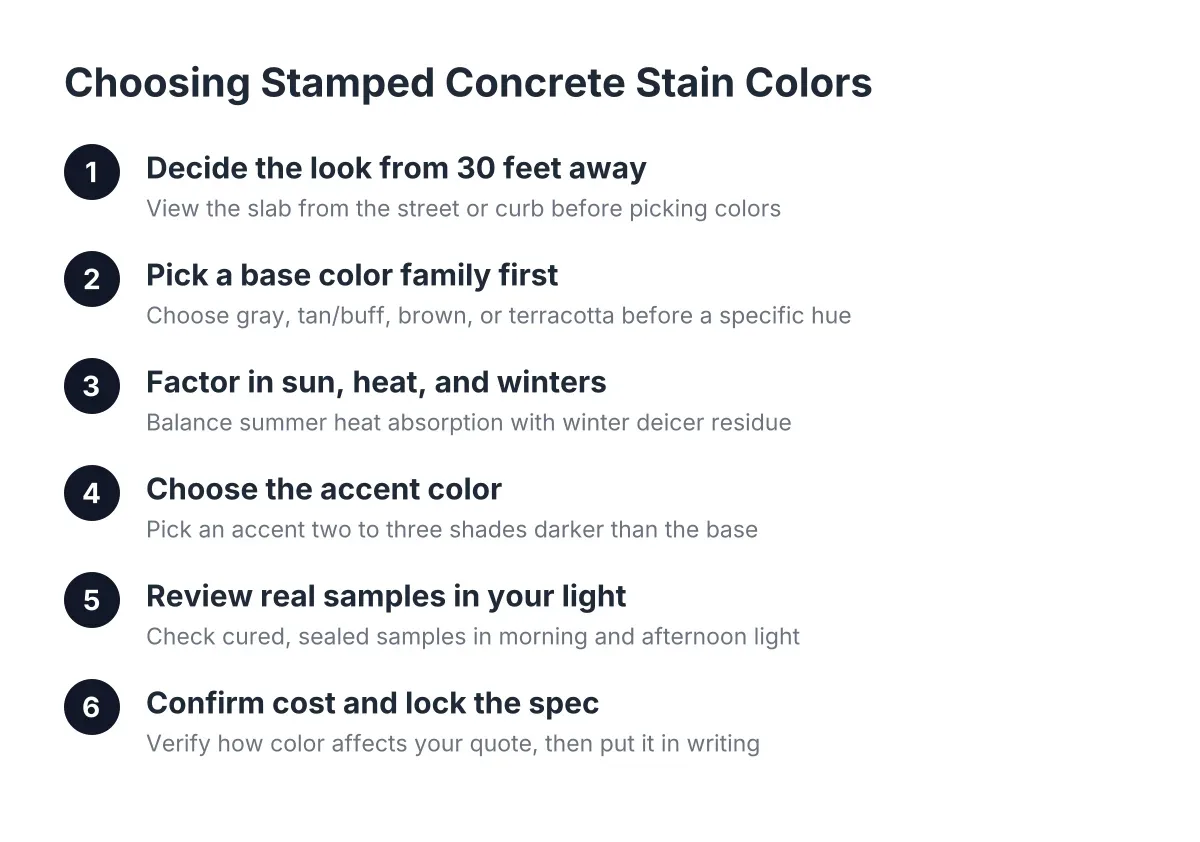
Color systems range from a single integral color mixed into the truck to layered systems with a base color, an antiquing release in a second tone, and sometimes accent stains. Each layer adds material and labor. A two-tone system is what makes stamped concrete read as natural stone instead of tinted concrete, so many homeowners find the upgrade worth it.
One practical note for sunny Utah patios: dark colors absorb heat and get uncomfortably hot underfoot in July, while lighter tones reflect sun and stay cooler. Plenty of homeowners pick a deep charcoal from a sample card and regret it in August. If the patio faces south or west, lean lighter.
Stamped, Stained, or Exposed Aggregate
Stamping is not the only decorative route. A stained concrete patio skips the stamping labor and applies color to a smooth or broom-finished slab, usually at a lower cost than a full stamp job. Exposed aggregate shows the stone in the mix for texture and traction, and it holds up well in freeze-thaw conditions. Both are worth pricing alongside a stamped bid if the goal is simply something better than plain gray.
For an HOA replacing a shared patio or pool deck, exposed aggregate or a textured stamp with added grit in the sealer also improves traction when wet, which matters for liability on common areas.
Sealing, Joints, and the Costs That Come Later
Stamped concrete needs a sealer to protect the color and surface, and that sealer wears. Plan to reseal every few years, more often on surfaces that see snow shoveling and foot traffic all winter. Resealing is not expensive compared to the original pour, but it is a recurring cost that plain broom-finished concrete mostly avoids.
Control joints are cut or tooled into the slab so that when concrete cracks, and all concrete eventually cracks, it cracks along planned lines. On stamped work, crews often hide joints inside the pattern lines. That takes planning and adds labor, and it is another spot where an experienced decorative crew earns its rate over a flatwork-only crew.
One honest trade-off: if a stamped surface is badly damaged years later, matching the pattern and color in a repair is harder than patching plain gray. Patching and resurfacing a damaged section is far cheaper than tearing out a whole slab, but on stamped work the repair may stay visible. Weigh that against the look you want.
A Hypothetical Bid: Two Quotes for the Same Salt Lake City Backyard
Suppose a homeowner in Millcreek collects two bids for a 20×20 stamped patio and one comes in 30 percent under the other. On paper the cheap bid wins. Read line by line, the picture changes. Say the lower bid assumes the yard is already graded, includes no demolition of the cracked old patio, specs fiber mesh only with no rebar, lists a single integral color with no release tone, and says nothing about base depth or sealer.
In that scenario, the higher bid includes breakout and haul-off of the old slab, a compacted gravel base, rebar plus fiber, a two-tone color system, an ashlar slate pattern, saw-cut joints hidden in the pattern, and a sealer coat. The two contractors are not pricing the same patio. The homeowner who signs the cheap bid often pays the difference later, in change orders or in a slab that heaves after its second Wasatch Front winter.
The lesson applies to HOA boards gathering competitive bids too. Before the board compares numbers, make every bidder price the same written scope: demolition, base, reinforcement, thickness, color system, pattern, and sealing. Otherwise the comparison is noise.
Can You Cut the 20×20 Stamped Patio Cost by Doing It Yourself?
You can rent stamps, but pouring and stamping 400 square feet yourself is a high-risk way to save money. Concrete stamps for rent are available at tool rental outlets, and the mix itself is a small share of the total. The problem is the timing. A 5-yard pour gives one short window to place, screed, float, color, and stamp, and there is no second chance if the surface sets before the pattern is done.
For example, a mix that is too wet spreads easier but weakens the slab; a good mix keeps the paste and aggregate blended without separating, and judging that in the moment is experience, not something a video teaches. Add Utah's freeze-thaw demands on base prep and curing, and a failed DIY stamp job costs more to tear out and redo than hiring a decorative concrete crew the first time.
If you want sweat equity, do the parts that are forgiving: demolition of the old patio, hauling, or landscaping around the new slab. Leave the pour and the stamping to a crew that does it weekly. For anything structural, near a foundation, or on a sloped or poorly draining lot, talk to a professional before committing to a plan; some sites need drainage or engineering input that no cost guide can cover.
Is Stamped Concrete Still Cheaper Than Pavers?
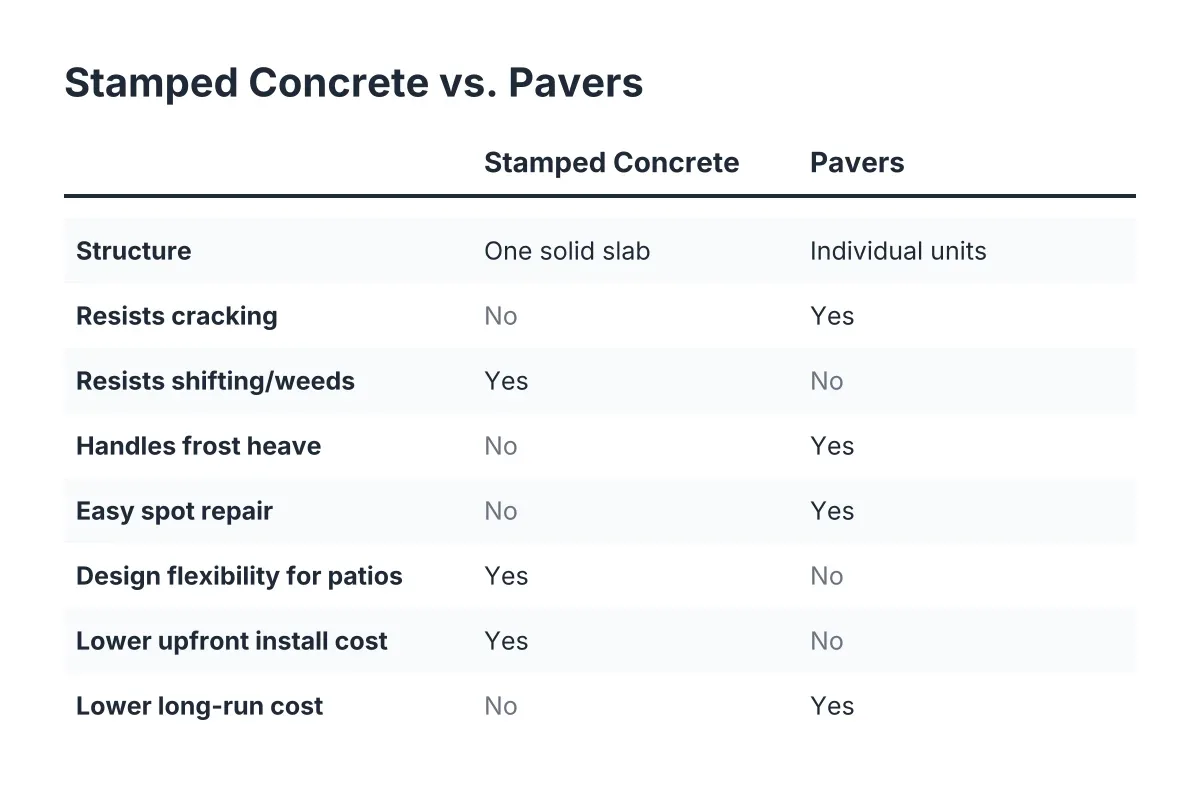
Stamped concrete usually installs for less than natural stone and competes closely with quality pavers, while plain concrete remains the cheapest hard surface of the three. The right comparison depends on what you count. Stamped concrete pours as one slab, so there are no individual units to shift or sprout weeds between joints. Pavers cost more in labor to set but allow spot replacement of a damaged unit.
For a Salt Lake City homeowner chasing curb appeal, stamped concrete delivers a stone or slate look at a lower cost than the real material, with the trade-offs covered above: periodic resealing and harder invisible repairs. For a property manager, a single sealed slab is often easier to maintain across a multi-unit site than hundreds of paver joints, though trip-hazard repairs on pavers are simpler. Neither option wins outright; the maintenance model should match who will care for the surface.
Questions to Ask Before You Sign a Bid
Use these to pin down the real 20×20 stamped patio cost in each proposal, not just the headline number:
- Does the bid include demolition and haul-off of the existing surface?
- What base material and compaction are specified, and how deep?
- What reinforcement is included: rebar, fiberglass rebar, fiber mesh, or a combination?
- What slab thickness is quoted, and is it enough for how the patio will be used?
- Is the color integral, broadcast hardener, or both, and is an antiquing release included?
- Which stamp pattern, and does the price change with a border or a second pattern?
- How will control joints be placed and hidden in the pattern?
- Is sealing included, and what resealing schedule does the contractor recommend for this climate?
- How will the slab be sloped to drain away from the house or building?
- Can you see local stamped projects that have been through at least a couple of winters?
That last question matters most for the Curb Appeal Upgrader worried about fake-looking patterns or fading color. A photo of fresh work tells you little. A stamped patio that still looks sharp after two or three Salt Lake City freeze-thaw seasons tells you the crew got the base, the mix, the stamping, and the sealer right.
The Bottom Line for Salt Lake City Buyers
The cost of a 20×20 stamped patio is a stack of specific decisions: how much site work the yard needs, how thick the slab is, what goes underneath it, and how far you take the color and pattern. National averages, like Lawn Love's $2,925 for a typical installed patio, set a floor well below what a 400 square foot stamped project runs, because stamped work adds skilled labor and finish materials on top of a plain pour.
Get bids that itemize those decisions, hold every bidder to the same written scope, and spend first on the parts you cannot see: base, reinforcement, and drainage. In this climate, the slab that survives the winters is the one that was priced honestly underground, not the one with the prettiest pattern on top.
If you need stamped and decorative concrete, Salt Lake Valley Concrete can help.
Prefer to talk it through? Call (385) 433-4634 — a quick call is usually the fastest way to get a straight answer for your situation.