Stamped Concrete Driveway: Realistic ROI for Salt Lake Homes in 2026
You have already decided on an upgrade, and now the question is how to make a stamped concrete driveway realistic in two ways: realistic in looks, so it reads as stone instead of a repeating rubber-mat pattern, and realistic in return, so the money you spend shows up in curb appeal and value. Understanding the stamped driveway ROI helps you make informed decisions. This matters in Salt Lake City, where freeze-thaw winters, road salt, and clay-and-gravel soils punish shortcuts. Here are eight practical moves that help homeowners and small rental property owners get the most from the project they have already committed to.
1. Set a Realistic Baseline Before You Count the Return
A concrete driveway is not a cheap surface to begin with, so the decorative upgrade sits on top of a real base cost. According to HomeAdvisor, a standard concrete driveway averages close to $6,400, while even a high-end gravel driveway tops out around $3,500. Stamping, color, and sealing add to that baseline because they add labor steps, materials, and skilled crew time.
Think of the return in three parts: curb appeal now, durability over the years, and what you avoid spending on a replacement later. For a rental owner, there is a fourth part: a clean, finished entry and driveway photograph well in listings and set the tone for how tenants treat the property. The return is strongest when the slab under the pattern is built right, which is why the next several items focus on the pour as much as the pattern.
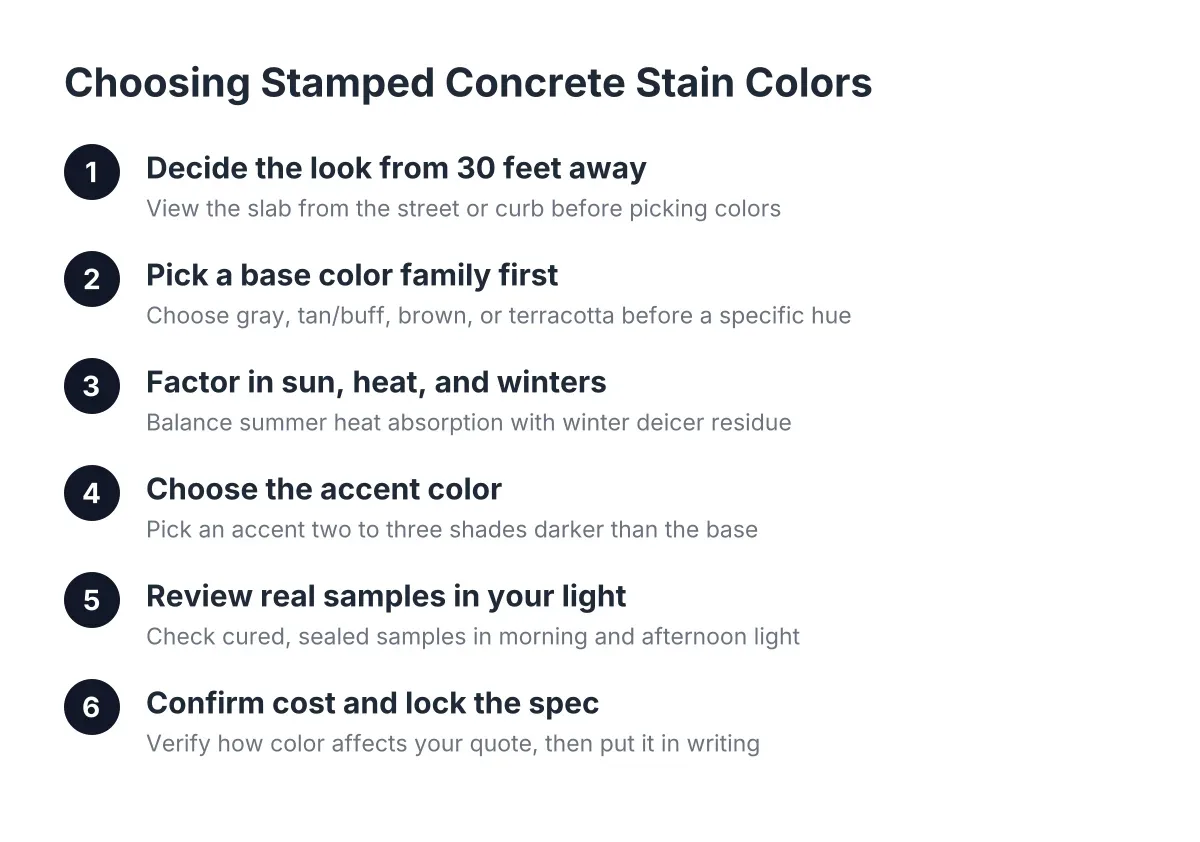
2. Pick a Pattern and Color That Match the House, Not the Catalog
The fastest way to make stamped concrete look fake is to pick a pattern that fights the home's style. A random stone or flagstone pattern suits most Salt Lake bungalows and ramblers. Ashlar slate works well on newer homes with cleaner lines. Herringbone brick can look sharp on a traditional brick house but out of place on a modern one.
Color is where realism is won or lost. Real stone is never one flat color, so a realistic stamped driveway uses a base color plus a secondary release color that settles into the texture. Ask your concrete contractor to show you the two colors together on a sample, not just chips in a binder. In addition, keep this in mind for sunny south-facing driveways: dark colors absorb heat and get hot underfoot in summer, so many contractors steer homeowners toward lighter and mid-tone bases for driveways, patios, and pool decks.
3. Insist on a Slab Built for Wasatch Front Conditions
The pattern is the last two percent of the job. The ninety-eight percent underneath decides whether your investment survives Salt Lake winters. Clay-and-gravel soils along the Wasatch Front can shift with moisture, and hard freeze-thaw cycles stress any slab that was poured over a weak base.
Before the pour, confirm these basics with your contractor:
- Excavation down to stable material, with soft clay pockets removed rather than paved over
- A compacted gravel base, not concrete poured on raw dirt
- Reinforcement sized for vehicle loads, since a driveway carries far more weight than a patio
- Air-entrained concrete mix appropriate for freeze-thaw climates
- Control joints planned into the stamp layout, so cracking happens where it is hidden
- Slope that moves snowmelt off the slab instead of letting it pool and refreeze
None of these items are decorative, and all of them protect the decorative work on top. A beautiful pattern on a bad base is money spent twice.
4. Plan Drainage So Snowmelt Works for You, Not Against You
Water is the enemy of every driveway in this valley. Snowmelt that pools on the surface soaks in, freezes overnight, and pries at the surface and the sealer. Over a few winters, that cycle dulls color and flakes the top layer, which is exactly the damage that makes decorative concrete owners regret the spend.
Therefore, walk the site with your contractor before the pour and ask where water goes in March. The slab should slope away from the garage and foundation. Edges matter too: keeping grass trimmed back along the driveway edge gives water a channel to escape instead of sitting on the concrete. A small change in slope during installation costs little; fixing drainage after the pour costs plenty.
5. Schedule the Pour Around Salt Lake's Weather Window
Stamped work is more time-sensitive than plain flatwork. The crew has a limited window to place, color, and stamp the concrete before it stiffens, and hot, dry, or freezing weather shrinks that window. A rushed stamp means shallow texture, missed release color, and a pattern that looks pressed-on rather than built-in.
For Salt Lake City, that usually means pouring in the warmer months and avoiding days with hard overnight freezes. If your timeline is tight, say a rental turnover in late fall, talk honestly with your contractor about whether the weather supports a quality stamp or whether the job should wait until spring. Waiting a season is cheaper than living with a mediocre pattern for twenty years.
6. Maximizing Your Stamped Driveway ROI Through Realistic Design
A stamped concrete driveway looks realistic when three things line up: a two-tone color system, deep and varied texture, and a layout with borders and joints placed where real stone would have them. Flat single-color slabs with shallow texture are what give stamped work a bad name. The difference is craft, not the stamp mats themselves.
Here is what to ask for, and what to look at in your contractor's past driveway work:
- Two-color depth: a base color with a contrasting release agent that shades the low spots, the way natural stone varies.
- Full-depth stamping: crisp grout lines and texture you can feel, achieved by stamping at the right moment in the set.
- Randomized mat rotation: the crew rotates and offsets mats so the pattern never visibly repeats down the length of the driveway.
- A border detail: a smooth or contrasting band along the edges frames the field pattern and hides where mats meet the forms.
- Hand detailing: touch-up rollers and skins on spots the big mats miss, especially along the garage apron and sidewalk transitions.
For example, suppose a homeowner in Sugar House replaces a cracked gray driveway with an ashlar slate pattern, a gray-buff base, and a charcoal release, framed by a smooth four-inch border. From the street, that reads as cut stone. The same square footage with one flat tan color and a repeating mat seam reads as imitation from the curb. Same cost class, different outcome.
7. Protect the Investment With Sealer and Smart Winter Habits
Sealer is what holds the color and sheds the salt. Plan on resealing on a recurring schedule, with the exact interval depending on sun exposure, traffic, and how much deicer the driveway sees. Skipping sealer to save money is the single most common way owners erase their own stamped driveway ROI; faded, salt-etched stamped concrete loses the realism you paid for.
Winter habits matter just as much:
- Use a plastic-edged shovel or a snow blower with skid shoes, not a steel blade scraped across the texture
- Go easy on deicing salt, especially in the slab's first winter, and favor plain sand for traction where you can
- Rinse salt residue off in spring before it sits through warm weather
- Reseal before the surface looks worn, not after
For a small rental portfolio, put resealing on the same calendar as other recurring maintenance. One scheduled visit across two or three properties is easier to budget than emergency resurfacing at one of them.
8. Run the Realistic ROI Math for Your Specific Property
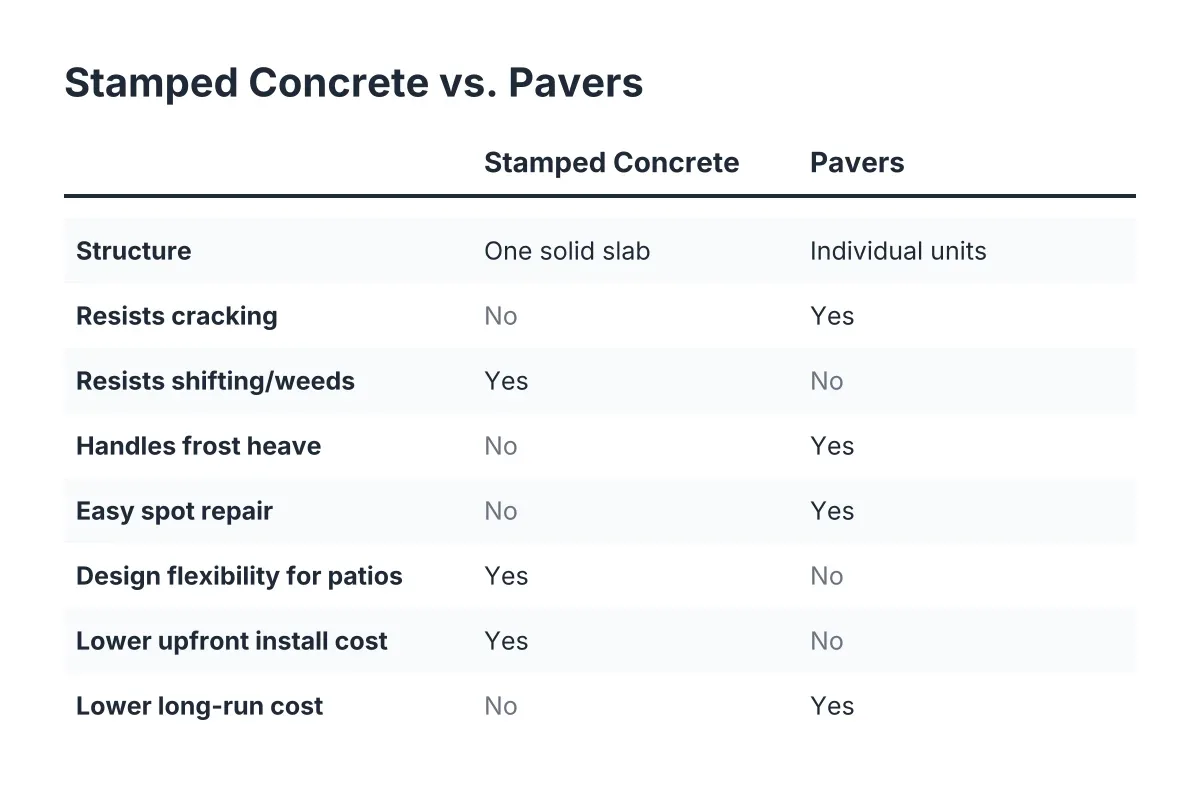
The honest answer on return is that it depends on what you are comparing against. Stamped concrete costs more than plain gray flatwork because of the added color, labor, and sealing steps. However, it typically installs for less than natural stone or high-end pavers while delivering a similar look from the street, and a slab has no individual units to shift or sprout weeds between.
As an illustrative estimate, say a duplex owner in Millcreek is replacing a spider-cracked driveway anyway. Spider cracking spread across the surface usually points to full replacement rather than patching, so the base cost of removal and repour is already on the table. In that scenario, the stamped upgrade is only the increment above plain concrete, not the whole bill, and that increment buys curb appeal that shows in listing photos and rent conversations. Owners sometimes extend the look further, pairing the driveway with a stained patio or even stained concrete floors in house interiors, where concrete acid stain colors give a related warm, mottled finish.
One trade-off deserves a plain statement: sealed stamped surfaces can be slick when wet or icy, so ask about a grit additive in the sealer, especially on sloped driveways. And if your site has a steep grade, a history of slab heaving, or persistent drainage problems, bring in a professional to assess the base before anyone talks patterns.
Keeping Realistic Expectations for a Stamped Driveway Long Term
A stamped concrete driveway with realistic texture and color is not a set-and-forget surface, but it is a durable one when the slab, drainage, and sealing are handled right. Expect the color to mellow slightly over the years, plan for resealing, and accept that hairline cracks can appear even in well-built concrete; control joints hidden in the pattern are there to manage exactly that.
Measured against those expectations, the return holds up. You get a driveway that stands out on a street of plain gray slabs, survives Salt Lake freeze-thaw winters when built for them, and costs less over its life than replacing a bad slab twice. The decision is made; the eight moves above are how you make it pay.
If you need concrete driveways, Salt Lake Valley Concrete can help.
Prefer to talk it through? Call (385) 433-4634 — a quick call is usually the fastest way to get a straight answer for your situation.