Resurfacing vs. Deep Concrete Repair in Salt Lake City, UT: Which Fixes Your Damage
Your driveway is spalling, your patio has a crack that grew over the winter, and you need to know which fix actually solves it. The choice between resurfacing and deep concrete repair comes down to one question: is the damage on the surface, or does it go through the slab? Get that answer right and you pay for the correct fix once. Get it wrong and you pay twice. This guide walks homeowners and rental property owners in Salt Lake City, UT through the decision step by step, helping you choose between resurfacing vs deep repair.
Step 1: Figure Out Whether Your Damage Is Surface or Structural
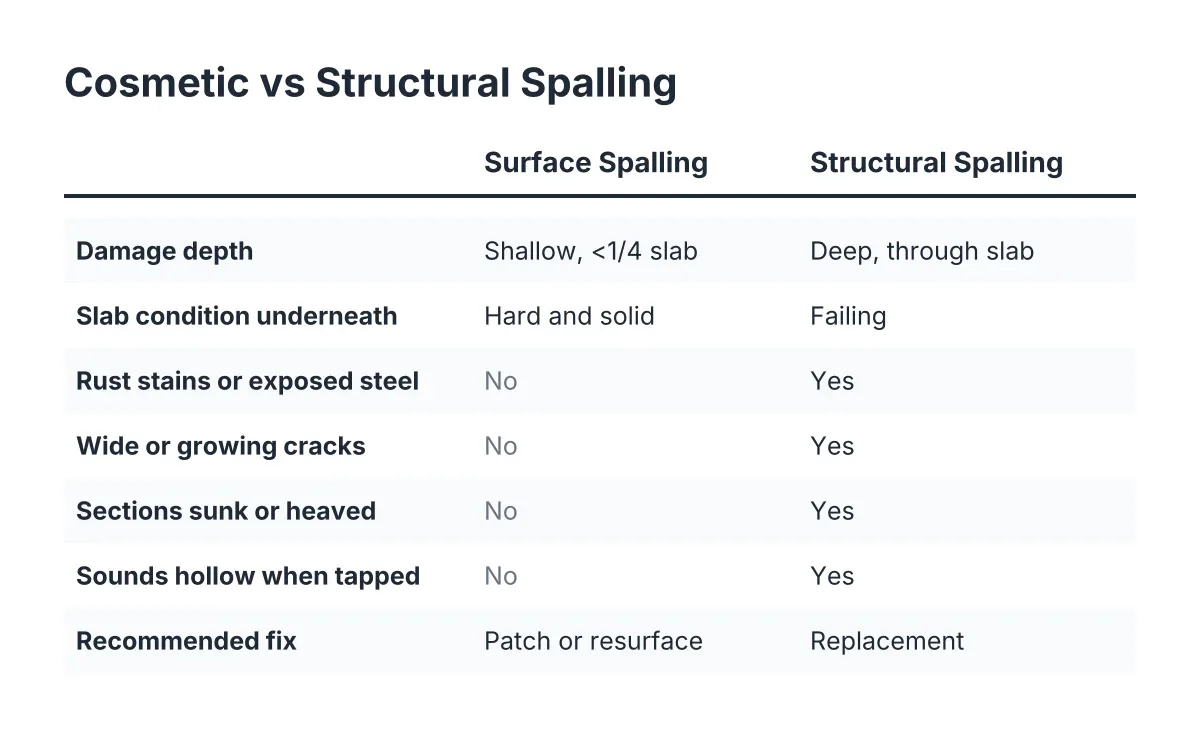
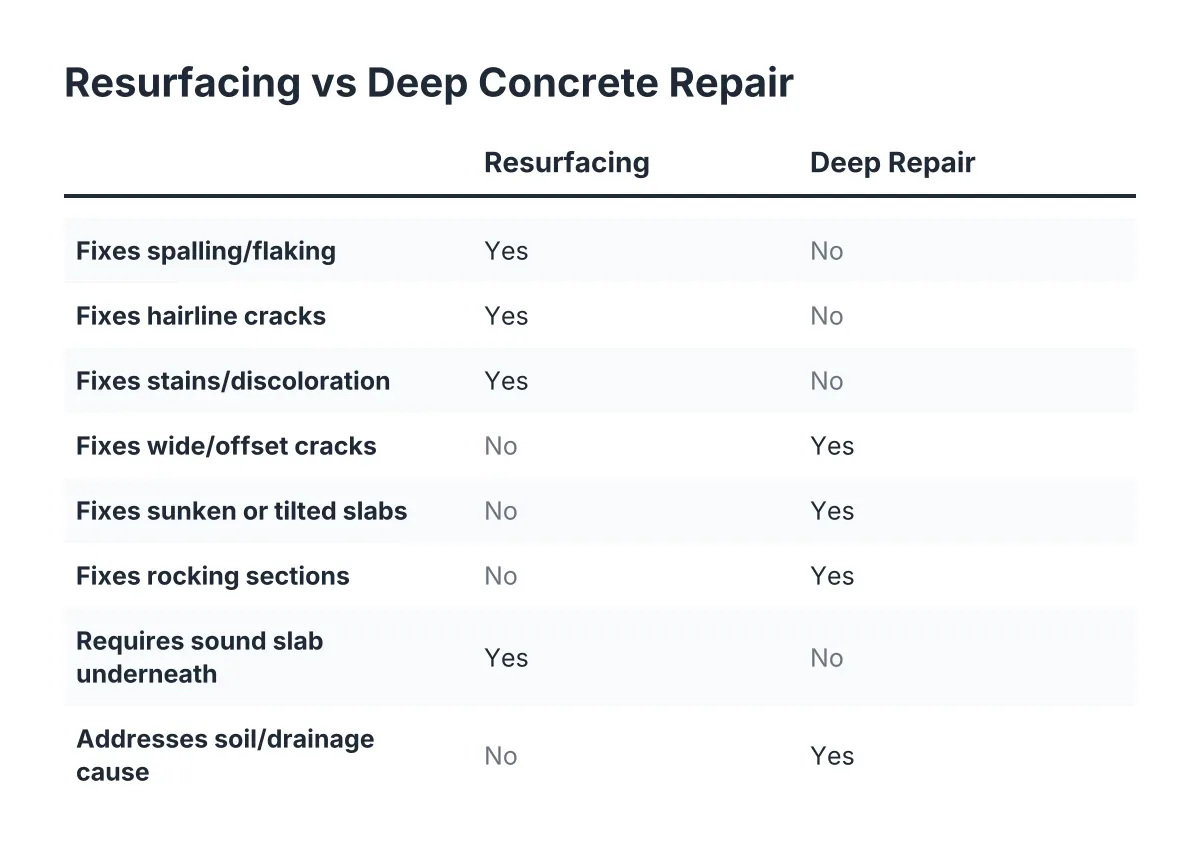
Start by reading the damage itself, because resurfacing and deep repair solve different problems. Resurfacing is a thin overlay that fixes cosmetic and shallow surface damage. Deep concrete repair fixes problems in the slab body: wide cracks, sunken sections, and crumbling edges.
Look at your concrete and sort what you see into two buckets.
Surface problems that resurfacing can fix:
- Spalling or flaking, where the top layer pops off and exposes the gravel underneath
- Hairline cracks that do not continue through the slab
- Pitting from years of deicing salt
- Stains, discoloration, or a worn, ugly finish
Deeper problems that need structural repair first:
- Cracks wider than a credit card edge, or cracks where one side sits higher than the other
- Slabs that have sunk, heaved, or tilted so water pools on them
- Sections that rock or move when a car drives over them
- Crumbling that goes more than a half inch deep
Here is the test that matters most: set a level or a straight board across the slab. If the surface is ugly but flat and solid, resurfacing is on the table. If the slab has moved, no overlay will fix that. The Wasatch Front makes this distinction common. Our clay and gravel soils shift with moisture, and hard freeze-thaw cycles each winter push water into cracks and pry them wider. A crack that grew noticeably since last fall is usually telling you the problem is below the surface.
Step 2: Match the Right Fix to Each Type of Damage
Next, map each problem to its repair method so you can judge any estimate you receive. A good concrete contractor will name the method, not just quote a number.
When Resurfacing vs Deep Repair: Choosing Surface Solutions
Resurfacing means grinding and cleaning the old slab, repairing minor flaws, and troweling on a polymer-modified overlay. The result looks like new concrete, and you can add a broom finish, color, or a stamped pattern. It works when the slab underneath is sound. For a rental property owner, this is often the right move at tenant turnover: a spalled but stable walkway gets a fresh, uniform surface without the cost of tearing anything out.
When deep concrete repair comes first
Deep repair addresses the slab body and what is under it. That includes cutting out and widening structural cracks so repair material bonds to sound concrete, lifting or replacing sunken sections, and fixing the drainage or soil problem that caused the movement. Skipping this step is the classic mistake. An overlay poured over a moving crack will mirror that crack within a season or two, because the overlay moves with the slab beneath it.
When you need both: resurfacing after deep concrete repair
Many Salt Lake City driveways need the combination. Suppose a landlord owns a fourplex where the front walkway has one sunken panel plus spalling across the rest. The right sequence is deep repair on the sunken panel first, then resurfacing across the whole walkway so everything matches. Pairing resurfacing with deep concrete repair in the right order is what makes the finished surface last instead of failing at the patch lines.
Step 3: Rule Out Full Replacement Before You Commit
Before you spend on either fix, confirm the slab is worth saving. Resurfacing and repair beat replacement on cost by a wide margin when the base slab is sound; patching a section costs far less than demolishing and repouring an entire slab. For scale, HomeAdvisor puts the average cost of a new concrete driveway around $6,400, and a typical professionally installed patio runs about $2,925 nationwide according to Lawn Love. A resurfacing job on the same footprint is a fraction of a full repour.
However, replacement wins in a few situations:
- Cracks run through most of the slab, not just one or two panels
- The slab was poured thin or without reinforcement and keeps breaking
- The base soil has failed broadly, so sections keep sinking year after year
- More than about a third of the surface needs deep repair, at which point repairs stack up toward replacement cost
If your slab falls in that last category, a full tear-out and repour is honest advice, not an upsell. This is also where a professional assessment earns its keep; widespread settling or suspected soil problems are not something to diagnose from a photo or a blog post.
Step 4: Understand What Each Job Involves So You Can Spot Quality Work
In addition to choosing the fix, you should know what the work looks like. The details below separate a repair that lasts from one that fails next winter.
For deep crack and spalling repair, expect the crew to:
- Cut or chisel out all loose, crumbling concrete so repair material bonds only to sound slab. Structural cracks get widened with a V-shaped cut; yes, the crack looks worse before it looks better, and that is correct technique.
- Clean crack edges down to bare concrete so new sealant or repair material can grip.
- Dampen the old concrete before placing patch material, so the dry slab does not pull moisture out of the fresh mix and weaken the bond.
- Keep larger, thicker patches damp while they cure, since bigger masses of fast-setting material generate more heat and will surface-crack without attention.
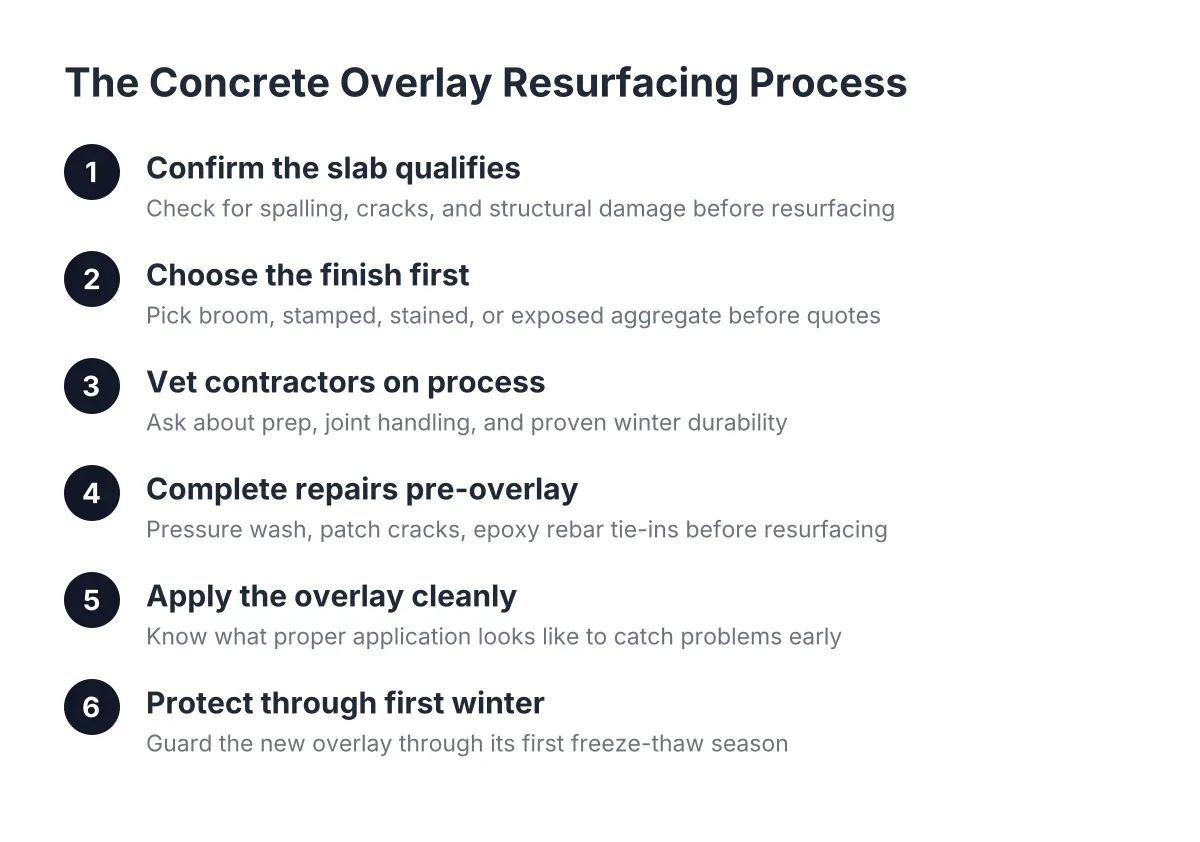
For resurfacing, expect the crew to:
- Pressure-wash or grind the entire surface and repair minor flaws first.
- Tape off every expansion joint and control joint. Overlay material must never bridge those joints; they exist so the slab can move, and covering them causes random cracking.
- Apply the overlay at the correct thickness. Polymer overlays get sticky and hard to work when applied too thick, and visible ripples in a finished surface mean exactly that.
- Manage sun and temperature. On a hot Salt Lake City afternoon, working in shade extends working time; crews that ignore this fight the material and leave trowel marks.
Ask any contractor you interview how they handle joints and crack prep. The answers tell you more than the price does.
Step 5: Get Estimates That Separate Repair From Resurfacing
Finally, get written estimates that price the deep repair and the resurfacing as separate line items. A lump-sum number hides the decision you are trying to make. When the two are split out, you can see what the structural fix costs on its own and decide whether to resurface now or at the next turnover.
What drives the price in 2026 is no mystery: square footage, how much deep repair the slab needs before any overlay, the finish you choose (plain broom finish versus colored or stamped), and site access for equipment. Decorative finishes cost more than plain gray. A back patio a wheelbarrow can barely reach costs more per foot than an open driveway.
When you compare concrete resurfacing contractors, weigh these signals alongside price:
- They inspect the slab in person and check it for flatness and movement before quoting
- They explain which damage is surface and which is structural, in plain language
- They name their prep steps: joint taping, crack cutting, cleaning, and dampening
- They are willing to say "this slab needs replacement" or "this one just needs an overlay" and explain why
- For rental owners, they will scope trip hazards and code-violation items separately, since those carry liability and usually cannot wait
One trade-off to accept going in: resurfacing renews the surface, but it does not strengthen a thin or failing slab, and even a well-done overlay has a service life shorter than new full-depth concrete. If the base slab is sound, that trade is worth it. If it is not, fix the slab first.
The short version for Salt Lake City, UT property owners: flat and solid but ugly means resurface. Moving, sunken, or cracked through means deep repair first. Both, in that order, is how a damaged driveway or patio comes back looking new and stays that way through the next freeze-thaw season.
If you need concrete repair and resurfacing, Salt Lake Valley Concrete can help.
Prefer to talk it through? Call (385) 433-4634 — a quick call is usually the fastest way to get a straight answer for your situation.