Concrete Resurfacing vs. Replacement Cost: Which Makes Sense in Salt Lake City?
Your driveway is spalling, your patio has cracks, and you need to decide what to do about it. The first question most Salt Lake City homeowners ask is the right one: what is the concrete resurfacing versus replacement cost difference, and which option actually lasts? The short answer is that resurfacing costs a fraction of replacement, but it only works when the slab underneath is still sound. This guide walks through how to tell which situation you are in, what drives the price of each option, and how the choice plays out over time along the Wasatch Front.
Resurfacing and Replacement Are Different Jobs
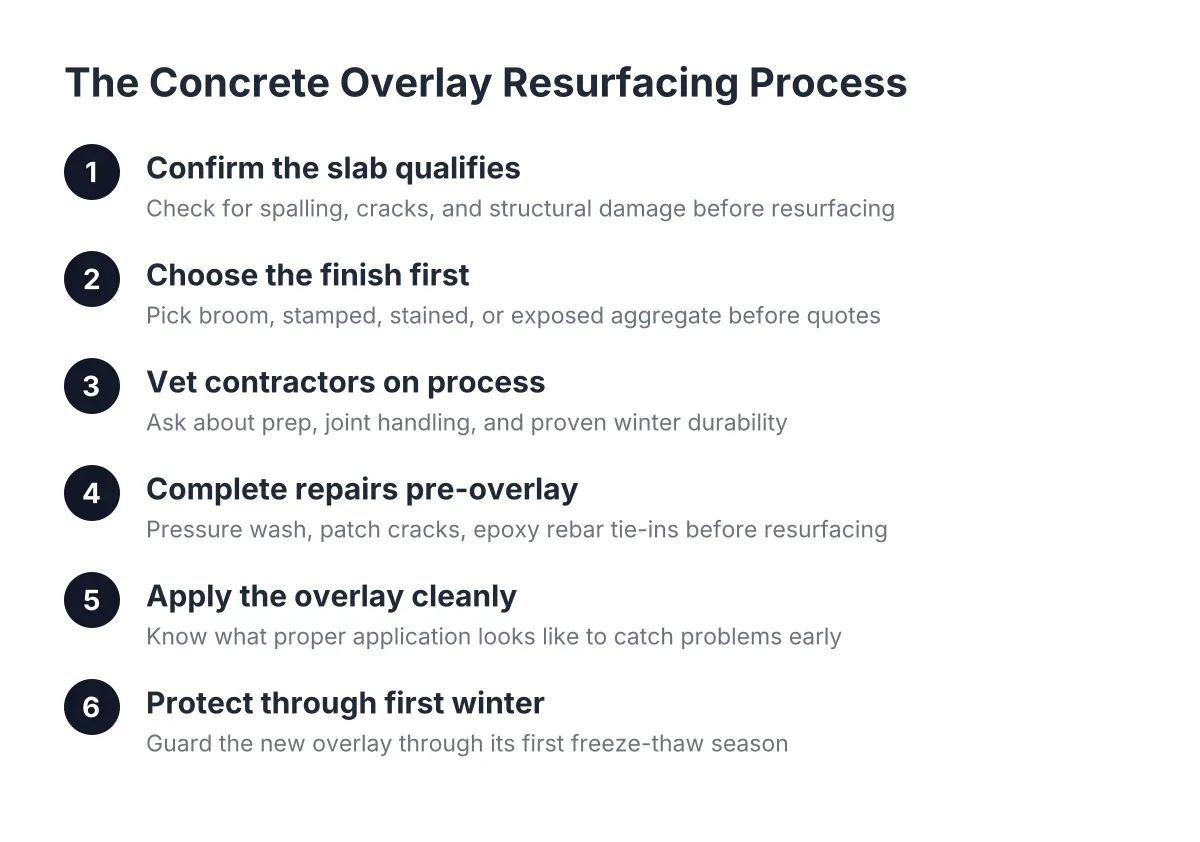
Concrete resurfacing covers an existing slab with a thin layer of polymer-modified overlay material. The crew cleans the old surface, repairs cracks and spalled spots, then applies the overlay and finishes it. You keep the original slab; you get a new wearing surface on top. Done right, it hides surface damage, restores traction, and can even add decorative texture or color.
Replacement is the full job: break out the old concrete, haul it away, regrade and compact the base, set forms and reinforcement, and pour a new slab. It costs more because it includes demolition, disposal, excavation, gravel base work, and a full pour. It also resets the clock. A new slab on a properly compacted base is a decades-long surface, not a repair.
The distinction matters because the two options solve different problems. Resurfacing fixes the surface. Replacement fixes the slab. If your problem lives below the surface, no overlay will solve it, no matter how well it is applied.
Why Concrete Resurfacing Costs Less Than Replacement
Concrete resurfacing costs less than replacement because it skips the most expensive parts of concrete work: demolition, hauling, excavation, base preparation, and the volume of new concrete. An overlay uses a thin layer of material over an existing slab, so you pay mostly for surface prep and skilled application rather than a full rebuild.
Think about where the money goes on a replacement project. A crew has to saw-cut and break out the old slab, load tons of broken concrete, and pay disposal fees. Then they regrade the subgrade, bring in and compact gravel base, set forms, place reinforcement, and schedule a ready mix concrete delivery. Every one of those steps carries labor, equipment, and material costs that resurfacing avoids entirely.
Resurfacing concentrates its cost in two places: surface preparation and application labor. The old slab has to be cleaned, often pressure washed or ground, and cracks have to be repaired before any overlay goes down. The overlay material itself is modest in cost for a typical driveway or patio. That is why resurfacing quotes commonly land at a fraction of replacement quotes for the same square footage.
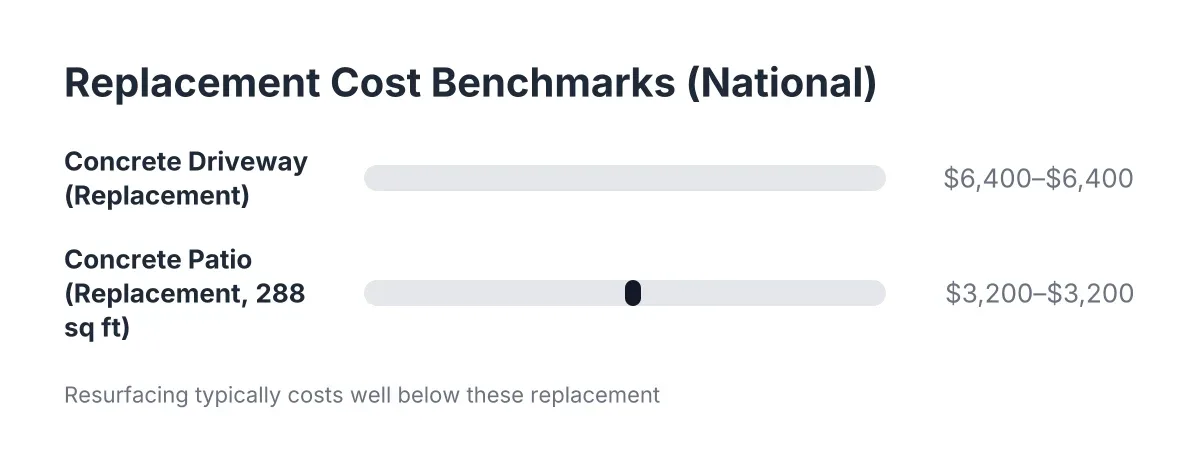
For context on what full installation runs, a concrete driveway averages about $6,400 nationwide, according to HomeAdvisor. On the patio side, Concrete Network reports a typical 288 square foot concrete patio averages $3,200, which works out to about $11 per square foot installed. Resurfacing an existing slab of the same size typically comes in well below those numbers, because you are not paying for excavation, base, forms, or a full-depth pour. Exact pricing depends on your slab, which is why any honest contractor measures before quoting.
When Resurfacing Is the Right Call
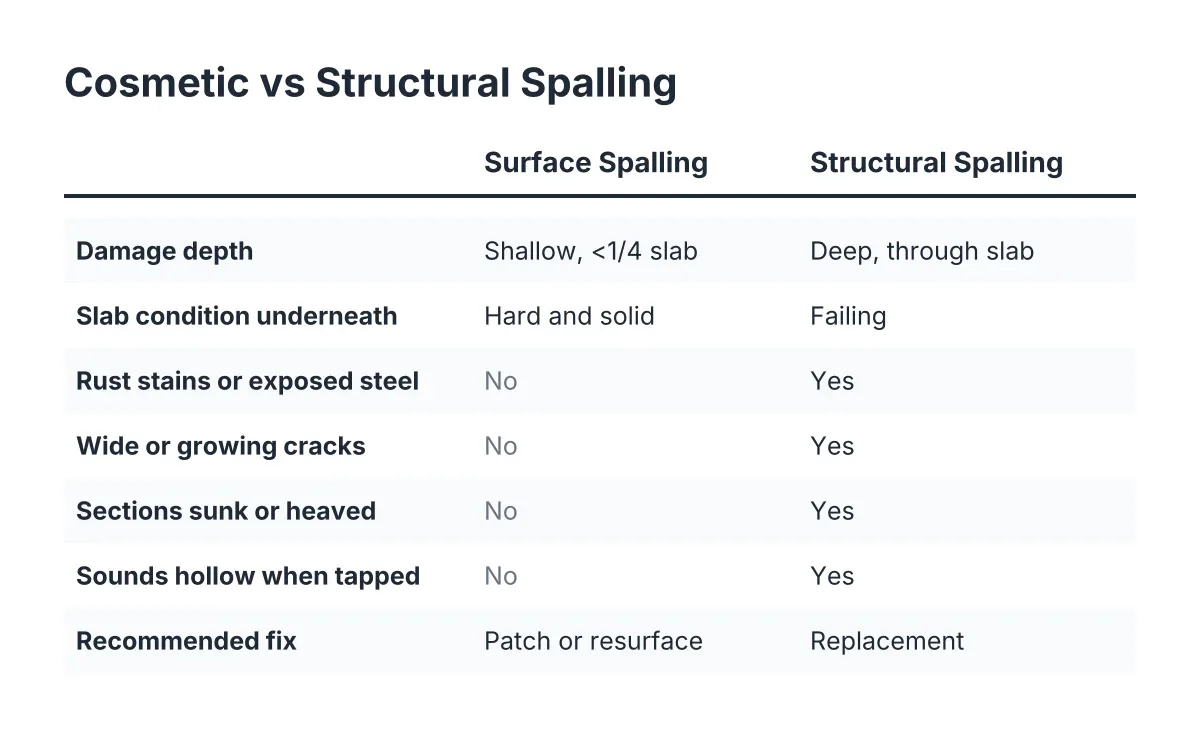
Resurfacing makes sense when the damage is cosmetic and the slab underneath is structurally sound. The classic candidates are surfaces that look rough but still sit flat and solid.
Good signs for resurfacing include:
- Spalling or flaking on the surface, often from freeze-thaw cycles and deicing salt
- Hairline cracks that are stable and not widening
- A worn, pitted, or stained surface that is otherwise level
- An outdated finish you want to update with a decorative or colored overlay
- Sections that are level with each other, with no slabs heaving or sinking
Spalling is the most common reason Salt Lake City homeowners search for concrete resurfacing near me in the first place. Winters here are hard on exposed flatwork. Water soaks into the surface, freezes, expands, and pops the top layer off in flakes. If that damage stays shallow, an overlay restores the surface without touching the slab below.
There is also a decorative angle. If you are prepping a pre-2000 home for sale and the patio is structurally fine but dated, a stamped or colored overlay can deliver the look of decorative concrete at a lower cost than tearing out and repouring with stamped concrete. For a homeowner weighing curb appeal spending against resale value, that math often favors resurfacing.
One caveat applies to every overlay job. Resurfacing material should never run across expansion joints or control joints. Those joints exist to manage movement, and a good crew tapes them off and respects them during application. If a bid does not mention how joints will be handled, ask. It is a quick way to separate experienced concrete resurfacing contractors from crews who have mostly done patch work.
When Replacement Is the Only Honest Answer
Replacement is the right call when the slab itself has failed, not just its surface. Structural problems, settling, and widespread deep cracking cannot be fixed with a thin overlay, because the overlay will crack right along with the slab beneath it.
Watch for these signs:
- Spider cracking spread across the whole surface, not just one area
- Slabs that have sunk, heaved, or tilted so sections no longer meet flush
- Cracks wide enough to catch a quarter, or cracks with vertical offset
- Crumbling edges and deep pitting that go beyond the top layer
- Drainage problems where the slab now slopes toward the house or garage
Spider cracking deserves special attention because it is the pattern contractors use most often to rule out resurfacing. When fine cracks web across an entire driveway, the slab is telling you the problem is systemic: a failing base, inadequate thickness, or decades of freeze-thaw stress. An overlay on that surface is a short-term cosmetic fix at best.
Settling matters along the Wasatch Front because our clay and gravel soils expand and shift with moisture. Spring snowmelt saturates the ground, slabs move, and sections sink or lift relative to each other. Resurfacing cannot relevel a sunken slab. If your driveway has a trip edge where two panels meet, you need the slab addressed, not the surface.
Here is where the resurfacing versus replacement cost comparison flips. Paying for an overlay on a failing slab means paying twice: once for the resurfacing that fails early, and again for the replacement you needed from the start. The cheaper option is only cheaper when it actually fits the problem.
A Side-by-Side Look at Cost and Durability
Suppose a homeowner in Sugar House has a 600 square foot driveway from the early 1990s. The surface is spalled from years of winter salt, but the slab sits flat, the cracks are hairline, and nothing has settled. In that scenario, resurfacing is a strong candidate. The illustrative math might look like an overlay bid at a third or so of the replacement bid for the same driveway, with the overlay delivering a fresh, broom-textured surface that handles our winters.
Now change one detail. Say the same driveway has two panels that dropped an inch where the downspout dumps snowmelt every spring, and spider cracks web across the lower half. In that scenario, replacement is the honest recommendation. The base has failed under part of the slab, and any overlay would telegraph those cracks within a season or two.
Durability follows the same logic as cost:
- A quality overlay on a sound slab can last many years with basic care, resealing, and sensible deicer use.
- A full replacement on a properly compacted gravel base is the longest-lasting option available, often outliving the overlay by a wide margin.
- An overlay on a bad slab is the shortest-lived option of all, regardless of how well it is applied.
Weather also affects overlay quality in ways homeowners rarely think about. Resurfacing material gets stickier and harder to work the thicker it goes on, and visible ripples in a finished overlay usually mean it was applied too thick. Direct summer sun shortens working time, which is why experienced crews shade the work area or schedule applications around heat. These are craft details, but they decide whether your overlay looks right in year five.
What Drives Concrete Resurfacing and Replacement Costs in Salt Lake City
The cost of resurfacing or replacing concrete in Salt Lake City comes down to a handful of measurable factors: slab size, the condition of the existing surface, how much base and grading work is needed, the finish you choose, and how easily a crew can access the site. No contractor can give you a real number without seeing those factors, which is why ballpark figures online vary so widely.
For resurfacing, the big variables are:
- Square footage, since prep and application labor scale with area
- Amount of crack repair and spall patching needed before the overlay
- Finish type, since a plain broom finish costs less than a stamped or colored overlay
- Surface condition, since heavily contaminated or coated slabs need more prep
For replacement, the list grows:
- Demolition and hauling, which depend on slab thickness and access
- Excavation and grading, especially on lots where the subgrade has shifted
- Gravel base depth and compaction, which our local soils make non-negotiable
- Reinforcement, forms, and the concrete itself
- Finish choice, from standard broom finish to stamped or exposed aggregate
New construction planners face one more variable: coordination. If a builder left flatwork out of the bid and you are lining up your own concrete contractor, sequencing matters. On a combined driveway and patio project, a smart crew finishes excavation and base work first, then removes the final apron or transition section last, timed right before the pour. That keeps the access point usable for other trades and protects adjacent surfaces from equipment traffic. Ask any flatwork bidder how they plan to sequence access; the answer tells you whether they have run a full lot's worth of flatwork before.
Scheduling pressure is real in 2026. Among construction firms with open craft positions, 88% say those jobs are as hard or harder to fill than a year ago, according to the Associated General Contractors of America. Good crews book out, so getting resurfacing or replacement on a calendar early protects your timeline, whether that timeline is a move-in date or a spring listing.
How to Decide: A Practical Checklist
Before you collect quotes, walk your own slab and answer these questions honestly.
- Is the damage on the surface, or in the slab? Flaking and stains favor resurfacing. Sunken panels, wide cracks, and spider webbing favor replacement.
- Is everything still level? Kneel down and sight across the slab. Offsets between panels mean movement, and movement means replacement territory.
- Where does water go? If snowmelt pools on the slab or drains toward your foundation, resurfacing will not fix the slope. Regrading requires a new pour.
- What is your horizon? Selling in two years favors a lower-cost cosmetic refresh if the slab qualifies. Staying fifteen years favors the full replacement.
- What do multiple bids say? If you search for driveway resurfacing near me and three contractors inspect the slab, two recommending replacement is a signal worth hearing, even when it costs more.
The same test applies to patios. A homeowner searching concrete patio resurfacing near me with a level, lightly spalled patio is usually a strong overlay candidate. A patio that has settled away from the house or cracked into shifting sections is not.
One honest limitation: no article can inspect your slab. Hollow spots, hidden base failure, and subsurface moisture problems only show up during an on-site evaluation, and sometimes only during demolition. If your concrete sits near a foundation, a retaining wall, or a drainage path, have a professional assess it before you commit either way.
The Bottom Line on Cost Versus Longevity
The resurfacing versus replacement decision is a trade between upfront cost and long-term durability, and the condition of your existing slab decides which trade is available to you. A sound slab gives you both options, and resurfacing wins on price. A failed slab gives you one real option, and spending less on an overlay only delays the replacement bill.
Treat the resurfacing versus replacement cost question as a diagnosis problem first and a budget problem second. Get the slab evaluated, get specific line-item quotes for whichever option fits, and make sure every bid spells out prep work, joint handling, base work, and finish. In Salt Lake City, where freeze-thaw winters and shifting clay soils punish shortcuts, the cheapest bid that skips those details is rarely the cheapest choice five years from now.
If you need concrete repair and resurfacing, Salt Lake Valley Concrete can help.
Prefer to talk it through? Call (385) 433-4634 — a quick call is usually the fastest way to get a straight answer for your situation.