What Drives Concrete Resurfacing Cost in Salt Lake Valley: A Straight Answer
Your driveway looks rough. Maybe the surface is flaking off in patches, or spider cracks spread a little further every winter. You start searching for answers and find a dozen articles throwing out national price averages that tell you nothing about your slab, your soil, or your winters. Here is a more useful way to think about it: understanding concrete resurfacing cost factors comes down to a handful of specific elements, and once you understand them, you can judge any estimate that lands in your inbox. This guide walks through those factors the way a Salt Lake City concrete contractor actually sizes up a job.
No invented numbers here. Prices shift with material costs, crew availability, and the season. What does not shift is the logic behind the price. That logic is what this article gives you.
The Problem Underneath the Problem
Before talking cost, it helps to understand what you are actually looking at when your concrete fails. Most homeowners along the Wasatch Front are not dealing with bad concrete. They are dealing with concrete that has been through a hard life.
Salt Lake Valley slabs sit on clay-and-gravel soils that expand and shrink as moisture moves through them. On top of that, our winters run freeze-thaw cycles that push water into every hairline crack, freeze it, and wedge the crack wider. Then spring snowmelt pools against the slab, soaks the base, and the cycle starts again. Add years of deicing salt on a driveway and the surface starts to flake, a condition called spalling.
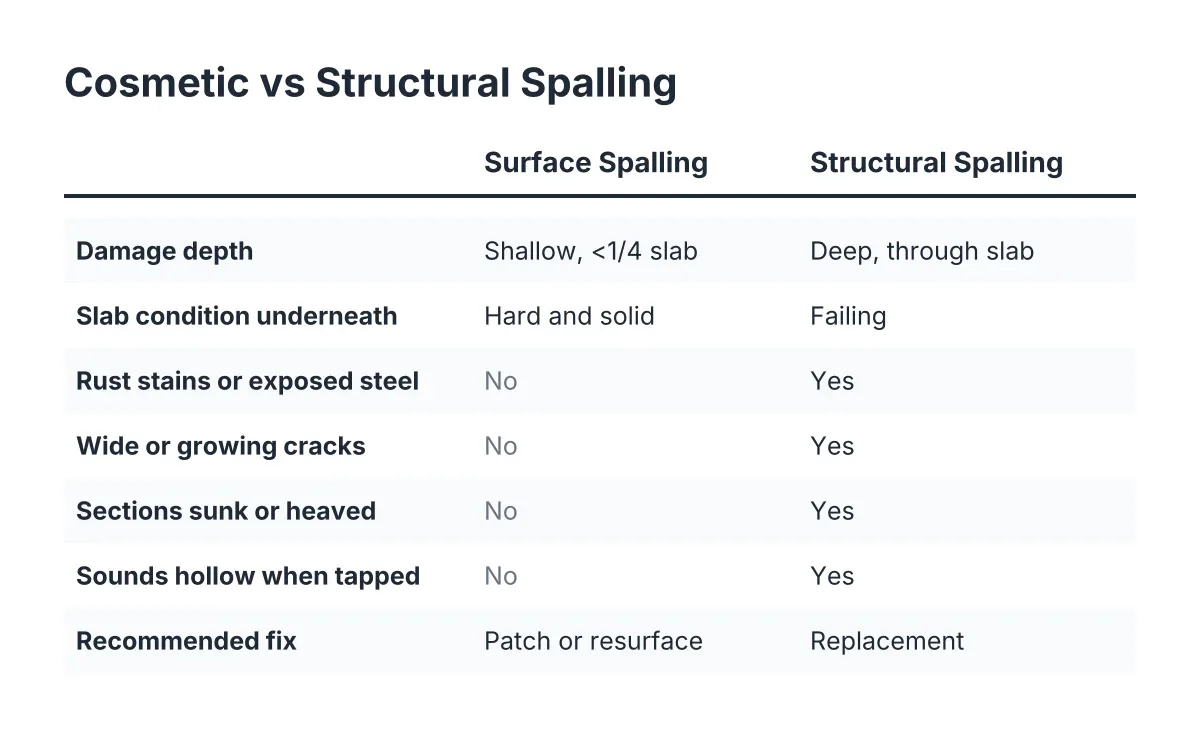
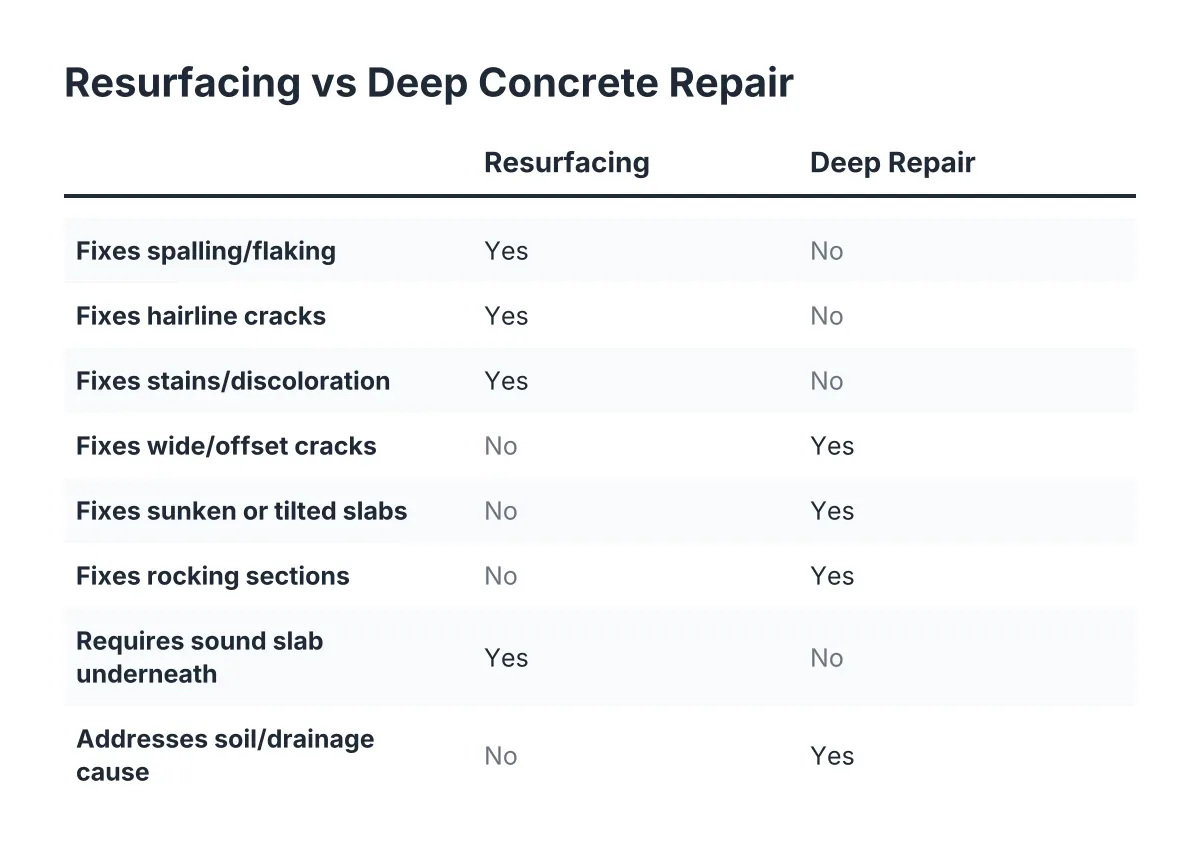
Here is the part that matters for cost. Surface damage and structural damage are different problems with different fixes and different prices. Spalling, shallow pitting, surface staining, and light cracking live in the top fraction of an inch. Resurfacing handles those. Deep structural cracks, slabs that have sunk or heaved, and widespread spider cracking across the whole surface are signals the problem goes below the surface. Resurfacing over a failing slab is paying twice: once for the overlay, and again when the slab underneath keeps moving and cracks the new surface.
So the first question a good contractor asks is not "how many square feet?" It is "what is this slab doing, and why?"
Why Resurfacing Exists at All
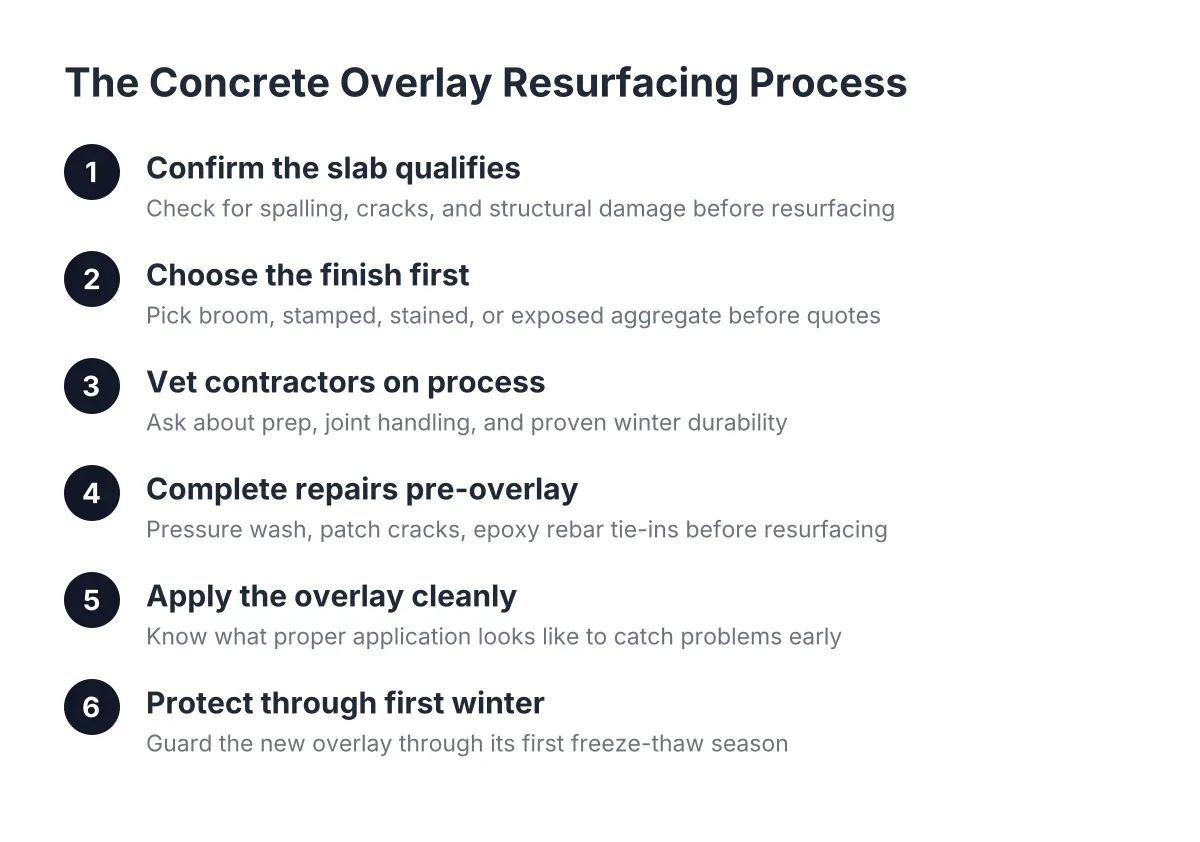
Resurfacing is the middle option most homeowners do not know they have. On one end sits crack repair, filling and sealing individual cracks. On the other end sits full replacement, which means demolition, hauling, excavation, base work, forming, and a new pour. Resurfacing sits between them: the contractor repairs the damage, cleans and preps the existing slab, and applies a new wear surface over the top.
The appeal is simple. Patching and resurfacing a damaged slab costs far less than demolishing and replacing it, because you skip the most expensive parts of concrete work: tear-out, disposal, excavation, and the full volume of new concrete. For scale, HomeAdvisor puts the average cost of a new concrete driveway around $6,400, and Lawn Love reports a professionally installed concrete patio averages $2,925 nationwide. Resurfacing exists to keep you from paying replacement money for a surface-level problem.
However, it only makes sense when the slab underneath is sound. That one condition shapes everything else in this article.
What Drives Concrete Resurfacing Cost Factors in Salt Lake City
Concrete resurfacing cost factors include six things: the size of the surface, the condition of the existing slab, the amount of repair work needed before the overlay goes down, the finish you choose, site access, and timing. Every honest estimate you receive is some combination of those six, whether the contractor spells them out or not.
Let's take them one at a time.
Square Footage, With a Catch
Size is the baseline. More surface means more material and more labor, so a 1,200 square foot driveway costs more to resurface than a 300 square foot patio. For reference on how pros think about area pricing, Concrete Network notes a typical 288 square foot patio averages about $11 per square foot for new installation; resurfacing is priced per square foot too, usually at a lower rate than new concrete.
The catch is that square footage is the least interesting cost driver. Two driveways of identical size can come in at wildly different prices because of everything below. If an estimate is based on area alone, with no one looking at the slab's condition, treat it as a guess, not a bid.
The Condition of the Slab Underneath
This is the biggest swing factor in any resurfacing price, and it is where the concrete resurfacing cost factors push some homeowners toward replacement instead. A contractor evaluating your slab is checking a few things:
- Crack type and pattern. A few isolated cracks can be routed, filled, and covered. Spider cracking spread across the whole surface is a classic sign the slab itself is failing, and it usually points to removal and replacement rather than an overlay.
- Settlement. If one side of your patio has sunk and water pools there, resurfacing will not fix the slope. The slab needs to be lifted or replaced first, because an overlay follows the surface it sits on.
- Depth of spalling. Shallow flaking is ideal overlay territory. Deep pitting that exposes aggregate may need a thicker repair layer, which adds material and labor.
- Joint condition. Expansion joints and control joints exist so the slab can move without cracking randomly. Resurfacing material should never run across those joints; they get taped off and preserved, then re-cut or re-tooled into the new surface. Slabs with crowded or failed joints take more prep time.
Each of those checks translates directly into hours and material. A clean, sound slab with cosmetic spalling is the cheap end. A slab needing extensive crack repair, grinding, and joint work before the overlay even starts is the expensive end.
Surface Prep: The Work You Never See
Prep is the least visible line item and the one that decides whether the job lasts. Before any overlay goes down, the existing surface has to be cleaned, usually pressure washed, sometimes ground or shot-blasted, so the new material bonds. Oil stains, old sealers, and paint all have to come off, because an overlay bonds to concrete, not to whatever is sitting on top of it.
For example, a driveway with years of persistent oil and tire staining that regular pressure washing cannot touch may need professional-grade cleaning or mechanical grinding before resurfacing. That adds cost. Skipping it is how overlays delaminate and peel within a couple of seasons, which is exactly the outcome a homeowner worried about "paying for a repair that cracks again in a year" is trying to avoid.
Finish Type: Plain, Broomed, or Decorative
The finish you pick moves the price more than most people expect. Options run from a basic gray overlay to stamped and decorative concrete patterns with integral color or stain.
- A plain overlay with a broom finish is the budget option. Brooming also textures the surface, which improves slip resistance when it is wet, a practical point for Salt Lake City sidewalks and driveways that spend months under snowmelt.
- Stained and colored concrete adds material and a second round of labor.
- Stamped overlays that mimic stone or pavers sit at the top. They take skilled finishers, more working time, and often sealing as a final step.
None of these choices is wrong. They are just different answers to "what do you want this to look like, and what is that worth to you?"
Site Access and Working Conditions
Access is the quiet cost driver. A wide-open driveway facing the street is easy. A backyard patio reachable only through a 36-inch gate means material gets moved by hand, which means more labor hours.
Weather matters too. Resurfacing material sets fast in direct summer sun, which shortens working time and raises the risk of a poor finish. Crews often tent the work area or schedule around the heat, and that planning is part of what you are paying for. In addition, Salt Lake City's season for this work has real boundaries; overlays do not cure well in freezing conditions, so late-fall jobs can carry scheduling pressure or get pushed to spring.
Timing and the Labor Market
Finally, the broader market sets the floor under every bid in 2026. Skilled concrete finishers are hard to find; among construction firms with open craft positions, 88% say those jobs are as hard or harder to fill than a year ago, according to the Associated General Contractors of America. Scarce labor shows up in pricing and in lead times, especially during the peak Salt Lake Valley pouring season from late spring through fall.
A Tale of Two Driveways: How the Cost Drivers Play Out
Suppose two neighbors in Millcreek each have a 20-year-old, 900 square foot concrete driveway, and both call for resurfacing estimates the same week.
The first driveway has surface spalling near the garage where deicing salt collects, two hairline cracks, and solid, level slabs. In that scenario, the estimate covers pressure washing, crack filling, taping off the control joints, a standard overlay, and a broom finish. It is a straightforward job, priced accordingly.
The second driveway looks similar from the curb, but up close the surface shows spider cracking across most of its area, and the slab nearest the street has settled where snowmelt drains. In that scenario, an honest contractor explains that an overlay would follow the sunken slope, pool water in the same spot, and crack along the same spider pattern within a few winters. The real options are lifting or replacing the settled section and possibly replacing the whole driveway. The resurfacing quote the neighbor expected becomes a replacement conversation.
Same size, same street, completely different price and scope. That gap is why national cost averages frustrate people. The drivers, not the averages, determine what you pay.
Repair, Resurface, or Replace: A Homeowner's Decision Filter
You do not need to be a contractor to narrow down which category you are in. Run through this filter before you start collecting bids:
- Is the slab flat and stable? Walk it. Set a level or a straight board across suspect areas. If sections have sunk, heaved, or rock underfoot, resurfacing alone is off the table until the movement is addressed.
- Where does water go? Watch the surface during snowmelt or after rain. Pooling against the house or in a sunken corner is a base and drainage problem, not a surface problem.
- What do the cracks look like? A few clean cracks: repairable. Cracks with vertical offset, where one side sits higher than the other: movement. Spider cracking everywhere: likely replacement.
- How deep is the damage? Flaking you can brush away is surface spalling, a resurfacing candidate. Pits exposing gravel, or crumbling edges, point to deeper deterioration.
- How old is the slab, and what is it on? A slab that has stayed flat for decades on well-draining gravel is a better overlay candidate than a younger slab already moving on expansive clay.
This filter will not replace a professional evaluation, and some conditions, like a failing base or a slab over a buried utility, only show themselves once work starts. But it will tell you whether the bids you receive match the problem you actually have.
How HOAs and Property Managers Should Frame the Numbers
If you manage an HOA or commercial property, the same cost drivers apply, multiplied across shared sidewalks, curbs, and common-area flatwork. The difference is scale and liability. A spalled driveway is cosmetic; an offset sidewalk slab in a 200-unit community is a trip hazard and a claim waiting to happen.
Therefore, the useful move for a board is to map each section of concrete against the decision filter above before the bid process starts. Sections with surface wear and sound slabs are resurfacing candidates and can be bundled for per-square-foot efficiency. Sections with settlement or offset joints need repair or replacement priced separately. When reserve studies flag "deteriorating flatwork" as one line item, splitting it into resurface-versus-replace categories gives the board a real budget instead of a lump of uncertainty, and it keeps bids comparable because every contractor is pricing the same scope.
Reading an Estimate Like a Contractor Wrote It
When bids come in, compare them against the six drivers, not just the bottom line. A useful estimate from concrete resurfacing contractors should tell you what condition they found the slab in, what prep and repair work is included, how joints will be handled, what finish is specified, and what happens if hidden damage turns up during prep. If you are comparing results and one bid is far below the others, the missing money is usually in prep. That is the work that decides whether the overlay lasts.
A few questions worth asking any bidder in Salt Lake City:
- What did you see in the slab that makes it a resurfacing candidate rather than a replacement?
- How will you handle the expansion and control joints?
- What surface prep is included, and what would trigger extra prep charges?
- How will the overlay handle our freeze-thaw winters and deicing salt, and what sealing or maintenance does it need?
- What is your working season, and when could this realistically be scheduled?
A contractor who answers those plainly is showing you their reasoning. A contractor who dodges them is asking you to buy a number without the logic behind it.
The Bottom Line on Resurfacing Costs
Concrete resurfacing cost factors shape what you pay: square footage, slab condition, prep work, finish type, site access, and timing. In the Salt Lake Valley, slab condition carries the most weight, because our clay-and-gravel soils and freeze-thaw winters are hard on the base under every driveway and patio. A sound slab with surface damage makes resurfacing one of the best values in residential concrete. A moving slab makes it money spent on a surface that will not hold.
Start with the decision filter, watch where water goes, and make every bidder explain which category your concrete falls into and why. The homeowner who understands the drivers does not need to fear the estimate. They can read it.
If you need concrete repair and resurfacing, Salt Lake Valley Concrete can help.
Prefer to talk it through? Call (385) 433-4634 — a quick call is usually the fastest way to get a straight answer for your situation.