Best Concrete Driveway Contractors in Salt Lake City: What Sets Pros Apart
If you are finishing a new build or a garage addition in Salt Lake City, the search for the best concrete driveway contractor for new builds usually starts at a bad moment: the builder left flatwork out of the bid, the lot is still dirt where the driveway should be, and move-in is on the calendar. You have already decided to hire a pro. The job now is to run the hiring and the pour the right way so the work holds up through Wasatch Front winters. This guide walks you through it step by step, from scoping the work to protecting the finished slab.
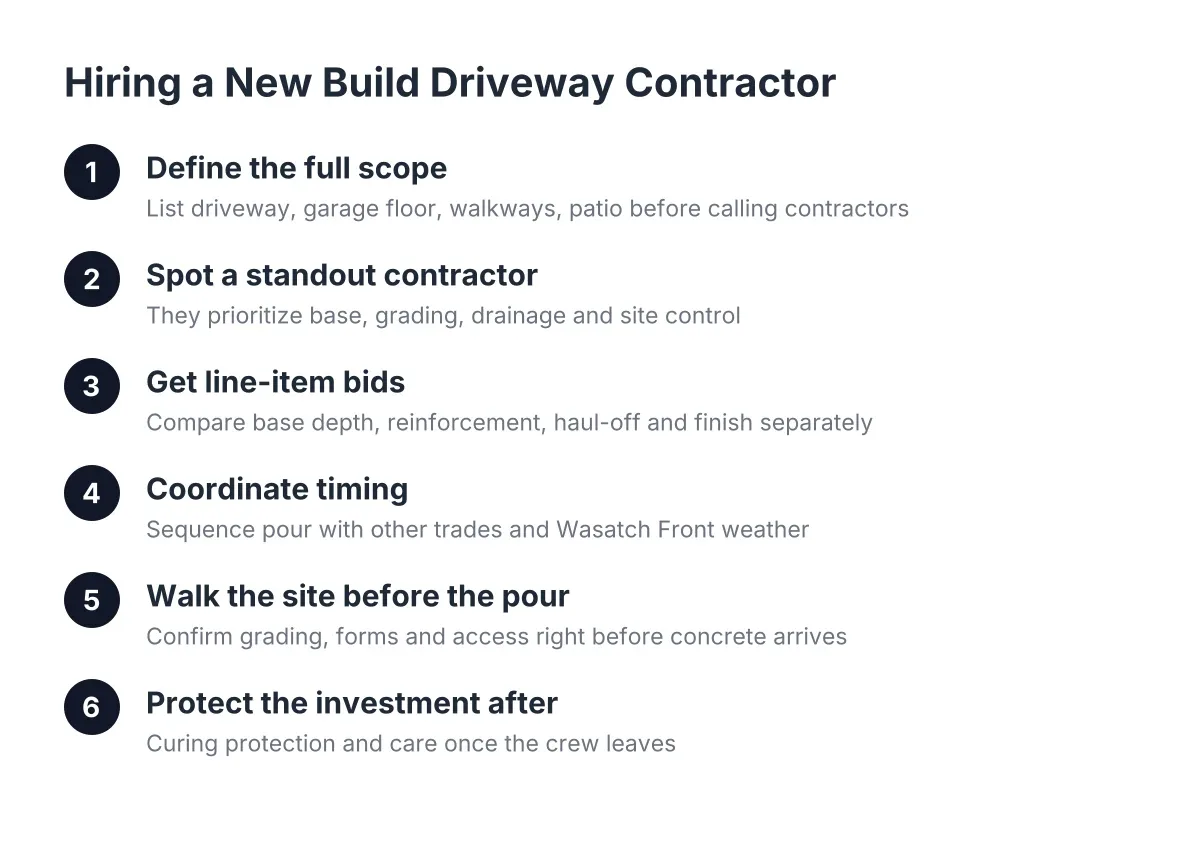
Step 1: Define the Full Scope Before You Call Anyone
Write down everything that needs concrete, not just the driveway. On a new build, that usually means the driveway, the garage floor, walkways, a patio, and sometimes a shop slab. Pricing all of it at once matters for two reasons.
First, mobilization costs real money. A crew that excavates, grades, and pours your whole lot in one planned sequence costs less per square foot than three separate small jobs. Second, matching matters. Pouring the driveway and walkways together gets you consistent color, finish, and joint layout across the property.
A complete driveway scope from a good concrete contractor should include:
- Excavation and haul-off of soil or old concrete
- Grading for drainage away from the garage and foundation
- Compacted gravel base suited to the soil on your lot
- Forms, reinforcement, and the concrete pour itself
- Finishing, control joints, and edging
- Curing protection and basic cleanup
Items that are often extra: removing an old driveway, major regrading, long concrete pump runs for tight access, decorative or stamped concrete finishes, and sealing. Ask about each one so the quote reflects your actual lot, not a generic square-footage number.
Step 2: What Makes the Best New Build Driveway Contractors Stand Out
What separates the best driveway contractors for new builds from the rest is what happens under and around the slab, not the gray surface you see at the end. Almost any crew can make fresh concrete look fine for a year. The difference shows up after a few freeze-thaw winters.
Watch for these markers of a crew that knows the Salt Lake Valley:
- They talk about base and grading first. Clay and gravel soils along the Wasatch Front move with moisture and frost. A pro explains how much excavation and compacted base your lot needs, and why angular drainage rock locks into the slab better than smooth, round pebble gravel.
- They plan drainage before they plan finish. Snowmelt and spring runoff need somewhere to go. A proper pour slopes water away from the garage and foundation.
- They sequence the job around your access. Experienced crews remove the final section of the old apron or leave an access strip until just before the pour, so you and your other trades can still use the driveway during the work.
- They explain placement method. Pumped concrete sets faster than concrete placed straight off the truck chute, which changes finishing timing. A crew that can explain that trade-off has done this at scale.
- Their job sites look controlled. Skilled finishers place concrete cleanly without draping plastic over your siding and walls. Heavy plastic sheeting everywhere can signal a crew that expects to make a mess.
Labor is also a market reality in 2026. Among construction firms with open craft positions, 88% say those jobs are as hard or harder to fill than a year ago, according to the Associated General Contractors of America. The strongest finishers work for the strongest companies, which is one more reason to vet the crew, not just the price.
Step 3: Get Line-Item Bids, Not One Lump Number
Collect at least two or three written bids, and insist on line items. A single lump sum hides the places where bids differ: base depth, reinforcement, haul-off, and finish type. When one bid comes in far below the others, the savings almost always come out of the base or the reinforcement, which is exactly where a Salt Lake driveway fails first.
For scale, HomeAdvisor reports a concrete driveway averages close to $6,400 nationally, while even a high-end gravel driveway tops out around $3,500. Your number will depend on slab size, excavation, reinforcement, finish, and site access, so treat national averages as context, not a quote. On a full new-construction lot with driveway, garage floor, and walkways, expect the total to run well past a single-driveway figure because you are pricing several slabs at once.
When you compare bids, ask each contractor the same three questions:
- What base depth and material are you pricing, and how will you compact it?
- How are you reinforcing the slab, and where will the control joints go?
- What happens if you find soft soil or unexpected fill once you excavate?
The third question matters most for the planner persona. Suppose a hypothetical homeowner in Herriman is finishing a new build and the excavator left loose fill where the driveway apron goes. A fair bid names a unit price for extra excavation and base up front. A vague bid turns that discovery into an ugly change order mid-job.
Step 4: Coordinate Timing With Your Other Trades and the Weather
Flatwork has to land in the right slot in your build schedule. Pour too early and other trades drive equipment across green concrete. Pour too late and you push back your certificate of occupancy. Talk through sequencing with your contractor before you sign.
A typical sequence on a new build looks like this: finish heavy exterior work first, then rough grading, then flatwork, then landscaping. Within the flatwork itself, crews usually complete excavation and base work early and remove the last access section only when the pour is imminent, so the driveway path stays usable for deliveries as long as possible.
Weather is the other clock. Along the Wasatch Front, hard freezes complicate cold-season pours, and curing concrete needs protection from both freezing and fast drying. A straightforward contractor will tell you when conditions are wrong for a pour, even if it delays your schedule. That honesty is a feature, not a problem. Expect the slab to need days before foot traffic and longer before vehicles, with full strength developing over weeks; your contractor should give you specific timing for your pour and mix.
This is also where DIY ends. Grading, base compaction, and finishing a driveway-sized pour are not weekend projects, and a bad pour costs more to remove and redo than it did to install. Hire the pro, and if your lot has steep slopes or signs of unstable soil, bring in an engineer before concrete gets priced.
Step 5: Walk the Site Before the Pour
Do a pre-pour walkthrough with the contractor. This single hour prevents most disputes. Confirm these points together, on the ground:
- Forms sit at the heights you expect against the garage slab, sidewalk, and street
- Slope carries water away from the foundation and toward the drainage path you agreed on
- Base is compacted, uniform, and matches the bid
- Reinforcement is in place, not lying on the dirt
- Control joint layout is marked, especially where the driveway meets walkways
- Decorative details, like a stamped concrete border or colored finish, are confirmed in writing
For a small landlord, the same walkthrough applies to rental properties. Say an investor who owns a fourplex in Millcreek is replacing a heaved parking pad and entry walk during tenant turnover. Confirming slope and joint layout before the pour is what prevents the next trip hazard, which is the whole liability reason the work got scheduled.
Step 6: Protect the Investment After the Crew Leaves
The best pour still needs a sane first month. Follow your contractor's cure guidance exactly. Keep vehicles off the new slab until the contractor clears it, keep heavy equipment and dumpsters off it permanently, and skip deicing salts the first winter. Plain sand gives traction without attacking young concrete.
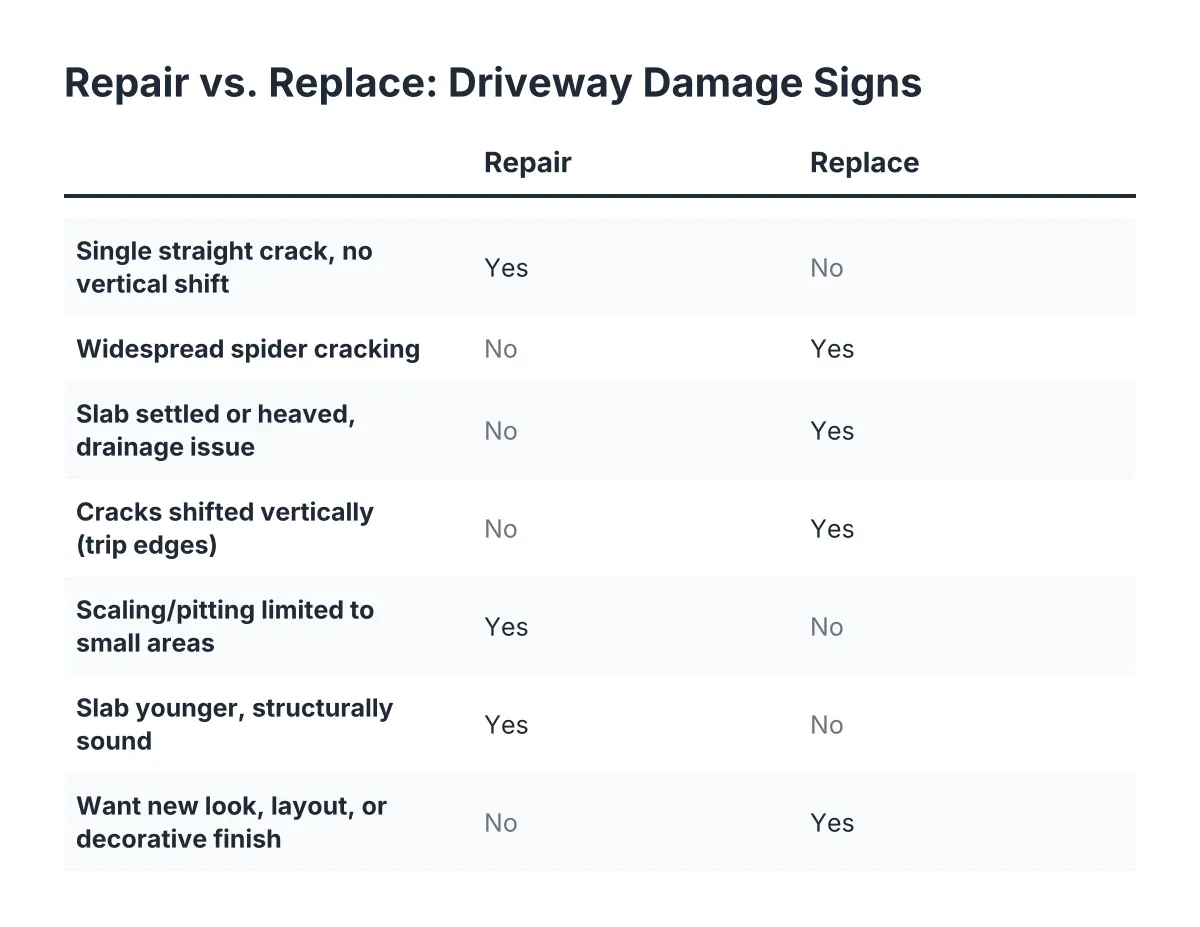
Over the long term, reseal on the schedule your contractor recommends, keep grass edged back from the slab edges so water drains off the surface, and address small cracks early with crack repair before freeze-thaw cycles widen them. Widespread spider cracking across an old surface usually means replacement, not patching; catching damage while it is still a repair is how you avoid that outcome.
In addition, landlords with several properties benefit from treating concrete like a portfolio item. One relationship with a driveway contractor for new builds and repairs who already knows your properties makes recurring sidewalk repair, resurfacing, and parking pad work faster to price and schedule year after year. The same logic applies to anyone searching for residential concrete driveway contractors for a one-time job: the hire you make now determines whether you ever have to make it again.
Get a Driveway Bid That Matches Your Lot
Finding the best concrete driveway contractors in Salt Lake City comes down to this checklist: full written scope, line-item pricing, straight answers on base and drainage, realistic scheduling around weather, and a pre-pour walkthrough. Any contractor who clears those bars is worth hiring. Any who dodges them is telling you something.
Salt Lake Valley Concrete pours and repairs driveways, patios, sidewalks, and flatwork across the Salt Lake Valley, and we price every job the same way this article describes: by slab size, excavation, reinforcement, finish type, and site access, with no invented numbers. If you have a new build waiting on flatwork or a rental property with concrete that needs attention, reach out for an estimate and we will walk the site with you.
If you need concrete contractors in Salt Lake City, UT, Salt Lake Valley Concrete can help.
Prefer to talk it through? Call (385) 433-4634 — a quick call is usually the fastest way to get a straight answer for your situation.