Concrete Driveway Repair vs. Replacement: When to Patch and When to Repour
If your driveway is cracked, chipped, or sinking, the first question is simple: can it be fixed, or does it need to come out? The decision between driveway repair and replacement comes down to a handful of things you can check yourself, like how deep the cracks go, whether the slab has settled, and how old the concrete is. This guide walks through each one so you can size up your own driveway before you ever call a contractor, and so you know what a good contractor should be checking when they show up.
Salt Lake City driveways face a tougher life than driveways in milder climates. Hard freeze-thaw cycles each winter, clay and gravel soils along the Wasatch Front, and road salt tracked in off the street all work against a slab. That matters for this decision, because damage that might be worth patching in Phoenix is often a sign of deeper trouble here.
How to Read the Damage on Your Driveway
Before anyone talks repair or replacement, look at what the concrete is actually telling you. Different kinds of damage point in different directions, and the pattern matters more than any single crack.
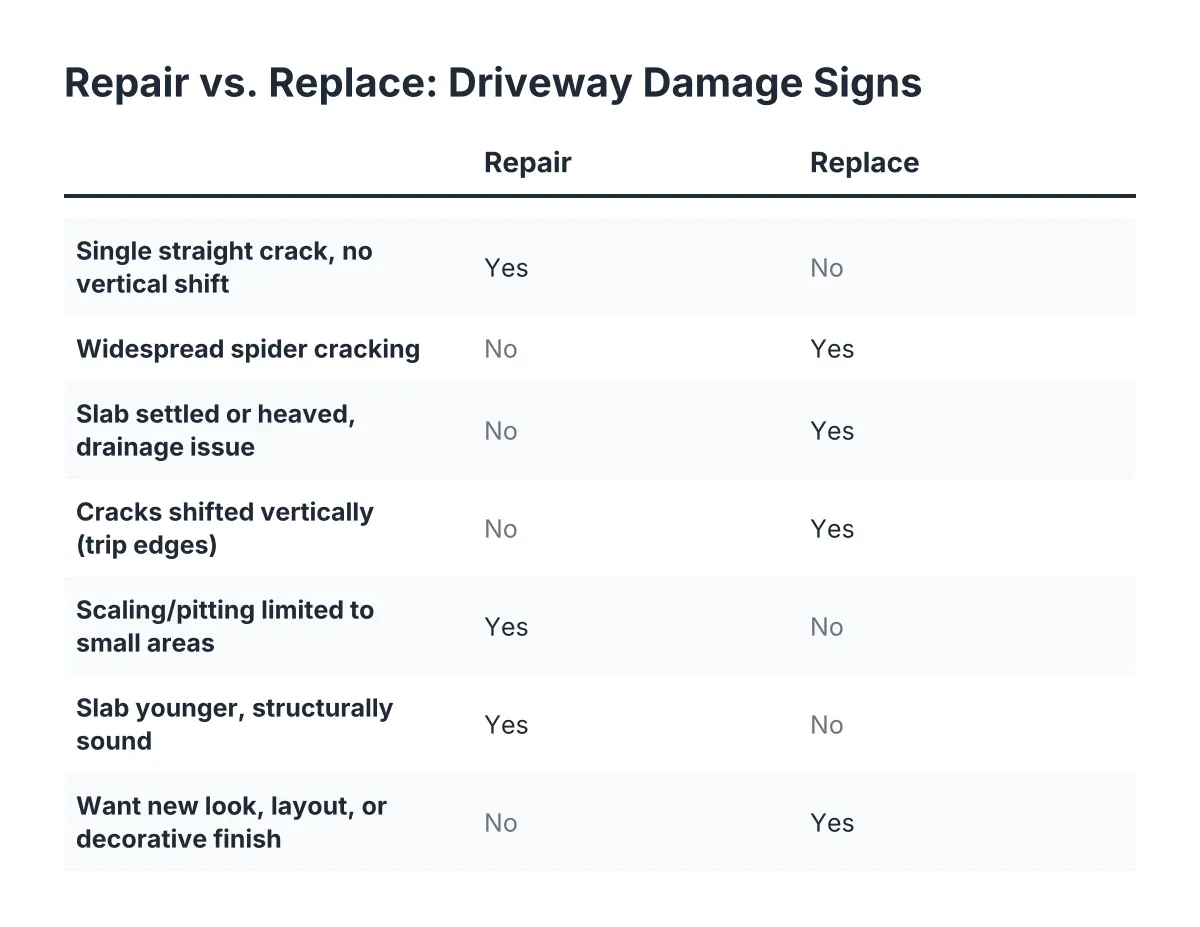
Start with the cracks themselves. A single straight crack, even a long one, is usually a candidate for crack repair. Concrete cracks; that is what it does. A clean crack that has not shifted vertically can be cleaned out and sealed, and the driveway keeps working for years.
Spider cracking is a different story. When fine cracks spread across the surface in a web pattern, the slab is telling you it is breaking down as a whole, not in one spot. Contractors treat widespread spider cracking as one of the clearest signs that removal and replacement makes more sense than chasing individual cracks. You can seal a web of cracks, but new ones keep opening, and you end up paying for repairs on a slab that is already failing.
Next, check for settling. Kneel at the edge of the slab and sight across it. If one section sits lower than its neighbor, or if water pools in the middle after snowmelt, the base under the concrete has moved. Surface repairs cannot fix a base problem. In the Salt Lake Valley, expansive clay soils and seasonal moisture swings are a common reason slabs settle unevenly, and a patch on top of a sinking slab is money spent on a symptom.
Finally, look at the surface itself. Flaking, pitting, and scaling, where the top layer pops off in thin sheets, often trace back to freeze-thaw damage or salt exposure. If scaling is limited to a few spots, resurfacing can restore the driveway. If the surface is coming apart across large areas, the damage usually runs deeper than a resurfacing layer can hide.
When to Repair vs. Replace Your Driveway
Repair is the right call when the damage is on the surface and the slab underneath is still sound. A structurally healthy driveway with cosmetic problems does not need to be torn out. Crack repair, patching, and resurfacing cost a fraction of a full repour, and done right, they buy real years of life.
Repair tends to make sense when:
- Cracks are isolated, roughly hairline to a quarter inch wide, with no vertical shift between the two sides
- The slab sits level, drains away from the garage and house, and shows no sign of settling
- Surface damage like pitting or scaling covers a small portion of the driveway, not most of it
- The concrete is on the younger side of its life, with no widespread spider cracking
- You need the driveway to look better and last several more years, not several more decades
Each repair type handles a different problem. Crack repair seals individual cracks so water cannot get in, freeze, and widen them. That last part is the whole point in Salt Lake City; an unsealed crack that fills with snowmelt in November will be a wider crack by March. Patching fills voids, spalled spots, and broken corners with new material. Resurfacing goes further, laying a thin new layer over the whole slab to give you a fresh, uniform surface.
Resurfacing deserves a special mention for anyone comparing concrete driveway resurfacing vs. replacement on looks alone. A resurfaced driveway can take color and texture, which means a plain gray slab can come out looking like a new decorative pour at a lower cost than tearing out and starting over. For a homeowner upgrading curb appeal on a sound slab, that is often the sweet spot. The catch is that resurfacing only works on a stable base. Overlay a settling or spider-cracked slab and the new surface inherits every problem underneath it.
One honest limitation: when you repair a driveway versus replacing it, patches and sealed cracks can be blended, but they rarely disappear, especially on broom-finished gray concrete. If a flawless, uniform surface is the goal, resurfacing or replacement gets you there; spot repairs do not.
Choosing Replacement Over Driveway Repair
Replacement is the right call when the problems run deeper than the surface. A full repour costs more up front, but it resets the clock entirely: new base, new reinforcement, new concrete, and a finish you choose.
Replacement usually wins when:
- Spider cracking covers large areas of the slab, not just one corner
- Sections have settled, heaved, or tilted so the driveway no longer drains properly
- Cracks have shifted vertically, leaving trip edges between slab sections
- The concrete is old enough that repairs would be the first of many
- You want a different look, layout, or width than the current driveway offers
That last point matters for anyone planning a bigger upgrade. If you are redoing the front yard and want the driveway to match new landscaping, or you want stamped concrete, exposed aggregate, or a stained finish instead of plain gray, replacement is your opening. Decorative options like stamping and integral color go into the concrete when it is poured. You cannot stamp an existing slab. A repour lets you widen the driveway, add a walkway in the same finish, and pick a color and pattern that fits the house, all in one project.
There is also a simple math problem with repairing a failing slab. Suppose a homeowner in Sugar House has a 30-year-old driveway with spider cracking across half the surface and a settled section near the garage. Say crack repair and patching would run an estimated 15 to 20 percent of the cost of a new driveway. That sounds like a win, until the clay soil shifts again next spring and new cracks open next to the patches. Two or three rounds of that and the homeowner has spent half the cost of a repour on a driveway that still looks patched. In that scenario, replacement is cheaper over ten years even though it is more expensive this year.
As a rough national reference point, a concrete driveway averages around $6,400 according to HomeAdvisor, though your cost depends on size, excavation, base work, reinforcement, finish, and site access. Decorative finishes add to that; a plain broom finish costs less than stamped or exposed aggregate. No contractor can give you a real number without seeing the site, and in Salt Lake City the soil and grading under your specific driveway drive more of the price than most homeowners expect.
Freeze-Thaw, Clay Soil, and Salt: Why the Decision Is Different in Salt Lake City
Salt Lake City conditions push more driveways toward replacement than milder climates do, because the local stress factors attack the base and the full depth of the slab, not just the surface. Freeze-thaw cycles widen every unsealed crack, clay soils move with moisture, and road salt accelerates surface scaling each winter.
Here is how that plays out. Water gets into a crack in the fall. It freezes, expands, and pries the crack wider. It thaws, more water gets in, and the cycle repeats dozens of times before spring. A crack you could have sealed cheaply in September is a repair-or-replace question by April. This is why crack repair and sealing in this climate is maintenance, not an afterthought, and why timing matters when you schedule the work.
The soil adds a second layer. Clay holds water and swells, then shrinks as it dries. Gravel pockets drain differently than the clay around them. A driveway poured on a poorly prepared base over this kind of ground settles unevenly, and once the base moves, the slab cracks no matter how good the concrete was. When a contractor recommends replacement, a big part of what you are paying for is the chance to fix the base: proper excavation, compacted gravel, and grading that moves snowmelt away from the slab instead of under it.
Salt is the third factor. Deicing salt tracked in from the street, or spread on the driveway itself, attacks the concrete surface and feeds scaling. A quality mix, a proper cure, and a penetrating sealer give new concrete a fighting chance. Old concrete that was never sealed often shows it by year ten or fifteen here.
For the homeowner eyeing decorative concrete, this is the question behind the question: will stamped or stained concrete hold up in a Utah winter? The honest answer is yes, when it is poured and sealed for this climate. Integral color runs through the full depth of the slab, so it does not wear off the way a painted coating can. Stamped texture needs a sealer maintained on schedule, and any decorative driveway here should be resealed periodically to stand up to salt and freeze-thaw. A contractor who does decorative work in this valley should be able to explain their mix, cure, and sealing approach for winter without being asked twice.
What a Concrete Driveway Repair or Replacement Project Actually Involves
Knowing what the work looks like helps you judge whether a bid is thorough or thin. Repair and replacement are different jobs with different steps, and the preparation is where good work separates from bad on both.
Good driveway repair and replacement decisions explained
Good repair work is mostly preparation. Before any crack gets filled, both sides need to be cleaned down to bare, sound concrete, with old sealant and loose material removed, so the new sealant can bond. Hairline cracks are opened up wider before repair, which looks like making the problem worse but is what lets the material grip. Larger cracks get loose concrete cut away from each side for the same reason.
Patches follow the same logic. Loose debris gets chiseled out of the void so the patch bonds to solid material, and the area is dampened before new material goes in so the old concrete does not pull moisture out of the fresh mix and weaken the bond. One more detail worth knowing: filling a wide exterior crack solid with rigid material is usually the wrong move. Concrete moves with the seasons, and a flexible sealant over a backer rod allows that movement; a rigid fill just cracks again beside the repair.
This is also where the DIY question comes in. A concrete driveway repair kit from a home center can handle a small, stable crack, and for a homeowner comfortable with the prep work, that is a reasonable weekend project. The kits fall short on anything structural, anything involving settling, and anything where the finished look matters, because color-matching patch material to weathered concrete is harder than the packaging suggests.
How a replacement pour comes together
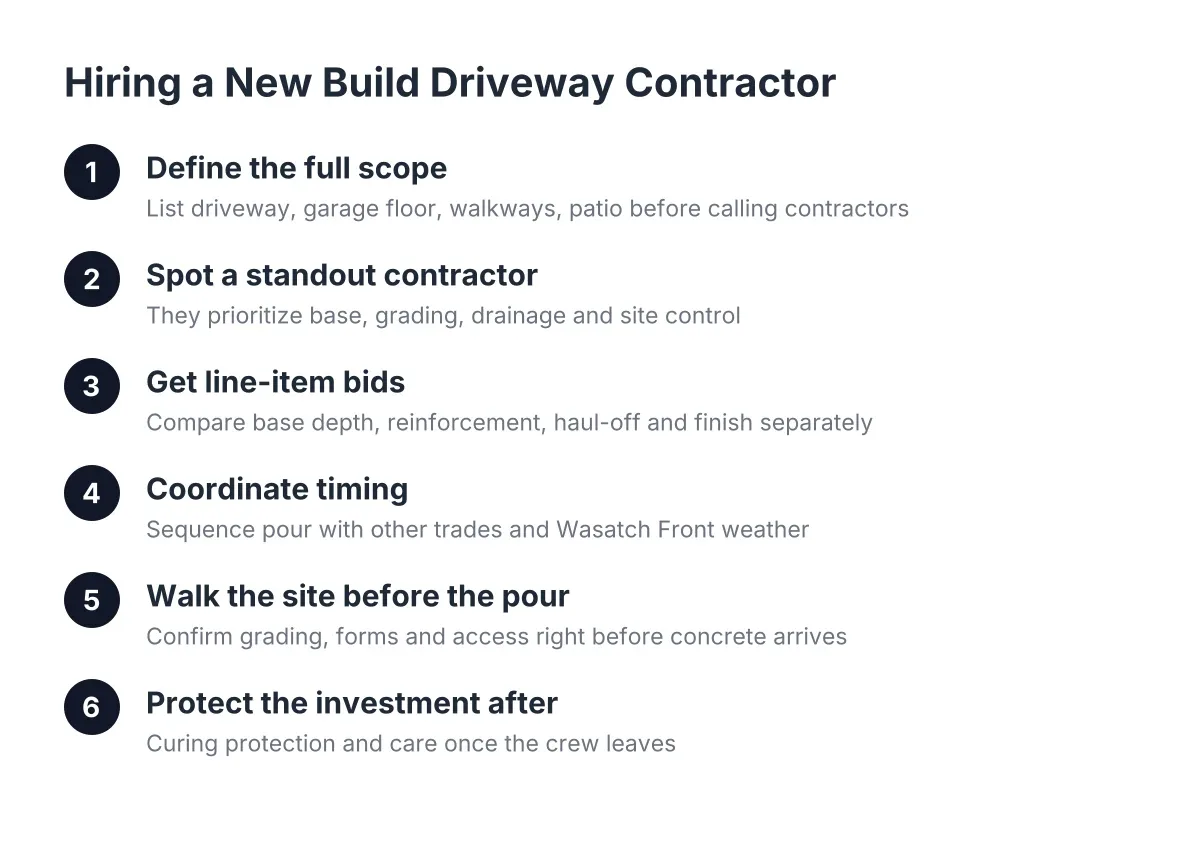
A full concrete driveway repair or replacement project on the repour side runs in a set order: demolition and removal of the old slab, excavation, base installation and compaction, forming, reinforcement, the pour itself, finishing, and curing. On a combined project, say a driveway and patio replaced together, experienced crews sequence the demolition deliberately. They often leave the old driveway apron or a transition section intact until just before the pour, so equipment has a stable access point and the adjacent surfaces do not get chewed up by repeated traffic.
Decorative choices happen at specific points in that sequence. Integral color goes into the mix, stamping happens during finishing while the concrete is still workable, and staining and sealing come after the cure. If you want a stamped or exposed aggregate driveway, those decisions need to be locked in before the truck arrives, not discussed on pour day.
How to Choose Between Bids, Not Just Between Repair and Replace
Once you know which direction your driveway points, the next decision is who does the work. Searching for concrete driveway contractors will turn up a long list, and the bids you get back may not even agree on whether to repair or replace. That disagreement is useful information. Ask each contractor to walk you through their reasoning on your specific slab: what they saw in the cracks, the base, and the drainage that led to their recommendation.
A few things separate a strong bid from a thin one in 2026:
- The estimate explains what drives the price: square footage, demolition and excavation, base and compaction, reinforcement, finish type, and site access, instead of one unexplained number
- The contractor addresses the base and drainage, not just the concrete, especially on clay soil
- For decorative work, they can show driveways or patios they stamped or stained locally, since plain flatwork skill does not automatically transfer to decorative finishes
- The sequence and timeline account for weather, because pouring and curing in this climate has a season
Labor availability is part of the picture too. Among construction firms with open craft positions, 88 percent say those jobs are as hard or harder to fill than a year ago, according to the Associated General Contractors of America. Skilled finishing crews are stretched, which is one more reason to book ahead of the busy season and to be wary of a bid that undercuts every other by a wide margin.
One scenario worth consulting a professional on regardless of what this guide says: any driveway with significant settling near the garage or foundation. Drainage and grading problems that sink a driveway can also direct water toward the house, and that is a site evaluation, not a judgment call from the curb.
The Bottom Line on Patch vs. Repour
The decision tree is shorter than it feels. Sound slab with isolated cracks or surface wear: repair or resurface, and seal before winter. Spider cracking, settling, or a slab near the end of its life: replace, and fix the base while it is open. Wanting a stamped, stained, or exposed aggregate driveway that matches the house: replacement is the only road there, since decorative finishes go in at the pour.
Either way, once you understand the concrete driveway repair versus replacement question, a contractor walk of the slab with you and explanation of what they see gets easier. Get more than one opinion, ask why behind every recommendation, and weigh the ten-year cost, not just this year's invoice. A driveway in the Salt Lake Valley has to survive clay soil, freeze-thaw winters, and road salt; the right call is the one that holds up through all three.
If you need concrete driveways, Salt Lake Valley Concrete can help.
Prefer to talk it through? Call (385) 433-4634 — a quick call is usually the fastest way to get a straight answer for your situation.