How to Choose a Concrete Driveway Contractor: 8 Checks Before You Sign
If your builder left the driveway and flatwork out of the bid, you are now the one hiring the concrete crew. It happens on a lot of new builds and garage additions, and the pressure is real: the slab, driveway, and walkways have to land on the builder's timeline or move-in slips. This checklist walks through how to choose a driveway contractor who can handle a full lot's worth of flatwork, price it honestly, and pour it right the first time. Each item below is a check you can run before you sign anything.
1. Confirm They Handle the Whole Flatwork Scope, Not Just the Driveway
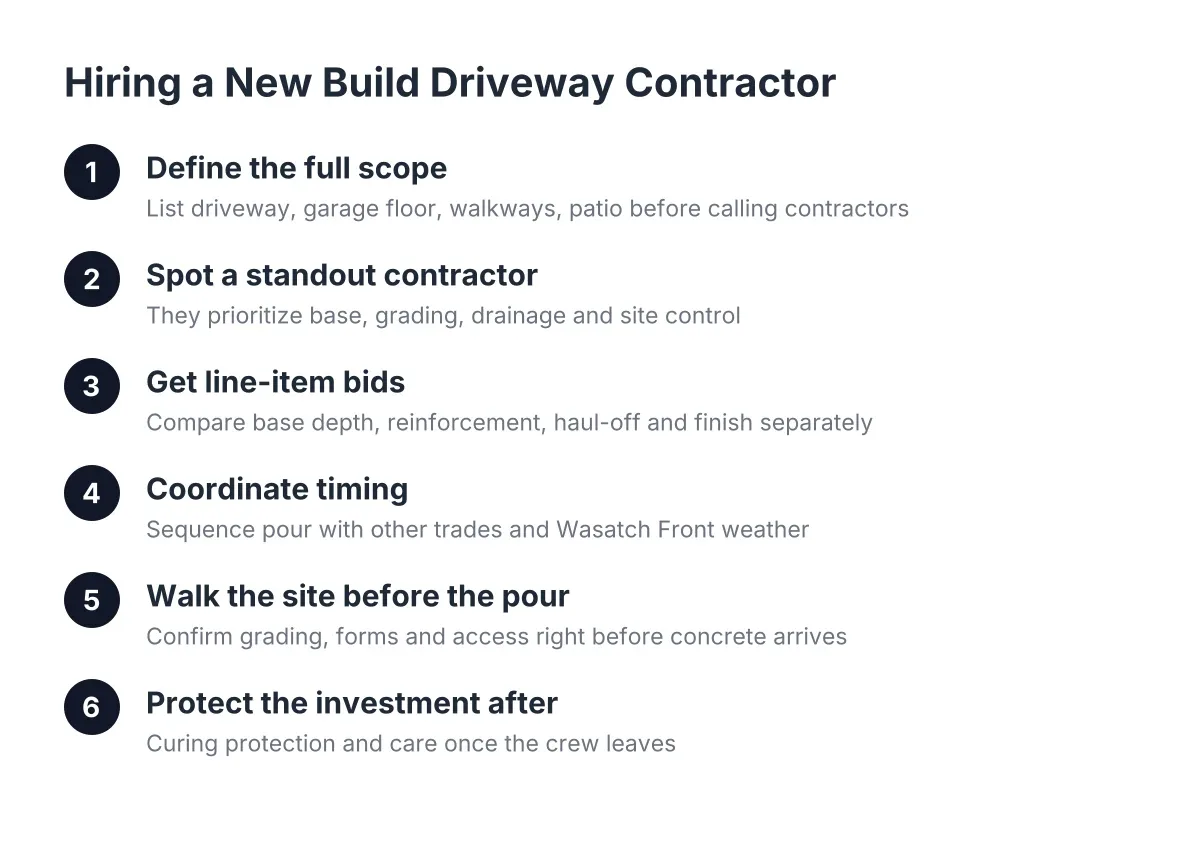
A new build or major addition rarely needs one slab. It needs a driveway, a garage floor, walkways, maybe a patio, and sometimes curb and gutter work, all graded to match each other and drain away from the house. Ask whether the contractor can bundle those scopes into one plan, because hiring separate crews for the driveway and the garage floor is how you end up with surfaces that do not line up at the thresholds.
A full driveway scope should include demolition or stripping, excavation to grade, gravel base, forming, reinforcement, the pour, finishing, control joints, and curing. If any of those shows up as "by others" or is missing from the bid, ask why. On a new build, grading and base prep are often the biggest unknowns, so get them in writing.
2. Make Them Explain Base Prep and Grading Before They Quote
The concrete you see is only half the job. The gravel base and the grade under it decide whether the driveway stays flat or settles and cracks. A contractor worth hiring will walk your lot, look at what the excavator left behind, and tell you how much base material and compaction the site needs before they will commit to a price.
This matters more along the Wasatch Front than in many places. Salt Lake Valley lots sit on a mix of clay and gravel soils that behave differently from one street to the next. Clay holds water and moves; gravel drains and stays put. A quote that never mentions your soil or base depth is a quote built on assumptions, and assumptions turn into change orders.
3. Ask How They Price the Job, Line by Line
You do not need the cheapest bid. You need a bid you can read. The main cost drivers for a driveway are slab size and thickness, excavation and haul-off, base material, reinforcement, finish type, and how hard it is to get trucks and equipment to the pour. A fair quote breaks those out so you can compare bids on the same terms.
For context on the overall number, searching something like "concrete driveway cost near me" will turn up broad figures; according to HomeAdvisor, a concrete driveway averages close to $6,400 nationwide, while even a high-end gravel driveway tops out around $3,500. Treat national averages as a floor for expectations, not a promise. A new-construction package that bundles a driveway, garage floor, and walkways is a bigger scope, and your site conditions, finish choices, and access all move the number.
Watch for these signs of a fair quote:
- Square footage and slab thickness stated for each pour
- Base depth and compaction called out, not implied
- Reinforcement type specified (rebar, mesh, or fiber)
- Finish and any decorative work priced as its own line
- Exclusions listed plainly, so "extra" never means "surprise"
4. Check Their Freeze-Thaw and Drainage Habits
Salt Lake City winters put concrete through hard freeze-thaw cycles, and spring snowmelt tests every slope on the lot. Ask the contractor how they handle air-entrained mixes, control joint layout, and curing in cold or hot weather. Then ask how they will slope the driveway and walkways so meltwater runs away from the garage and foundation instead of pooling at the apron.
The answers do not need to be technical lectures. You are listening for specifics: joint spacing tied to slab dimensions, a curing plan that matches the season, and a drainage path they can point to on your lot. A contractor who shrugs at these questions is pricing a pour, not building a driveway that lasts through local winters.
5. Choosing a Driveway Contractor Who Can Work Your Builder's Schedule
When you are choosing a driveway contractor to fit a construction timeline, ask how they sequence work around other trades, how far out they book, and what weather conditions delay a pour. A contractor used to new-construction flatwork will talk about staging, access, and cure times before you even ask, because they know a late slab stalls everyone behind it.
Sequencing matters on the ground, too. On replacement and new-build jobs, experienced crews often finish excavation and base work early but leave the final apron or transition section in place until just before the pour, so trucks and trades keep a usable access point. If your contractor plans the tear-out and the pour with access in mind, that is a good sign they have run full-lot jobs before.
Labor availability is part of the schedule conversation in 2026. According to the Associated General Contractors of America, 88% of construction firms with open craft positions say those jobs are as hard or harder to fill than a year ago. Crews are booked. The contractors still delivering on time are the ones who plan sequencing instead of promising everything at once.
6. Look at Finished Driveways, Not Just Photos of Wet Concrete
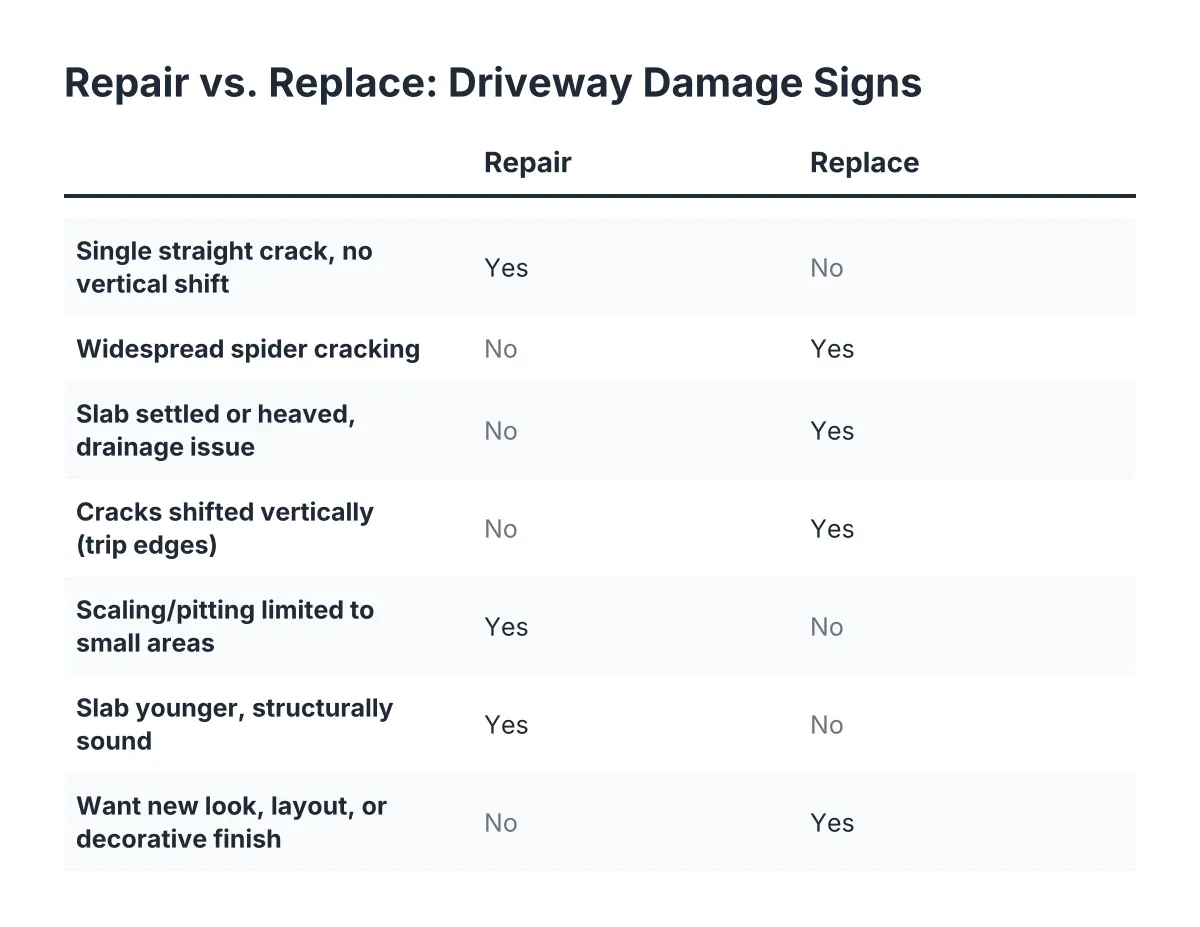
Anyone can photograph a fresh pour. You want to see driveways that have been through at least one Salt Lake winter: clean edges, tight control joints, no spider cracking spread across the surface, and no scaling where ice melt sat all season. Spider cracking across an older slab is the classic sign of a pour or base that failed; it is the pattern that usually means full replacement instead of patching.
If you are considering stamped concrete or a colored finish, ask to see those too, since decorative concrete takes a different skill set than a standard broom finish. One practical note on color: dark finishes absorb heat and get much hotter in direct sun, so many contractors steer homeowners toward lighter tones for patios and large exposed slabs. A contractor who raises that trade-off without being asked is thinking about how you will live with the surface, not just how it photographs.
7. Verify Licensing, Insurance, and Who Actually Shows Up
Confirm the contractor holds a current Utah contractor license and carries liability insurance and workers' compensation. Ask whether the crew on your job is their own or a subcontractor, and who supervises the pour day. None of this is paperwork for its own sake; an uninsured crew on your lot during an active build is your risk, not theirs.
In addition, ask who your point of contact is once the job starts. On a multi-scope flatwork package, questions come up daily: where the pump truck parks, when the garage floor cures enough for framing to continue, which day the ready mix delivery lands. One accountable person on the contractor's side keeps those answers fast.
8. Get the Warranty Terms and Cure Expectations in Writing
Before you sign, know what the contractor stands behind and for how long. Concrete cracks; the question is where and how much. A written agreement should cover workmanship terms, what counts as a defect versus normal shrinkage cracking at control joints, and what the fix looks like if something fails.
Also get cure and use timelines in writing: when you can walk on it, when light vehicles can drive on it, and when heavy construction traffic can cross. Suppose a homeowner in Sugar House is finishing a detached garage and shop; the slab pours on a Tuesday, and the framer wants to load lumber on it Thursday. In that scenario, a clear cure schedule in the contract prevents the argument before it starts. One honest caveat: if your lot has steep grades, fill from excavation, or signs of poor drainage, bring in a geotechnical or structural professional before the pour; no checklist replaces an engineer on a difficult site.
Quick Checklist: Choose Your Concrete Driveway Contractor With Confidence
Run every bid through these eight checks before you commit:
- Full flatwork scope covered, driveway through garage floor and walkways
- Base prep and grading assessed on site, not assumed
- Line-item pricing that names the cost drivers
- Freeze-thaw mix, joints, curing, and drainage addressed for Salt Lake conditions
- Scheduling plan that fits your builder's timeline
- Finished local work you can see, including decorative finishes if you want them
- Current license, insurance, and a named point of contact
- Written warranty terms and cure timelines
Most concrete driveway contractors will pass some of these checks. The one you hire should pass all eight without getting defensive, because every item on this list is a question they answer on real jobs every week. Weigh the trade-offs honestly too; the contractor with the longest lead time is sometimes the one worth waiting for, and the lowest bid is sometimes missing the base work that keeps a driveway flat.
If you are planning flatwork for a new build or major addition in the Salt Lake Valley, Salt Lake Valley Concrete can walk your lot, explain what drives the cost of your specific site, and put the full scope in writing, from first estimate to finished pour. Reach out when you are ready to talk through your driveway, garage floor, and walkway plans.
If you need concrete driveways, Salt Lake Valley Concrete can help.
Prefer to talk it through? Call (385) 433-4634 — a quick call is usually the fastest way to get a straight answer for your situation.