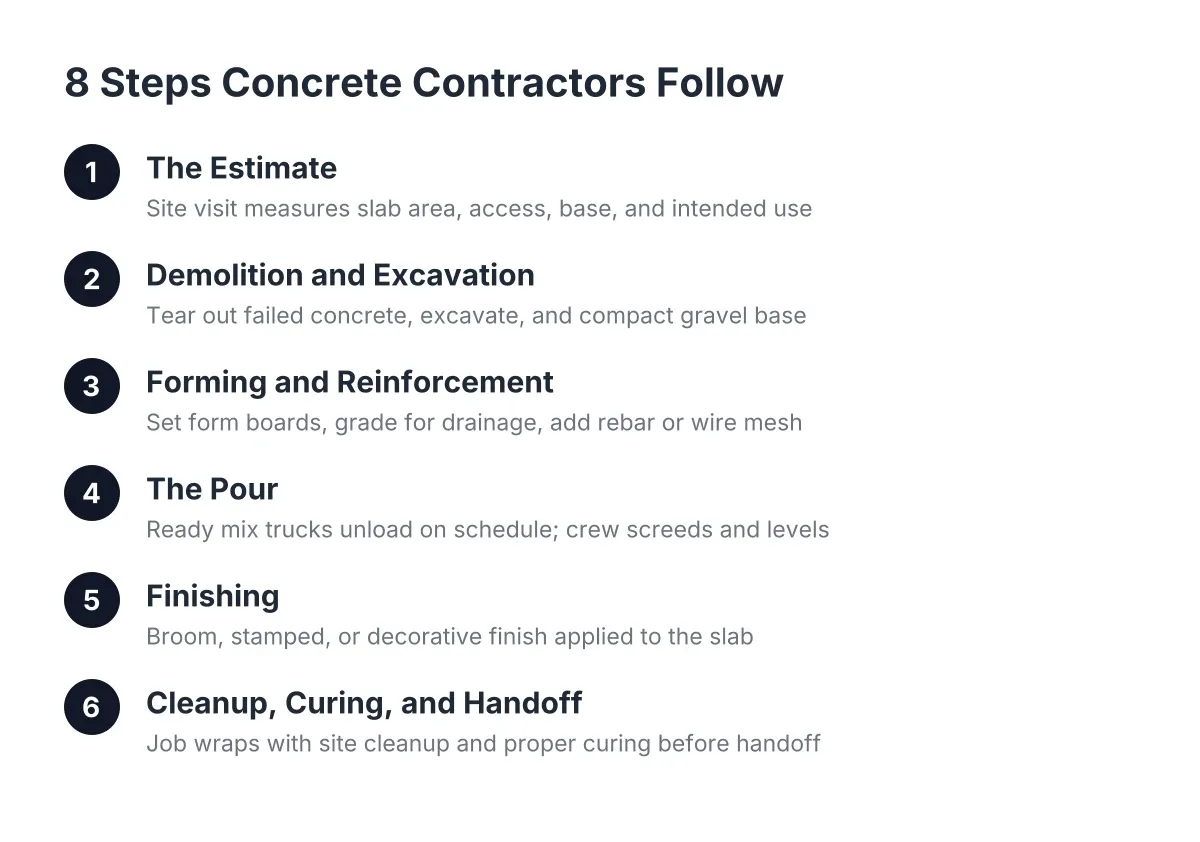
Concrete Contractor Costs in Salt Lake City: What Drives Your Final Price
If you are getting quotes for a driveway, patio, or slab repair, you want to know what the number on the estimate actually covers. This guide breaks down what drives concrete pricing in Salt Lake City step by step: what a fair quote looks like, and how to keep your project on budget from the first measurement to the finished pour.
The short version: your final price comes down to size, site conditions, what is under the slab, the finish you pick, and how hard it is to get concrete to the forms. Walk through the steps below in order and you will know exactly where your money goes before you sign anything.
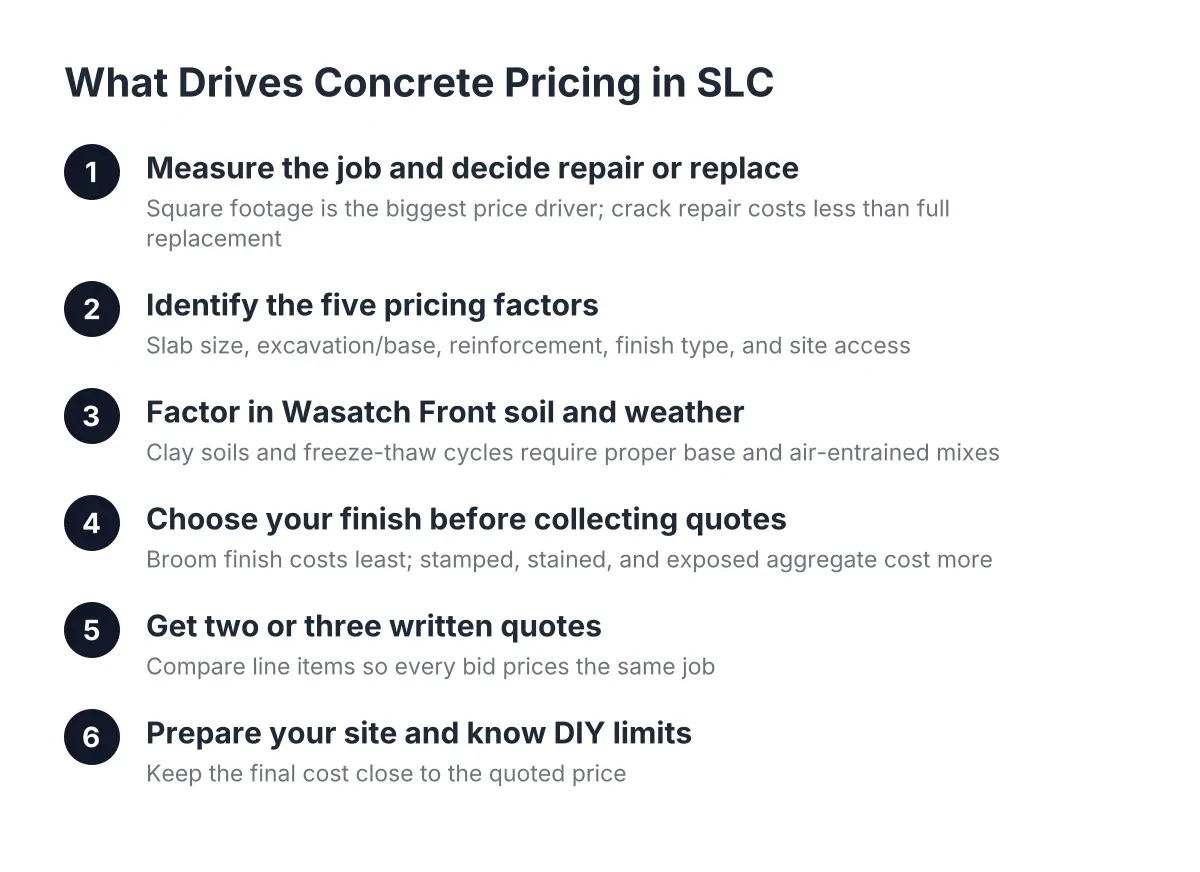
Step 1: Measure the Job and Decide Repair or Replace
Start with a tape measure. Square footage is the single biggest driver of price, so know your numbers before anyone shows up. Measure length times width for each section, including any approach or walkway that ties in.
Next, look hard at the damage. Hairline cracks on an otherwise flat, solid slab often point to crack repair or resurfacing. A slab that has sunk on one side, heaved at the joints, or crumbled through its surface usually points to replacement. Patching and resurfacing a damaged section costs far less than tearing out and replacing a whole slab, so do not assume you need full replacement just because the surface looks rough.
Here is the honest trade-off: repair is cheaper now, but a slab failing from a bad base or shifting soil will keep moving. A repair on top of that movement can crack again. A straight-dealing contractor will tell you which situation you have before quoting either option. If a contractor jumps straight to "replace it all" without explaining why the slab failed, get another opinion.
Step 2: What Drives Concrete Pricing in Salt Lake City
Concrete pricing in Salt Lake City comes down to five main factors: slab size, excavation and base work, reinforcement, finish type, and site access. Every legitimate quote is some combination of those five. Once you understand them, you can read an estimate line by line instead of staring at one mysterious total.
Here is what each factor means for your wallet:
- Slab size and thickness. More square footage means more concrete, more base gravel, and more labor. Driveways that carry vehicles need thicker slabs than patios or sidewalks.
- Excavation and base. Tear-out of old concrete, hauling debris, and building a compacted gravel base all take time and equipment. A bad base is why most slabs fail, so this line item earns its cost.
- Reinforcement. Rebar or wire mesh adds material and labor but helps the slab handle loads and resist cracking.
- Finish type. A standard broom finish costs the least. Stamped concrete, stained and colored concrete, and exposed aggregate add labor, materials, and skill, so they cost more per square foot.
- Site access. If a ready-mix truck can back up to the forms and chute the concrete in, placement is fast. If the crew has to pump concrete through a hose or wheelbarrow it around the house, labor and equipment costs climb.
For reference points, a concrete driveway averages close to $6,400 according to HomeAdvisor, and a professionally installed concrete patio averages $2,925 nationwide according to Lawn Love. Concrete Network puts a typical 288 square foot patio around $11 per square foot. Treat these as national ballparks, not Salt Lake City quotes; your lot, your soil, and your finish will move the number.
Step 3: Factor In Wasatch Front Soil and Weather
Local conditions shape both the build and the bid. The Salt Lake Valley sits on a mix of clay and gravel soils that shift with moisture. Clay that swells when wet and shrinks when dry is a common reason slabs along the Wasatch Front sink or crack, and it is why proper excavation and base compaction matter more here than in milder regions.
Winter does the rest. Hard freeze-thaw cycles push water into cracks, freeze it, and wedge the cracks wider every season. That crack that grew again this winter is not your imagination. Seasonal snowmelt and spring runoff also mean drainage planning matters; a patio that pools water will feed the freeze-thaw cycle year after year.
These conditions affect what drives concrete pricing in specific ways. Expect a quote to include base material and compaction suited to the soil, air-entrained concrete mixes that handle freezing, and grading that moves water away from the slab and your foundation. Skipping those to save money is how you end up paying for the same slab twice.
Timing matters too. Warm weather and full sun speed up how fast concrete sets, which narrows the finishing window, so summer pours get scheduled early in the day. Most residential flatwork in the valley gets poured between spring and fall; 2026 scheduling fills fastest in late spring.
Step 4: Choose Your Finish Before You Collect Quotes
Pick your finish first so every bid prices the same job. Comparing one quote for broom-finished gray against another for stamped and colored concrete tells you nothing.
A standard broom finish is the budget option and still the right call for most driveways and sidewalks; it gives traction in snow and ice. Decorative options raise the price per square foot in roughly this order: colored or stained concrete, then exposed aggregate, then stamped concrete with multiple colors and patterns.
One local caution on color: dark concrete gets much hotter in full sun than lighter concrete. For a patio where kids and pets walk barefoot in July, a lighter tone is the more livable choice even if the dark sample looks sharper in the showroom.
Step 5: Get Two or Three Written Quotes and Compare Line Items
Now collect bids. Two or three written quotes from local concrete contractors is the standard, and most Salt Lake City homeowners who get that many find the middle bid tells them what the job honestly costs. When you search for who does concrete work in your area, or for concrete pad contractors near your neighborhood, you will find a wide spread of prices. The line items explain the spread.
A fair quote for flatwork should spell out:
- Square footage, slab thickness, and concrete mix strength
- Tear-out and haul-away of existing concrete, if any
- Base material depth and compaction
- Reinforcement type (rebar or mesh)
- Finish type, color, and sealing
- Control joint layout
- Site access method (chute, pump, or buggy) and any pump fee
- Total price, payment schedule, and timeline
For example, suppose a homeowner in Sugar House gets three bids to replace a cracked 600 square foot driveway. Two bids land within a few hundred dollars of each other; the third comes in thousands lower. In that scenario, the low bid almost always skipped something, usually base depth, reinforcement, or debris hauling. Ask each bidder to confirm those items in writing before you compare totals.
Labor availability also feeds pricing. According to the Associated General Contractors of America, 88% of construction firms with open craft positions say those jobs are as hard or harder to fill than a year ago. Skilled finishing crews are not cheap to keep, and the lowest bidder is often the one cutting that corner.
Step 6: Know What Is DIY and What Needs a Pro
You can handle some of this yourself and save money. Sealing hairline cracks with a quality concrete crack filler, cleaning and resealing a slab every few years, and keeping deicer use reasonable are all homeowner jobs.
Call a professional when you see a slab sinking or tilting, cracks wider than a coin that grow each season, water pooling against the house, or crumbling and flaking across the surface. Those are structural or base problems, and surface products will not fix them. A trip hazard on a public sidewalk is also a liability issue worth fixing promptly, and some cities along the Wasatch Front require permits or inspections for sidewalk and driveway approach work, so ask your contractor who pulls the permit.
One honest limitation: no article can diagnose your slab from a distance. Whether yours is a candidate for crack repair, resurfacing, or full replacement depends on the base underneath it, and that takes an on-site look from someone who pours and repairs concrete for a living.
Step 7: Prepare Your Site to Keep the Final Cost Near the Quote
The cheapest change order is the one that never happens. Before the crew arrives, do these things:
- Move vehicles, planters, and anything stored on or near the work area
- Mark sprinkler lines and low-voltage wiring so excavation does not cut them
- Confirm in writing who handles permit fees, if required
- Ask where the ready-mix truck or pump will set up, and clear that path
- Plan to stay off the new concrete for the cure time your contractor specifies
Access planning matters because concrete trucks run on a schedule. A crew that can unload quickly keeps the pour clean and avoids standby charges; a blocked driveway or a surprise locked gate costs real money on pour day. If your driveway is the project, expect the crew to keep an access strip usable as long as possible and remove the final apron section right before the pour.
How Concrete Pricing Shakes Out at the Finish
By the time you reach pour day, there should be no surprises left. You measured the job, matched repair or replacement to the actual damage, picked a finish, and compared line-item bids built for Salt Lake Valley soil and winters. What drives concrete pricing in Salt Lake City is not a mystery number; it is the sum of size, base work, reinforcement, finish, and access, and now you can check each one.
Salt Lake Valley Concrete pours and repairs driveways, patios, sidewalks, and flatwork across the Salt Lake City area, from first estimate to finished pour. If you want a written, line-item estimate on your project, reach out and get your numbers on paper.
If you need concrete contractors in Salt Lake City, UT, Salt Lake Valley Concrete can help.
Prefer to talk it through? Call (385) 433-4634 — a quick call is usually the fastest way to get a straight answer for your situation.