What Concrete Contractors Do: 8 Services From Estimate to Finished Pour
If you own rental property in Salt Lake City, you probably think about concrete contractors only when something breaks. A tenant reports a near-miss on a heaved sidewalk, or the city flags a cracked walkway. Suddenly you need to know what these contractors actually do, what the work includes, and what counts as a fair quote. This article walks through the eight core services a good concrete contractor handles, from the first estimate to the finished pour, so you can evaluate bids with confidence instead of guesswork.
The list runs in roughly the order a real project unfolds. If you manage several properties along the Wasatch Front, this is also a checklist for vetting one contractor to handle all of them.
1. The Estimate: Where Good Concrete Contractors Earn Trust First
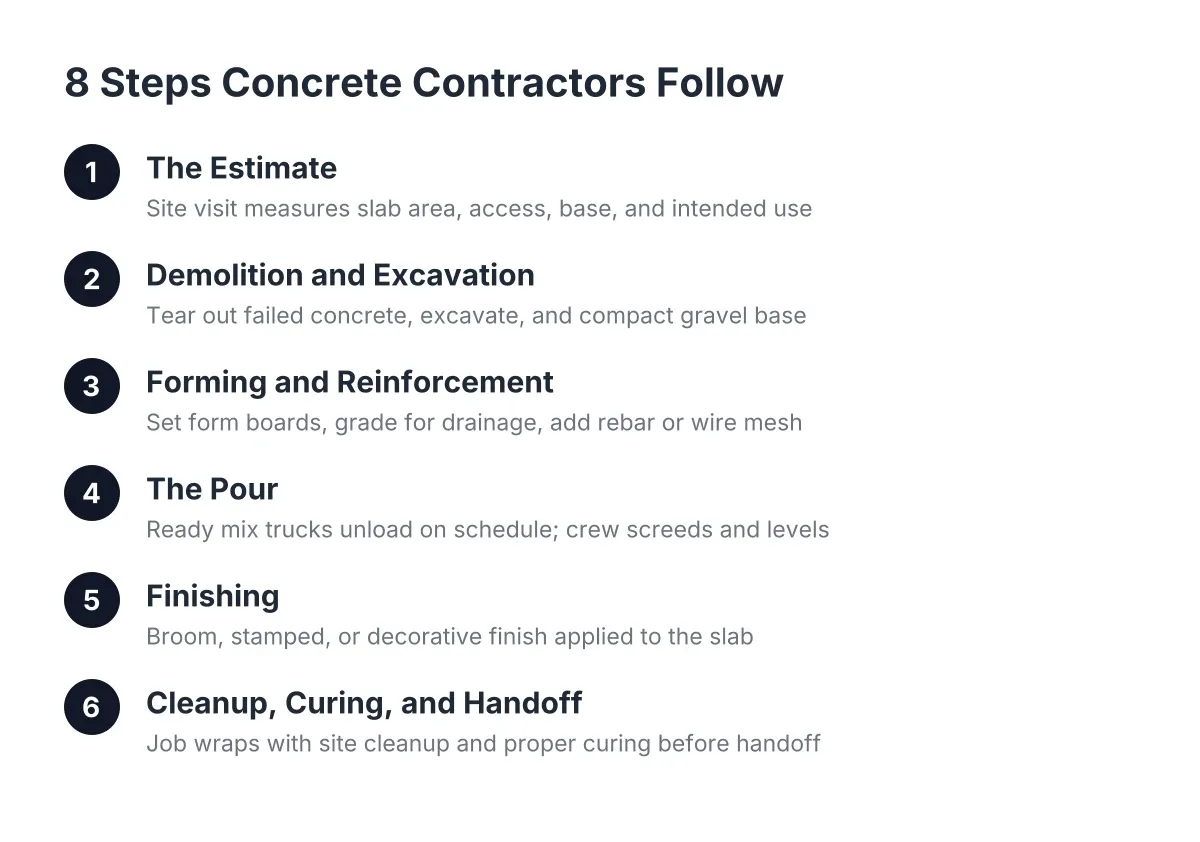
A real estimate starts with a site visit, not a number over the phone. The contractor should measure the slab area, check access for trucks and equipment, look at the existing base, and ask what the surface needs to hold, whether that is foot traffic on a walkway or vehicles in a shared parking area.
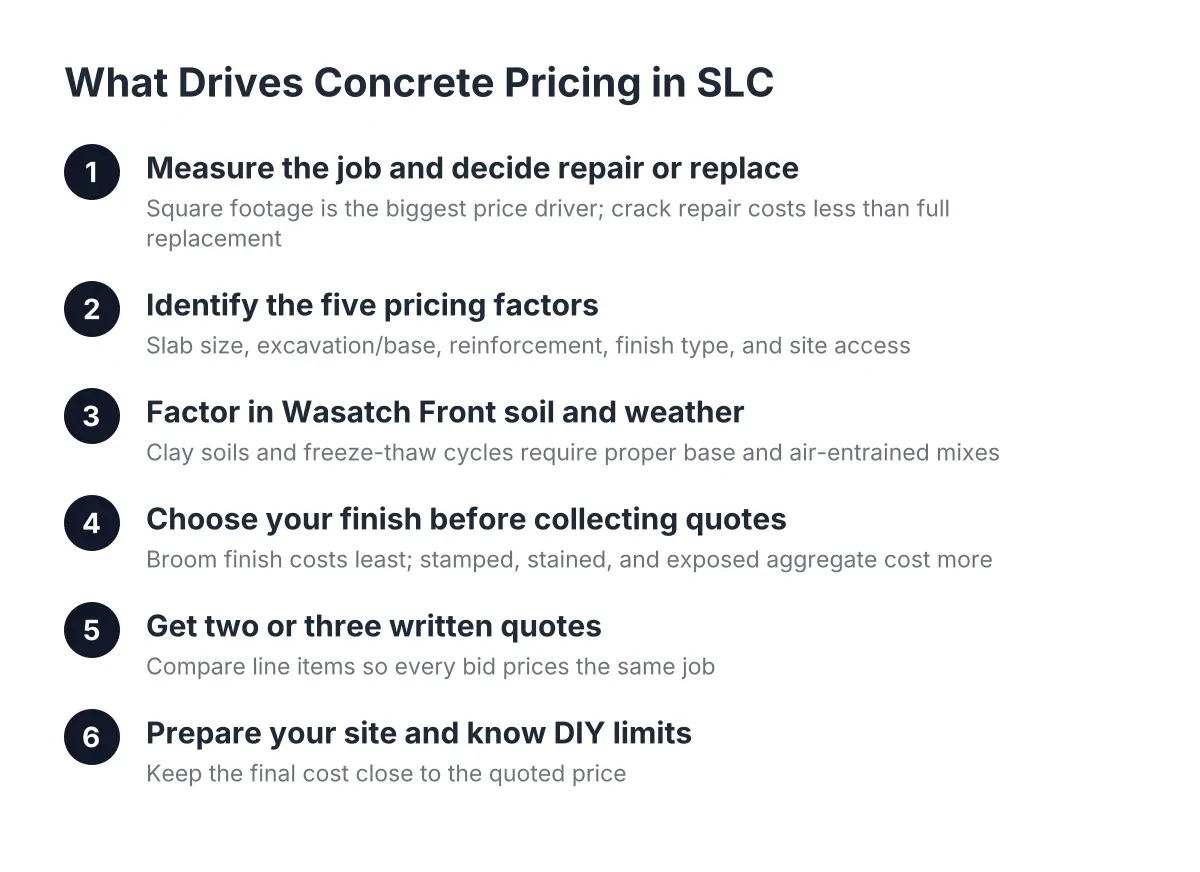
What drives the price is no mystery: slab size, excavation depth, reinforcement, finish type, and how hard the site is to reach. A fair quote itemizes those factors instead of giving one lump number. For context, a concrete driveway averages about $6,400 according to HomeAdvisor, and a typical 288 square foot patio runs about $3,200, roughly $11 per square foot, according to Concrete Network. Your job varies from those averages based on the factors above, which is exactly why the estimate should spell them out.
For a landlord managing multiple units, consistency matters more than any single number. Ask whether the contractor prices the same scope the same way at every property. If the answer is vague, keep looking.
2. Demolition and Excavation: Removing the Old Before Pouring the New
Most repair and replacement work starts with tearing out failed concrete. The crew saw-cuts clean edges, breaks out the old slab, and hauls away the debris. Then they excavate to the right depth and build a compacted gravel base.
This step matters more in the Salt Lake Valley than in milder regions. The clay and gravel soils along the Wasatch Front shift with moisture, and a slab poured on a poorly compacted base will crack or heave within a few winters. When you compare bids, check whether excavation and base prep are included or listed as extras. A cheap bid that skips base work is not cheap; it is deferred failure.
Experienced crews also sequence demolition to keep the property usable. On a driveway or parking area replacement, they typically remove the final apron or transition section last, right before the pour, so tenants keep access through most of the job.
3. Forming and Reinforcement: The Work You Never See Again
Before any concrete arrives, the crew sets form boards that define the slab's shape, slope, and thickness. Grading inside the forms directs water away from buildings, which matters during spring snowmelt in Salt Lake City. Reinforcement, usually rebar or wire mesh, goes in next to help the slab resist cracking under load and soil movement.
This is invisible work once the pour is done, so it is where corners get cut. A few things worth asking about in any bid:
- What thickness is the slab, and does it match the use (walkway versus parking)?
- What reinforcement is included, and where?
- How will the slab be sloped for drainage?
- Where will control joints be placed to manage cracking?
A contractor who answers those questions in plain language is showing you how they work. One who waves them off is telling you something too.
4. The Pour: A Timed Operation, Not Just Wet Concrete
Pour day is the most coordinated part of the job. Ready mix trucks arrive on a schedule, and the crew needs to unload each load quickly; slow crews risk extra charges from the supplier. The ready mix business is large and established, a $64 billion industry nationwide according to the National Ready Mixed Concrete Association, and it runs on tight truck turnaround.
Once concrete hits the forms, the crew spreads it to a rough grade, then screeds it level from one form board to the other. Tapping the forms helps release trapped air and gives the slab cleaner edges when the forms come off. Small habits like these separate experienced flatwork crews from hurried ones. One quiet tell: seasoned crews rarely drape plastic sheeting over nearby walls, because controlled technique prevents splatter in the first place.
Weather shapes the day too. Warm sun speeds up set time and shrinks the finishing window, which is one reason summer pours in the valley often start early.
5. Finishing: Broom, Stamped, and Decorative Concrete Options
Finishing turns a wet slab into the surface your tenants will walk on for decades. A broom finish is the standard for sidewalks, driveways, and parking areas because it adds traction, which matters through Salt Lake City winters. It is simpler to execute than decorative options, though a quality broom finish still takes skill and starts with a good mix; no amount of troweling fixes a poor mix design.
Decorative work is a separate skill set. Stamped concrete, stained and colored concrete, and exposed finishes cost more and demand tighter timing during the set. For a rental property, broom-finished flatwork usually makes sense for walkways and parking, while stamped or colored concrete might fit an entry or patio where curb appeal affects rent. For reference, Lawn Love puts the average professionally installed concrete patio at $2,925 nationwide; decorative finishes push above basic figures like that.
6. Flatwork and Foundations: Knowing Which Contractor Fits the Job
Not all concrete work is the same trade. Concrete flatwork contractors handle horizontal surfaces: driveways, sidewalks, patios, parking pads, and slabs on grade. Concrete foundation contractors pour footings, stem walls, and structural foundations, which involve different engineering and inspection requirements.
Most rental property maintenance falls on the flatwork side. Cracked sidewalks, settled walkways, curb and gutter sections, and parking slabs are flatwork problems. If a project touches the building's structure, such as a failing foundation wall, you need a foundation specialist and likely an engineer. A straightforward contractor will tell you when a job is outside their lane rather than improvise on structural work.
7. Repair and Resurfacing: The Portfolio Owner's Bread and Butter
Replacement is not always the answer. Concrete crack repair, resurfacing, and section replacement handle most of what an annual property walkthrough turns up. A good contractor will tell you which fix fits which problem:
- Crack repair works for stable cracks that are not moving or heaving.
- Resurfacing renews a worn but structurally sound slab.
- Section replacement handles trip hazards where one panel has heaved past its neighbor.
- Full replacement is for slabs with widespread cracking, drainage failure, or base problems.
Suppose you own a fourplex in Salt Lake City and a tenant reports a near-miss on a walkway panel that winter freeze-thaw cycles have lifted about an inch. In that scenario, the fastest liability fix is usually removing and replacing the heaved panels, not redoing the whole walkway. The documentation matters as much as the work: a written scope, photos, and an invoice you can file for ownership or insurance records. Ask up front whether the contractor provides that paper trail; for a landlord, it is part of the service.
However, repairs have limits. If the base under a slab has failed, surface fixes buy a season or two at most, and a contractor should say so before taking your money.
8. Cleanup, Curing, and Handoff: How the Job Should End
The job is not done when the trucks leave. The crew should strip forms, backfill edges, haul debris, and leave the site clean enough for tenants to use. Concrete also needs time to cure before it takes traffic; your contractor should tell you when people can walk on it and when vehicles can drive on it, and that guidance belongs in writing.
A good handoff also covers maintenance. In the Salt Lake Valley, that means guidance on de-icing products, since some melt chemicals damage new concrete through the first winter, and on keeping snowmelt draining away from the slab.
How to Evaluate Concrete Contractors for Rental Properties
Choosing concrete contractors for a rental portfolio comes down to three checks: verify they carry a current contractor license and insurance, confirm their quotes itemize the cost drivers, and test whether they communicate well enough to work around tenants. A contractor who passes all three can handle recurring work across your properties for years.
Searching for top rated concrete contractors in your area will surface plenty of names; these questions sort them:
- Are you licensed and insured, and will you send current documentation? For a landlord, this is non-negotiable liability protection.
- What exactly is in this price? Look for line items covering demolition, base, reinforcement, finish, and cleanup.
- How do you schedule around tenants? Access for cars and foot traffic during the job matters at an occupied property.
- Will you price the same scope consistently across my properties?
Timing is worth asking about too. Skilled concrete labor is tight; among construction firms with open craft positions, 88% say those jobs are as hard or harder to fill than a year ago, according to the Associated General Contractors of America. In 2026, that means the good crews book out, so getting repairs scoped before peak season protects your schedule.
One more honest note: some jobs need more than a contractor. Slabs failing over unstable fill, retaining situations, or anything structural may call for an engineer's input before anyone pours. A contractor who recommends that is protecting you, not padding the job.
Get a Straight Answer Before the Next Tenant Complaint
Concrete problems at a rental do not improve with time; freeze-thaw cycles and spring snowmelt along the Wasatch Front keep working on every crack. If you have a heaved sidewalk, a flagged walkway, or a parking slab due for replacement, Salt Lake Valley Concrete can walk the site, explain what is driving the cost, and give you a clear written scope from estimate to finished pour. Reach out to schedule an estimate at one property, or all of them.
If you need concrete contractors, Salt Lake Valley Concrete can help.
Prefer to talk it through? Call (385) 433-4634 — a quick call is usually the fastest way to get a straight answer for your situation.